

Episode Summary 07: Is Your Child’s Behavior Really a Disorder? A Psychiatrist Explains
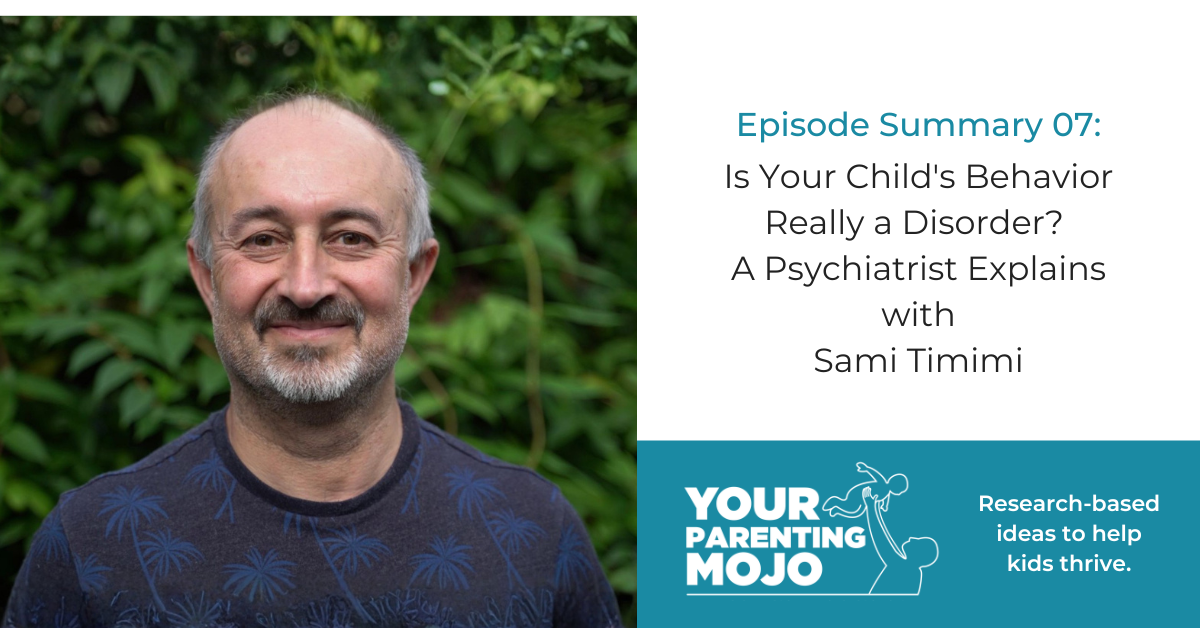
When your child struggles with behavior or attention, doctors might suggest ADHD medication. Before you move forward, you should know what a psychiatric diagnosis actually is – and what it isn’t.
This episode examines how psychiatric diagnoses actually work – and what they don’t tell you. Dr. Sami Timimi, a child and adolescent psychiatrist in the UK, explains how the mental health system has become an industrial complex that profits from turning distress into diagnoses.
You’ll learn why a diagnosis doesn’t mean doctors have found something wrong with your child’s brain, and why the framework we use to understand mental health struggles might be missing the bigger picture. If you’ve ever felt pressured to medicate your child or wondered whether there’s more to the story than a “chemical imbalance”, this conversation will give you the information you didn’t know you were missing.
Questions this episode will answer
What do you do when your child has a behavioral problem? Instead of immediately seeking a diagnosis, consider the social context – school environments, family stress, economic pressures, and whether your child’s environment actually fits their needs. Addressing these factors can be more effective than focusing solely on fixing the individual child.
What is a psychiatric diagnosis evaluation? A psychiatric diagnosis evaluation is a process where behaviors are observed and categorized according to checklists, but it doesn’t involve measuring anything in the brain or body. The diagnosis describes behaviors but doesn’t explain what causes them.
Can ADHD be misdiagnosed? Since ADHD diagnosis relies on behavior checklists rather than objective tests, two evaluators can reach different conclusions about the same child. The behaviors labeled as ADHD – hyperactivity, inattention, impulsivity – are descriptions, not explanations of what’s causing those behaviors.
What is the most common childhood behavioral disorder? ADHD is commonly diagnosed in children, but saying a child’s hyperactivity is caused by a hyperactivity disorder is circular reasoning – we’re just describing the behavior using medical language.
How does parenting affect mental health? Single parents and parents experiencing poverty face significant stressors that impact mental health. When parents seek help for depression or anxiety, they’re often directed toward medication rather than receiving support that addresses the actual challenges they face – lack of resources, isolation, and overwhelming demands.
What are the biggest determinants of mental health? Social and economic factors – housing security, job stability, poverty, social support, and community resources – are major determinants of mental health. These environmental conditions create distress that often gets labeled as individual mental illness.
How can social factors affect your mental health? Social factors like economic insecurity, isolation, and the structure of our society create feelings of alienation and the sense that “I’m not good enough.” When we say these problems are inside individuals rather than addressing social conditions, we miss opportunities to reduce distress at its source.
What does industrial complex mean in mental health? The mental health industrial complex refers to the entire ecosystem that profits from mental health diagnoses – from expensive assessments and therapies to pharmaceuticals, apps, books, and self-help products. It turns distress into a commodity that can be mined for profit.
What you’ll learn in this episode
- What happens during psychiatric diagnosis evaluations (and why no brain scan is involved)
- Why ADHD medication studies show different results at 14 months versus 30 months (and you’ve probably only heard of the 14 month outcomes)
- How the mental health industrial complex profits from turning distress into diagnoses
- What parents should know about the difference betweendescribingbehaviors andexplainingthem (and why it matters)
- Why circular reasoning (like “your child’s hyperactivity is caused by a hyperactivity disorder”) is everywhere in mental health but rarely discussed
- How poverty and lack of social support create mental health struggles that get diagnosed as disorders
- What happens when we assume problems are “inside” people rather than in their circumstances
- Why supporting families through social and economic interventions might reduce distress more effectively than individual treatment
- How the framework we use to understand distress shapes what solutions seem possible
- What to consider before starting medication for yourself or your child
Jump to highlights:
01:37 A brief introduction to today’s episode
04:06 Introducing today’s guest
05:41 What does the mental health industrial complex mean?
12:28 How does Dr. Sami Timimi respond when others view his perspective as a fringe position on ADHD and mental health?
14:45 Dr. Sami Timimi can’t blame the people for accepting diagnoses as brain-based conditions because they assume doctors have found something wrong in their brains
16:59 A quick review of what we learned today
Transcript
Is the idea that if you are having a problem in some way in your life, that the problem sits within you, right, within me as the individual. It's not a problem related to how society is operating. Is that how you see it too?
Dr. Sami Timimi:Yes, that's something that, it's a process that shifts the focus from an idea of what's happening, of why you're feeling distressed, why you're feeling alienated, why you have those feelings that, and this is a very common one in our society at the moment. I mean, we might have a chance to talk about why that is and what model of human is sitting behind the current system that we live in, but that feeling that I'm not good enough, that I don't fit in. These are very common experiences.
Emma:Hi, I'm Emma, and I'm listening from the UK. We all want our children to lead fulfilled lives, but we're surrounded by conflicting information and clickbait headlines that leave us wondering what to do as parents. The Your Parenting Mojo podcast distills scientific research on parenting and child development into tools parents can actually use every day in their real lives with their real children. If you'd like to be notified when new episodes are released and get a free infographic on the 13 reasons your child isn't listening to you and what to do about each one, just head on over to yourparentingmojo.com/subscribe. And pretty soon, you're going to get tired of hearing my voice read this intro. So come and record one yourself at yourparentingmojo.com/recordtheintro.
Jen Lumanlan:Hello and welcome to the Your Parenting Mojo podcast. What if I told you that when your child gets diagnosed with ADHD that no doctor has actually found anything wrong with their brain? What if the medications that we're told will help them are based on studies that show that they might work for 14 months, but by three years, kids on medication are actually doing worse than kids who never took it? And what if the whole system from diagnosis to treatment is built on describing behaviors and then claiming that those descriptions explain the behaviors? That's circular reasoning, but it's how a lot of psychiatric diagnoses work. I am not an expert on this topic. I am definitely learning alongside you as I dig into the books and academic research on this topic, and I've been really surprised by some of the evidence that I've found. I had always assumed that when a doctor diagnoses a mental illness that they understand what that illness is, and that if I went to one doctor, I'd get the same diagnosis as another doctor. That medications get prescribed because they've been shown to be effective, and it turns out that none of those things are necessarily true.
Jen Lumanlan:Before we go any further, I do want to address something head-on. When you start questioning mainstream medical narratives, people sometimes assume that you're anti-science or compare you to anti-vaxxers, and I do want to be clear on this. I am not anti-science. I am pro-good science, which really means being honest about what you found as you communicate that, and setting up the study in a way that actually allows you to understand the impact of what it is you say you're trying to understand. Vaccines have robust evidence showing that they prevent serious diseases and they save lives. The research on mental health diagnoses and treatments is rather more nuanced, shall we say, and it's not that I'm cherry-picking studies here that support my position while ignoring others. I'm looking at the same studies that pharmaceutical companies and medical organizations reference. I'm just also looking at the parts of those studies that don't get talked about as much. The long-term outcomes, the effect sizes, the comparison between what researchers found and what gets communicated to parents and patients.
Jen Lumanlan:Because my goal here is not to say, yeah, medical science sucks. It's to help us understand what the science actually shows, even when that feels uncomfortable to look at or is kind of complicated. So we're kicking off what is going to be an extended series on mental health, with part of a longer conversation with Dr. Sami Timimi. He is a child and adolescent psychiatrist in the UK and author of the new book, Searching for Normal. His views are often called fringe by mainstream doctors, but when I read all of his books and the papers that he references, I realized it's not that Dr. Timimi is conducting his own research program that some coming up with different results from the rest of the medical establishment and he's arguing that his studies are legit and theirs aren't. Instead, he's doing the same thing I'm doing. He's looking at the same papers as everyone else and he's saying, hey, you're focusing on the fact that kids who are diagnosed with ADHD and who are on stimulants do better than kids who aren't taking the medication 14 months after the start of the study. But most parents I know are playing the long game. And by the time you get to 30 months after the start of the study, the results are exactly reversed. The kids who have never taken the stimulants are doing better than the kids who did take them. So here in this conversation excerpt, we're focusing on a fundamental question. What are mental health diagnoses? What do they mean? Is it possible that I, the person with the diagnosis, am actually not the one with the problem? And if that's the case, what does this mean for how we should support people with mental health challenges? Let's begin.
Jen Lumanlan:And so we're going to dive right in here. So you talk about the mental health industrial complex. I wonder, can you give us a sense for what does that mean, right? What should we picture when we hear the phrase the mental health industrial complex?
Dr. Sami Timimi:It's really referring to a whole ecosystem that's developed around the concepts that we refer to as mental health. And it includes a whole set of products from assessments that have become more and more expensive, to different types of therapies, to all the different pharmaceuticals that are being used. And it's expanded and expanded. So it includes now books, self-help manuals, apps, podcasts, institutes, journals. So it's, it's this whole ecosystem, which in a sense is profiteering off the types of distress and the increasing spread of distress that we seem to be experiencing. So that's really what it refers to, a kind of commodification. In other words, the turning of distress into something that you can mine for profit.
Jen Lumanlan:Yeah. And I want to sort of look at some of the assumptions that are kind of baked into that, right? There's the idea that if you are having a problem in some way in your life, that that problem sits within you, right? Within me as the individual. It's not a problem related to how society is operating. Is that how you see it too?
Dr. Sami Timimi:Yes. That's something that, it's a process that shifts the focus from an idea of what's happening, of why you're feeling distressed, why you're feeling alienated, why you have those feelings that, and this is a very common one in our society at the moment. I mean, we might have a chance to talk about why that is and what model of human is sitting behind the current system that we live in, but that feeling that I'm not good enough, that I don't fit in. These are very common experiences. So that kind of alienation and insecurity and a shift in the way of understanding that from being a product of the way our society is organized economically, politically, socially, and towards an idea that it's flagging up something that's not right about you, something that's going wrong inside of you. And that's a process that is, you can understand why it might be attractive for people because we still have to make sense of our life. We still have to try and find a way. So you can't blame people for looking around to try and to make sense of why they feel the way they are. But it's also very useful for people who are either deliberately exploiting that, or just with all the best intentions, making money out of it. But it's also very good for politicians.
Jen Lumanlan:In what way?
Dr. Sami Timimi:Because it shifts the problems and these experiences of various types of distresses and insecurity away from an issue that is for politicians to solve, something that is to do with the economic system, the social structures, into the idea that how we deal with it is we need to provide more services that focus on fixing something that's gone wrong in the individual.
Jen Lumanlan:Yeah. And I want to make this super concrete, right? Like if I'm a parent and I'm struggling, and everybody around me, if I maybe post in a Facebook group and say, hey, I'm having a really hard time, what should I do? And 15 of the people in that group say, you should go to the doctor and get screened for depression. And then you get screened for depression and you end up on antidepressants. And maybe what we could, should be looking at is support for parents, right? There's a whole narrative around how kids of single parents struggle more than kids of parents in two-parent families. And so certain political parties take that as license to say, well, two-parent families, obviously, we should have more of them. Well, how about we support single-parent families so that we're removing the stressors of poverty and all the other things that make single parenting really hard? Because I would guess that single parenting under circumstances where poverty isn't an issue is a whole lot easier than it is where that is an issue. And so we let ourselves in a way, and the folks who are controlling the country, who have more control over the country than we do, off the hook when we say, yeah, the problem is me and I'm depressed.
Dr. Sami Timimi:Yeah, absolutely. And in a way you've said fairly clearly, I think the way you're going to get around or the way you're going to try and help reduce at a population level, the amount of distress, which is going to be interpreted as depression or anxiety or whatever else, there's a whole list of labels you can choose from. So actually, the way that it is going to be much more likely at a population level to reduce the prevalence of these things are actually social and economic interventions, better housing, more secure jobs, better supports in schools, etc., etc., so that people are less overwhelmed by the everyday demands, the material demands that you need to live.
Jen Lumanlan:Right. Yes. Okay. So we're going to go into sort of more depth on some “diagnoses” and how they show up in ourselves and our family members. But before we do that, I just want to kind of acknowledge that the way that we are talking about mental illness now, you know, your position on this topic is often quoted specifically in books on ADHD as being something of the fringe position. And usually what they're saying is, well, yeah, ADHD is legit and it is a thing and you take medication for it and that is how it is managed effectively. And there's this person out there in England, you know, Sami Timimi, he thinks other things. So I'm curious as to how you respond to folks who see your analysis of these issues in that way.
Dr. Sami Timimi:I understand it. This is the story that we've been sold. In many ways, I feel that those who support the idea that ADHD, for example, is a, I mean, you know, it needs to be said that you're talking about real behaviors. You're talking about presentations amongst young people and adults that can actually lead to a lot of distress and discomfort and alienation and stigma, et cetera, et cetera. So of course, this is not about the reality of the behaviors or the experiences. So what we're left with is a situation where in effect, the controversy isn't mine. I'm just pointing out the science, you know, that's, I'm just pointing out the facts, the facts of the facts. The controversy is when people put forward a hypothesis and assume it's true before they found the evidence to confirm that the hypothesis is reasonable. And also it would be fine if people said, okay, these are behaviors that go together. So they describe, but a description has no power of explanation. So you could say, you know, that these are certain behaviors that are often seen together, but not always. And they might, they describe something, but they are not telling you about the cause, because when you get into that idea that you're, for example, your child's hyperactivity is caused by a hyperactivity disorder, this is what's philosophically known as a tautology, a circular thinking trap.
Jen Lumanlan:Yeah. And these are all over mental health, right? Like the serotonin, we invent antidepressants first. And then we see that they have some kind of effect on serotonin. And then we say, well, we think depression is related to an imbalance in serotonin.
Dr. Sami Timimi:Yes. Yes.
Jen Lumanlan:We don't know. There's no evidence for this, but we think.
Dr. Sami Timimi:Yeah. And you can't blame parents. You can't blame individuals for accepting the idea that these are conditions for which the causes are known. So that when they get a diagnosis, people assume that somebody has found something in their brain. So people start talking about the reason I don't get to work on time is because there's a lack of dopamine in my brain or whatever, you know. And I can't blame people for feeling that, for imagining that, because all this other data is not being accessed. It's not part of the narrative for the reasons we were talking about a bit earlier. This is how the mental health industrial complex can grow and grow seemingly endlessly, because what you have are subjective concepts. You have concepts which don't have that empirical anchor to start with, because that kind of psychosocial dimension to our experiences, it's almost being wiped out. Even if we say we're taking a biopsychosocial model, what happens is when we start assuming, oh, there's something wrong, something broken in me, something imbalanced, something disordered, something that's a deficit, you're in danger of wiping out social reality, of eliminating the importance of context. And as human beings, we live our life in context. You know, our brain is the organ of the body whose job it is to navigate us through our environments. There's no point in having that part of us if we didn't, you know, we have to have an environment to navigate. And the problem with deleting the social context and imagining it comes mainly from inside, or sometimes even solely from inside, is that you end up with a fantasy version of reality.
Jen Lumanlan:So here's a quick review of what we learned in this conversation. Dr. Timimi is not running some kind of alternative research program that's coming up with different results from mainstream psychiatry. He's looking at the same research everyone else is looking at. The difference is in how that research gets interpreted and what parts get emphasized. Because the framework that we use to understand the distress that we're feeling matters. When we say a child's hyperactivity is caused by a hyperactivity disorder, we're not really explaining everything, we're just describing that behavior and calling that an explanation. That's circular reasoning and it's everywhere in the mental health field. When we locate the problem inside the individual, there's something broken, there's something disordered, something imbalanced in them, we lose sight of the social context. The poverty, the isolation, the overwhelming demands of modern parenting, the school environments that don't work for a lot of kids.
Jen Lumanlan:And when we lose sight of that context, the solution becomes fix the individual, medicate the individual, instead of asking, but what if we address the conditions creating so much distress in the first place? In the full episode, we go much deeper. Dr. Timimi walks us through exactly how ADHD assessments work now, the tick box algorithmic approach, and contrasts that with how he was trained, which involved understanding a child's whole context, visiting their school and their home, looking at family relationships and resources. We talk in detail about the MTA study on ADHD medications and those shocking three-year outcomes. And we looked at research from Norway showing that just getting an ADHD diagnosis can be associated with worse long-term outcomes, more unemployment, more disability benefits, more dropping out of school, independent of how severe the symptoms were. And we explore how Timimi actually works with families, focusing on what he calls emotional flow in relationships, finding stories of survival alongside stories of suffering, and seeing people as whole resourceful humans rather than collections of symptoms. The full conversation is available to you immediately in your private podcast feed inside the Parenting Membership. Coming up in this series, we have dedicated episodes on depression, ADHD, autism, how diagnoses get made, and we'll probably go in many other directions for this as well. We'll look at what the research really shows about treatments and what alternatives might exist. I know this is really challenging material. If you are struggling, or if your child is struggling, your experiences are really real. We're not questioning that. What we're questioning is whether the framework that we've been given for understanding that distress and suffering actually helps us in the long run. And if not, what should we do next? You can find this episode and all of its references at yourparentingmojo.com/mhic for a mental health industrial complex.
Emma:We know you have a lot of choices about where you get information about parenting, and we're honored that you've chosen us as we move toward a world in which everyone's lives and contributions are valued. If you'd like to help keep the show ad free, please do consider making a donation on the episode page that Jen just mentioned. Thanks again for listening to this episode of the Your Parenting Mojo podcast.

About the author, Jen
Jen Lumanlan (M.S., M.Ed.) hosts the Your Parenting Mojo podcast (www.YourParentingMojo.com), which examines scientific research related to child development through the lens of respectful parenting.