
Episode Summary 10: Burnout vs Depression: The Mental Load of Mothers
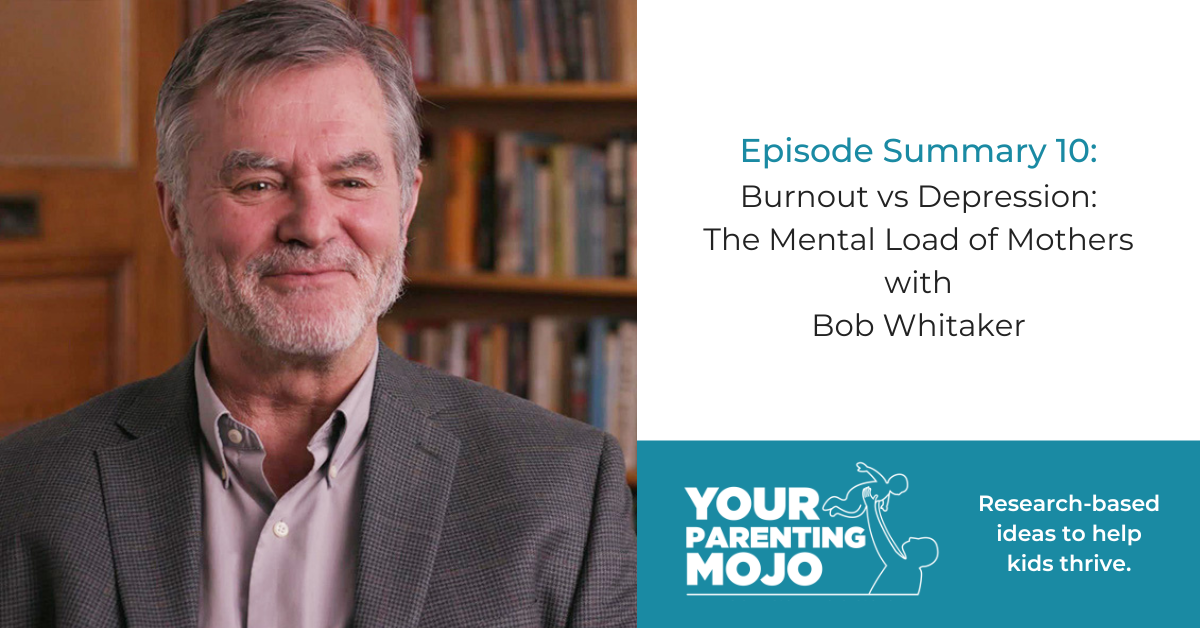
Many mothers go to the doctor because they feel exhausted, overwhelmed, and they aren’t sleeping – and leave with a depression diagnosis and a prescription. The message is: your brain isn’t working right, and medication will help you cope.
But what if the problem isn’t your brain at all? In this episode, I talk with journalist Bob Whitaker, who has spent decades investigating psychiatric treatment in the U.S. We look at how women’s distress has been medicalized instead of taken seriously as a response to impossible circumstances.
We look at how antidepressants work, which is quite different from what the drug companies have been telling us for years. He also shares the results of a New Zealand study on postpartum depression that should have changed how we support new mothers – but didn’t.
Questions this episode will answer
Is it burnout or depression? Burnout and depression share a lot of the same symptoms – exhaustion, low mood, difficulty functioning – but they have different roots. Burnout is a response to sustained, unmanageable circumstances. Depression, as it’s currently diagnosed and treated, is framed as a brain malfunction. This episode looks at why this difference matters, and why so many mothers get a depression diagnosis when they’re experiencing burnout.
Why are mothers more likely to be diagnosed with depression? Mothers in the US are frequently carrying an unequal share of household work, childcare, and mental load – often while also working full time – with little support. When that situation becomes unsustainable, the distress it causes is then treated as an individual brain problem rather than a response to a broken system.
What prevents postpartum depression? A study out of New Zealand found that consistent, practical support – help with the actual work of running a household – significantly reduced postpartum depression. But even though the findings were significant, more support has not become the standard of care.
Should I take antidepressants? Antidepressants may reduce symptoms for some people, but research shows they are far less effective than we’ve been told – and for mothers whose distress is rooted in unsustainable circumstances, medication addresses the symptom rather than the source. If antidepressants are helping you, that’s OK (and do keep taking them!). But antidepressants should be used to help create space for other interventions to work, rather than used long-term.
How does society affect women’s mental health? When we treat women’s distress as a potentially life-long medical problem rather than a signal about unsustainable circumstances, we direct attention away from the structural changes that would actually help. This episode traces how that pattern developed – and what a different approach might look like.
What you’ll learn in this episode
- Why the mental load of motherhood is a structural problem, not a brain problem that medication should fix
- How psychiatry functions as social control when it diagnoses individuals instead of the broken systems they’re living in
- What the New Zealand postpartum depression study found – and why its results were largely ignored
- How drug advertising has shaped what we believe about women’s distress – from Valium in the 1960s to antidepressants today
- How to shift from asking “what’s wrong with my brain” to “what would actually need to change in my situation”
If you want to learn more about Bob’s work and the research on depression and antidepressants, go to https://madinamerica.com/.
Want to go deeper?
The full one-hour conversation with Bob is available to Parenting Membership members. In it, Bob traces exactly how depression came to be understood as a chemical imbalance – not because research proved it, but because psychiatry in the U.S. wanted to rebrand itself as a legitimate medical discipline in the 1980s.
He walks us through how pharmaceutical companies funneled money to academic psychiatrists to become “thought leaders,” how Prozac was marketed as making people “feel better than well,” and how the industry captured the entire profession so thoroughly that by 1998, the New England Journal of Medicine couldn’t find a single academic expert on depression in the US who wasn’t taking money from pharmaceutical companies.
We went deep on the STAR*D trial – the largest antidepressant study ever conducted. The public was told 70% of patients got better. The actual stay-well rate at one year, once a researcher used a Freedom of Information request to get the raw data: 3%. Bob walks through exactly how that number was inflated – the protocol violations, the patients who were already in remission when they enrolled, the switched measurement scales – and why he calls it a straight-out public betrayal.
The whole episode is available to you in your private podcast feed immediately after joining the Parenting Membership.
Inside the membership, you’ll find research-based modules on the specific challenges that make family life hard – from navigating parenting as a team to raising siblings who get along. Monthly group coaching calls give you a chance to talk through your specific situation directly with me. And you’ll find a community of parents who share your values and are working through parenting challenges together, and with my support.
If you’ve been told the problem is your brain, and something in this episode made you wonder whether that’s the whole story – the membership is where you get help to figure out what’s right for you and your family.
Click the banner to learn more
Jump to highlights:
01:50 Introduction to today’s episode and guest
05:04 Just remember what the disease model does. It focuses on the problems in the head of the individual, not in the social way we arrange our society.
06:25 From hysteria and electroshock therapy (mostly given to women) in the 1800s, to marketing benzodiazepines to wives in the 1960s, the pattern of pathologizing women’s distress has been consistent.
08:32 When benzodiazepines were recognized as addictive in the late 1970s, psychiatry reframed anxiety as a type of depression and switched women to antidepressants, another numbing drug that keeps women quiet and functioning in an impossible situation.
13:31 In the New Zealand study, it says that when women got daily help with housework for six months, postpartum depression was prevented. Yet this support became standard care nowhere, because the system still believes the problem is in people’s brains, not in their circumstances.
14:17 Wrapping up today’s topic
Transcript
Human beings, in fact, are responsive to their environment. That's what we're built to be. And if you're in a good environment, you're often happier, you can feel joy. But if you're in an environment that's so difficult, maybe it'd be poverty, racist, and you're working 16 hours a day, 18 hours a day, that's your environment. And you're going to respond to that environment. And somehow, they've convinced us not to pay attention to the environment.
Jessica:Do you get tired of hearing the same old intros to podcast episodes? Me too. Hi, I'm not Jen. I'm Jessica, and I'm in rural East Panama. Jen has just created a new way for listeners to record the introductions to podcast episodes, and I got to test it out. There's no other resource out there quite like Your Parenting Mojo, which doesn't just tell you about the latest scientific research on parenting and child development, but puts it in context for you as well so you can decide whether and how to use this new information. If you'd like to get new episodes in your inbox, along with a free infographic on 13 reasons your child isn't listening to you, and what to do about each one, sign up at yourparentingmojo.com/subscribe, and come over to our free Facebook group to continue the conversation about this episode. You can also thank Jen for this episode by donating to keep the podcast ad free by going to the page for this or any other episode on yourparentingmojo.com. If you'd like to start a conversation with someone about this episode or know someone who would find it useful, please forward it to them. Over time, you're going to get sick of hearing me read this intro as well. So come and record one yourself. You can read from a script she's provided or have some real fun with it and write your own. Just go to yourparentingmojo.com and click read the intro. I can't wait to hear yours.
Jen Lumanlan:Hello and welcome to the Your Parenting Mojo podcast. Today, we're continuing our series on mental health and we're making a connection to an episode that I set up back in February when we talked with Dr. Allan Horwitz about the Diagnostic and Statistical Manual and how diagnoses are made. Even though I talked with today's guest Bob Whitaker first, I wanted you to hear from Dr. Horwitz first so you'd have the context for this conversation. So if you missed my chat with Dr. Horwitz where we looked at how the diagnostic process, which we might assume is very scientific and doesn't leave a lot of room for doubt, is actually not like that at all, you may want to listen to that first. If you're a Parenting Membership member, you have access to the deep dive in your private feed. If not, you can hear an excerpt in Episode Summary 9. So depression diagnoses in particular have soared over the past few decades, especially among women. And many of you listeners have told me about feeling overwhelmed by driving kids to all their extracurriculars and their therapy appointments and you rarely get time for yourself and you're not sleeping super well but your household still has to function. And maybe your partner is not pulling their share of the load. You might be feeling lousy so you go to the doctor, you get diagnosed with depression and you're prescribed medication. The problem is clearly you. You are not coping with life and you should take medication so you can feel better. But is it possible that you aren't actually the problem? I think it is. Our guest today is Bob Whitaker, a journalist who has spent decades investigating psychiatric treatment in America.
Jen Lumanlan:He won a George Polk Award and was a finalist for the Pulitzer Prize for a series of articles he co-wrote for the Boston Globe about treatments for schizophrenia, which became his book Mad in America. His New York Times best-selling book Anatomy of an Epidemic looks at what created the rise in depression and won the two thousand ten Investigative Reporters and Editors Book Award for Best Investigative Journalism. He's also the founder of Mad in America, a website that provides alternative perspectives on mental health. So in this interview excerpt Bob talks about what psychiatry is doing when individuals are diagnosed instead of a broken system. It's a form of social control. He traces the history of how women's distress has been medicalized over decades. And he shares some remarkable results from a New Zealand study that showed what actually prevents postpartum depression. And just a spoiler alert here, it wasn't medication. So here we go. I want to shift gears a little bit because a lot of the people who are going to be listening to this are women, right, are going to be mothers. And I've been thinking a lot about depression and burnout as that is linked to depression, right, because burnout is not a diagnosis. You can't be diagnosed with burnout using the DSM. And so when you get into a burnout situation, you tend to be diagnosed with, drum roll please, depression. And so I want to link this back to something you opened with at the beginning, right, this idea of psychiatry as a way of a model of social control. So I wonder, can you kind of talk us through how do you understand psychiatry as a model of social control, especially as it affects women?
Bob Whitaker:Yeah, that's a great question. And it's really important. And just remember what the disease model does for a second. It focuses on the problems in the head of the individual, not in the social, the way we arrange our society. And I know where you're going with, we know as women, not only have the opportunity to work and become doctors and lawyers. I mean, if you're old enough, you can remember when women didn't have the opportunity really to become doctors and lawyers. But that's part of it. But they, of course, they also have become in the United States, which is basically needed to income so often to raise children, etc. And of course, women were left with the, still the bulk of the home duties, the cooking duties and all that. But rather than talk about that problem, how we're organizing our society, and then when the woman who's burnt out, or, you know, just, I'm not getting sleep and I have all these too many tasks, we say, oh, you're depressed, you're anxious, you're stressed. Here's a pill, you take it. The whole disease model doesn't respond to the context of people's lives. And if you have a society where one group of people is facing more stresses than the other group, okay, then you're going to see that's the group that gets diagnosed more. Now there's a long history, of course, of diagnosing women with anxiety disorders.
Jen Lumanlan:Hysteria.
Bob Whitaker:Yeah, yeah. Hysteria put, you know, men putting their wives away in asylums because they were no longer happy going back to the eighteen hundredths. So that's a longstanding thing. And you know, who gets electroshocked? It's mostly women and a lot older women who are getting electroshocked, okay? So, and that, that even goes back, you know, if you were in the asylums, you were seeing a lot more, you know, electroshock and that sort of thing being given to women. But there's a really interesting way to understand this also. You know, when the benzodiazepines came out, Valium and Librium in the nineteen sixties, now this was an era when a lot of women weren't working, right? They were staying at home. But those drugs were marketed mostly to women. Go look at the ads.
Jen Lumanlan:Milltown as well, right?
Bob Whitaker:Milltown in that area? Milltown as well was the first.
Jen Lumanlan:And then we get- That was new to me, but yeah, it was quite something.
Bob Whitaker:But go look at the ads. And basically, the ads are like, now we're in a male-dominated culture right at this time, right? So the ads are like this. I don't know if I should say this, but basically that's a, are a little bit to the men as well. Is your wife a bitch when you, when you come home? That's really, it's basically, is she nagging you? Is she unpleasant? Give her Valium and she'll be bringing you your slippers and a drink when you come home. And there's literally an ad like that. Okay. So we can see this pathologizing of women with the benzodiazepines too, because, you know, maybe they're frustrated with their life, et cetera, and they're not serving the men well enough. And basically, the idea was, well, this will relax them. They won't care. They won't get so emotionally involved with you. So now what happens is we switch from the antidepressants to the, no, excuse me, the benzodiazepines to the antidepressants. Now, one of the reasons we make this switch in the eighties is because the benzodiazepines were seen as addictive, right?
Jen Lumanlan:They were always seen as like a Band-Aid, right? It was never, oh, this is curing me. It's, yeah, this is helping me feel better and cope with this crappy situation.
Bob Whitaker:Exactly. But then we also had that, that this Band-Aid can turn on you in the late seventies.
Jen Lumanlan:Yes.
Bob Whitaker:So what comes now, when we, we, they're going to reconceive of anxiety as depression, really. Okay. As a new disease of depression. And, and the idea is you're not going to get addicted to the antidepressants. So that's part of what drove this reconceptualization is we're going to take these drugs. We used to have benzodiazepines and turn them into antidepressants. Now antidepressants can have a numbing effect, a quieting effect as well. So you can see again, well, maybe women are the target of antidepressants. And so that's a form of social control in its own way. And it's certainly, it's eliminating the social context for people's lives from the equation that leads to prescribing. So this is what happened. And, you know, you mentioned, I think in your notes, then look at all the girls now getting, getting diagnosed and medicated. I mean, it's unbelievable girls growing up and they have all these different pressures with social media, TikTok, body questions and all, and rather saying like, this is really an unhealthy environment for girls to grow up in. We diagnose them with depression or anxiety or eating disorders, or, and then we give them drugs. Again, we place it inside the head of the individual and not in how we're raising our children.
Jen Lumanlan:Yep, absolutely. Yeah. And, and I want to kind of pull through when the, the thread of the advertisements, I hadn't seen the, the ads for, for Milltown and for the Benzos. When I went on YouTube and searched antidepressant ads, the ones that came up for me were the, you know, two thousands era where there's the mother sitting on the park bench, staring sadly at her children and, you know, oh, you never feel happy. You're always, you're always down in the dumps. And, and then you take the antidepressant and all of a sudden, you can be a good mother again, right? You can engage with your children again. And, and it's exactly the same thing, right? It's not saying, oh, you have way too much to do because you're trying to work and be a parent in a capitalist society where there's not enough bodies to do all this work you're supposed to do and get your kids ahead. And your husband's not doing, you know, his part of the work if you're in a cishet relationship and, and that not the problem. None of that is the problem. The problem is in your head. And therefore, it is your thing to fix. And therefore, here's a medication that you can take. And so we, we think, you know, oh yeah, this was, this was a super patriarchal world and, you know, bring the, bring down his slippers, but actually the world has not changed so super much. And it's just the way that we talk about it has shifted slightly to fit better with how we perceive our role in this situation today is my perspective.
Bob Whitaker:No, no, I'm with you on this. The stress is on, listen, the stress is on a lot of working people are pretty much through the roof, but clearly women are bearing the burden of that much more, especially in with home duties and, you know, who's doing the homework, the homework, who's taking care of the kids, who's taking the kids to the doctors, all that sort of thing. It seems like it's the responsibility of the mother to do all those things.
Jen Lumanlan:Yeah. Yeah. And I just want to pull out one more quote that really jumped out at me. Marisek, I don't remember the researcher's first name, but last name Marisek, depression is not something people have, but a set of practices authorized by the culture through which people express to others that they are suffering right. I'm not allowed to be angry. I'm not allowed to say that the system is what should be changed, but I'm allowed to turn that inward and be depressed and go and get a pill for it right.
Bob Whitaker:Yeah. I couldn't agree more. This is the ideology that's out there with this narrative. It's one that produces money. It's one that excuses us from changing our society. I think what this quote says so eloquently is this, human beings, in fact, are responsive to their environment. That's what we're built to be. And if you're in a good environment, you're often happier. You're if you can feel joy, but if you're in an environment that's so difficult, maybe it'd be poverty, racism, you know, you're, you're working 16 hours a day, 18 hours a day, that's your environment. And you're going to respond to that environment. That's how we are built to be. And, but what happens with the DSM model, it removes the environment. It removes the context and it's a historical. Everyone knows who's read their religious texts, who's read their novels, who's gone to plays. We all know that we're responsive to environments. That's what we were made by nature okay. We are exquisitely responsive to our environment. And somehow, they've convinced us not to pay attention to the environment. Can I tell you a really quick story about environment related to postpartum depression, since you've mentioned. In New Zealand, they were doing this study where they had women, they gave them, here's what happened afterwards. Either they got regular care, and this is already more care than you get in the United States, or what they did, they gave people a nanny or a person to come to their house every day for six months okay.
Jen Lumanlan:They did what?
Bob Whitaker:What they did was someone who came to their house and aid to help them with their duties of their house for six months. And I know that was compared to normal non-six-month daily care. Now, which group suffered from postpartum depression?
Jen Lumanlan:Not the ones who had the help, I'm guessing.
Bob Whitaker:No, that's the point. But did that become like the form of care? No, because we still believe in these drugs and then we can fix it. But that's such, when I was in New Zealand, this doctor who was behind it was telling me this, he said, of course, we didn't make that the first line of care. But when he was saying to people, does anybody doubt that was the better response right. Nobody did.
Jen Lumanlan:Right. Nobody did. So you just heard an excerpt of my conversation with Bob. In the full interview, he walks us through how depression came to be understood as a chemical imbalance caused by too little serotonin. And as a spoiler, that theory was never actually proven. It was a marketing story created because psychiatry wanted to rebrand itself as a legitimate medical discipline and pharmaceutical companies wanted to sell drugs. He talks about the biggest government-funded antidepressant study ever conducted, the STAR-D trial, with over four thousand patients. And the public was told that it showed a 70% success rate. But when independent researchers looked at the actual data, they found massive problems. And the real number was close to 3% of people who were actually well at the end of one year. It's just one of many examples of research being manipulated to tell the story that serves the industry, not the public. We also talk about advertising, which was how pharmaceutical companies turned depression into a disease that needed lifelong medication. The ads have evolved over the decades, but they always deliver the same message. The problem is you, and not your circumstances. And Bob raises a really important question about why depression used to be episodic. It was something you recovered from, but now it's chronic and it's recurring. And that question is, what if the medications themselves are making people chronically depressed? If you want to understand not just that depression is being medicalized, but how that happened and why, you'll want to listen to the full episode. Full episodes are available to you immediately on a private podcast feed after you join the Parenting Membership. Learn more at yourparentingmojo.com/parentingmembership. And if you want to learn more about Bob's work, go to madinamerica.com. You'll find research, personal stories, and resources about alternatives to the standard psychiatric approach. Thanks so much for listening, and I will see you next time.
Jessica:Hi, this is Jess from rural East Panama. I'm a Your Parenting Mojo fan and I hope you enjoy this show as much as I do. If you found this episode, especially enlightening or useful, you can also donate to help Jen produce more content like this and also save us from those interminable mattress ads. Then you can do that and also subscribe on the link that Jen just mentioned. And don't forget to head to yourparentingmojo.com to record your own message for the show.

About the author, Jen
Jen Lumanlan (M.S., M.Ed.) hosts the Your Parenting Mojo podcast (www.YourParentingMojo.com), which examines scientific research related to child development through the lens of respectful parenting.