
Episode Summary 14: When the Holidays Are Stressful: How to Take the Pressure Off Family Time
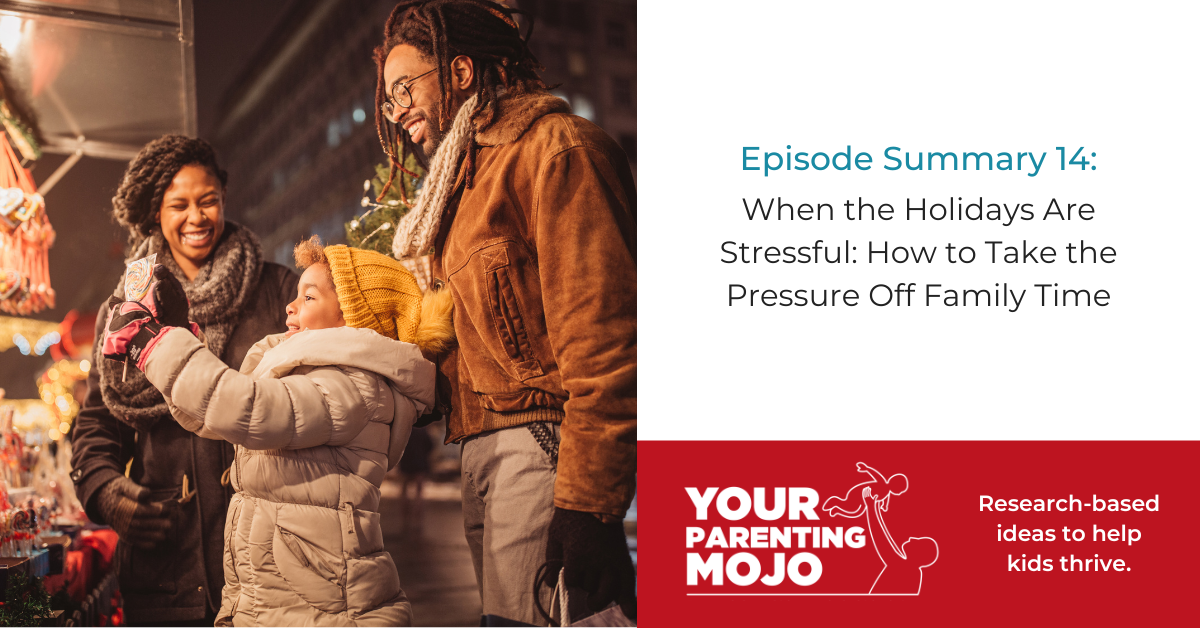
You’re a few weeks away from seeing family, maybe for the first time since last year, and you already have hopes for how it will go. Then you remember how it went last time. Your sensitive kid wouldn’t try the green beans and grandma took offense, and being around your parents brought up old comments about your weight and how kids should just do what they’re told.
We want our kids to have a good relationship with their grandparents, but so much sits underneath that many of us spend the visit gritting our teeth, just surviving the holidays.
In this episode, I coach Samuel, whose mother is coming to stay for Christmas. His family doesn’t see her often, so he wants this visit to go well, and he’s already dreading a repeat of the last one. We look at what he’s hoping they’ll get from their time together, what he might try differently to meet more of everyone’s needs, including his own, and whether all of that connection has to happen during this one visit. Your situation won’t be exactly like Samuel’s, but listen for the common elements, because you may find tools you can use this holiday season.
Questions this episode will answer
Is it true that holidays are stressful? Yes, holidays are stressful for many parents. The stress comes from what we hope the visit will be and from old family patterns that show up as soon as everyone is in the same room. The more expectations we have about the visit, the more pressure there is.
What do you do when holiday expectations and reality don’t match? Start by naming what you hope will happen. How much of that is within your power to change, and how much relies on other people changing? It’s difficult to change ourselves; it’s much more difficult to change another person. Changing how you show up can give others the space to show up differently too.
How to deal with a disappointing holiday? Look at what you were hoping the visit would give you, and sort what you could influence from what depended on other people. Then find ways to build that connection outside the one visit, such as small contacts through the year on your kids’ terms, so the next visit doesn’t have to make up for this one.
How to get past holiday anxiety? Pay attention to where the anxiety sits in your body, such as tight hands or legs. Then ask: what is this trying to tell me? Often it’s a hope for the visit or a memory of how the last one went. You can’t change how other people show up. Shifting your perception of the situation, and/or setting a boundary, are effective strategies to manage holiday anxiety.
How to deal with anxiety caused by family? Part of the anxiety can come from trying to make a relationship between two other people go well, such as your parent and your kids. Consider what it would be like to stop managing that, for example by leaving them to spend time together without you.
How can I maintain my mental health during the holidays? Name the needs you’re trying to meet, like rest and mental space, and plan for them ahead of the visit. Planning breaks before you reach the end of your rope is one way to manage holiday stress, by finding other things to do in the house or getting out for a well-deserved break.
How to keep grandparents involved? Build the relationship between grandparents and grandchildren through the year, so it doesn’t depend on one visit. Come toward kids on their terms, with a shared interest or a story they love. A grandparent could record stories for a child who loves being read to.
What you’ll learn in this episode
- Why the holidays are so stressful when we most want them to go well
- What Samuel noticed in his body when he talked about his mother’s visit, and why family stress at the holidays starts so long beforehand
- How managing a relationship between grandparents and grandkids can consume a lot of energy, which depletes you when you most need resources
- How a strategy that meets needs for Samuel and his wife can also leave his mother and his children space to build their own relationship
- Why a grandparent’s relationship with a grandchild doesn’t have to depend on one visit, and how a shared interest can keep it going all year
- Two questions to ask yourself before any family visit, and what to settle ahead of time so you can plan breaks before you reach the end of your rope
Get support with your own holiday situation
Your holiday situation won’t match Samuel’s exactly. You might be trying to figure out how to not host, how to navigate comments about your eating and weight, and how to get the kids out of holiday parties without a meltdown.
When you join the Parenting Membership, you also get our Holiday Support Bundle. It will help you to check your capacity before saying yes, identify your needs (remember, this is not: “I need you to stop doing X,” set boundaries with family, and find simple ways to reconnect that don’t require everyone to get dressed up in uncomfortable clothes.
The guides are short, so you can find something useful and try it without spending a lot of time reading.
If you want support working through your own situation, that’s what we do in the Parenting Membership, with coaching calls where we work through whatever situations are difficult in your life right now.
Join before end of day December 23 to receive the Holiday Support Bundle.
Click the banner to learn more.

Jump to highlights
01:48 Introduction: a thought experiment about holiday family visits and the stress underneath them
04:12 Why these few days feel so important to Samuel: a small family, few grandparents, and a short window
07:13 What would it be like to stop “managing” the relationship between his mother and his kids
09:35 Naming the needs in play: rest, ease, mental space, competence, and a relationship between his mother and his kids
11:59 Easing the pressure on the visit itself by creating more points of connection through the year
15:43 A concrete idea: the grandmother recording stories for his son’s Yoto cards
18:09 Jen’s takeaways: building on what already works, and questions to ask before your own holiday visit
19:39 How to hear more of the conversation, and where to find the Parenting Membership and its holiday resources
Transcript
These five days you come over Christmas have to be the best five days they can possibly be. I know that's unrealistic.
Jen:I'm kind of noodling this on this idea of kind of like managing the relationship between your mother and your kids, right, which is creating a lot of stress for you, a lot of anxiety for you. What would it be like to not do that?
Jessica:Do you get tired of hearing the same old intros to podcast episodes? Me too. Hi, I'm not Jen. I'm Jessica and I'm in rural East Panama. Jen has just created a new way for listeners to record the introductions to podcast episodes and I got to test it out. There's no other resource out there quite like Your Parenting Mojo, which doesn't just tell you about the latest scientific research on parenting and child development, but puts it in context for you as well. So you can decide whether and how to use this new information. If you'd like to get new episodes in your inbox, along with a free infographic on 13 reasons your child isn't listening to you and what to do about each one, sign up at yourparentingmojo.com/subscribe, and come over to our free Facebook group to continue the conversation about this episode. You can also thank Jen for this episode by donating to keep the podcast ad free by going to the page for this or any other episode on yourparentingmojo.com. If you'd like to start a conversation with someone about this episode or know someone who would find it useful, please forward it to them. Over time, you're going to get sick of hearing me read this intro as well. So come and record one yourself. You can read from a script she's provided or have some real fun with it and write your own. Just go to yourparentingmojo.com and click read the intro. I can't wait to hear yours.
Jen:Hi, I'm Jen and this is the Your Parenting Mojo podcast. I would like to start out today's episode by doing a little thought experiment. So let's cast ahead only a few short weeks now to the holiday season. You're going to be with family maybe for the first time since the last holiday. Do you already have hopes for how this is going to go? You might be imagining carrying on traditions around gatherings and maybe food from your childhood. And then you remember what it was like last year. Everyone was in the same room. Yes, but you're a sensitive kid, didn't want to try the green beans and grandma felt offended. Both kids wanted to play with cousins for as long as possible and then had massive meltdowns at bedtime. And being around your parents just brings up so much old stuff. Their comments about your weight and how in their day kids ate what was put in front of them and did what they were told and they're either saying or implying that you should punish them more and then they would behave better.
Jen:And of course you live every day with the scars that their way of parenting left on you but you could never just tell them that because then they would just turn the focus back on themselves and maybe even accuse you of being mean to them. So we want our kids to have a good relationship with their grandparents but there can be so much going on underneath that we end up spending each holiday just gritting our teeth and getting through it. So today we're looking at one parent's situation and some options that he hadn't considered before in terms of how to navigate it. We'll meet parent Samuel whose mother is coming to stay for Christmas and his family doesn't see her very often so he wants this visit to go well but he's already remembering how hard previous visits have been and dreading a repetition this year. We explored what he's hoping they will get from their time together, what he might try differently to meet more of everyone's needs including his own, and whether all of that connection has to happen during this one visit. I do a lot of group coaching calls in the Parenting Membership and one of the benefits of that is you get to see your own situation being reflected in the one that you're hearing about in the coaching. The exact details are going to be different but see if you see common elements and maybe you can apply some of the same tools and approaches that Samuel plans to use this year. So we're joining the conversation where Samuel explains why these few days with his mother feel so important.
Samuel:We're a relatively small family. We have one grandparent, well I have no grandparents left, so no grandparents. I have one mother, no father, cousins and uncles and relatively distant, relatively sort of remote to the family unit. My wife has her father, no grandparents left, although there is a grandparent figure, but not by blood, but he's definitely, he's certainly there. It's a very close-knit family and it feels like when I was a kid we spent loads of time with my grandparents. We lived in their house. We had multiple Christmases there. It was that sort of family. We now live quite far away from my mother. She doesn't see my grandkids as much as I saw my grandparents at all. So it does feel, it's not only those moments that I feel are missed, it feels very, very short, the window. You have to cram it in and it has to be effective. These five days you come over Christmas have to be the best five days they can possibly be. I know that's unrealistic.
Jen:A lot of pressure on everybody.
Samuel:It is a lot of pressure on. It is a lot of pressure. I just, but I feel like my kids love my grandmother. They don't see her a lot and they really do love to see her and they don't, I mean to be honest, they don't seem bothered by the fact that she talks about all this stuff like tenancy and rent and not fixing the electrical wiring at the property, blah, blah, blah. I just feel like it could be more and it's not, I'm trying to project my own childhood, it's not what I had and it feels like it could be gone very, it could be gone before anyone knows it and then you'll look back and think, oh, there's just not those moments. I know it's not made up of those moments but they're limited on resource in terms of grandparents and family. We really don't have a big family. So all those sort of, you know, you look at other people's houses and go, wow, look at that, they've got 20 people around for Christmas. We've got five, you know, and one of them is my mother. So yeah, wanting that to be as best as it can be, yeah, it is a lot of pressure. And it is unrealistic.
Jen:Yeah, what do you notice in your body as you say it is a lot of pressure?
Samuel:Well, yeah, there's a tenseness to that and there's a bit of, yeah, there's a bit of anxiety. I'm thinking about it now and there's already an anxiety.
Jen:Yeah, so where is that anxiety?
Samuel:Well, I can feel, I can certainly feel in my hands, my legs are crossed, so I'm definitely sort of tense. I'm also bent over. If I was standing up straight and sitting relaxed, I'd probably be more like here rather than hunched over the screen. Yeah, it's certainly, yeah, I can, yeah, physical reaction to the thought of it is definitely there. Okay. Yeah.
Jen:Yeah, I'm kind of noodling this idea of kind of like managing the relationship between your mother and your kids, right, which is creating a lot of stress for you, a lot of anxiety for you. What would it be like to not do that? That would be different.
Samuel:Yeah, it'd be a lot less thought process for me. I can't say I really manage, I don't try and manage this situation really. I just get frustrated by it. The thought of it not going well is annoying and when it feels like it isn't going well, I don't try and manage it. I don't try and say, no, you have to now go sit over there. Stop talking to me and go sit over there and talk to my children. Arguably, I could probably just leave them to it to an extent. I could, for example, just say, I'm going out. Me and my wife are going out. We don't go out. We look after our children 24/7. I think we've had, since our first child was born, maybe one or two dates. We've stayed away from the house once or twice. I think just literally leaving them to it for a period would probably be a good thing to do. I wouldn't feel like management in that case to me. It'll be what it'll be. You have your own experience on your own terms and we're popping out basically.
Jen:Yeah, assuming she's okay with it and physically capable and she knows it's coming.
Samuel:No, she's definitely physically capable. She would be fine with it. I think she'd probably love it. She left us with my grandparents all the time. It was basically a second line of parenting. She was a single parent so it was a second line of defense against the demands of being a mother. I think she'd be absolutely fine with it. I don't give her the opportunity really, I don't think. I do try and sort of, I don't know. It doesn't come naturally, I don't think. I think leaving our children with people doesn't come naturally anyway. I keep on looking over my wife. My wife's sitting in the corner over there. We find it difficult. It's not a natural position for us to be in, mainly because of the lack of family. It's a smaller family so the number of opportunities you have is pretty reduced. I could certainly see myself trying it this holiday.
Jen:I know you're a little bit familiar with my work and so what we're essentially looking at, what are the needs here in this situation? You have a need for some rest, some ease, some mental space. I'm hearing that coming through and a need for competence in parenting as well. You're also sort of invested in this relationship between your mother and your kids. Again, assuming she's okay with it and I might give her a heads up that you're thinking about this. That's just me. It's a strategy that could meet a lot of needs for you.
Samuel:Yes.
Jen:It's not the only strategy that's available to us but it is a strategy that seems rather efficient at meeting a whole bunch of your needs.
Samuel:Definitely. It would meet my wife's needs as well so it's like a double whammy. Extra bonus level on that one. Yes, certainly. I feel like it also removes the other aspect which is my mother has a tendency to talk to me quite a lot. She doesn't naturally talk to children. I can't remember my grandparents actively talking to me that much. I remember them talking around me. They certainly haven't come up with conversations, not necessarily with me at the time. That's probably an aspect where I feel like, I don't need to talk to you. I like talking to my mother. I just prefer she talks to my kids sometimes and engage with them. Leaving that would also free that aspect up because maybe she wouldn't feel the need to talk to me. We did actually try it a couple of years ago, thinking about it. I think we may have actually left the house and left them doing gingerbread houses. They loved it. They absolutely loved it, remembering it now. They did really like it apart from when the dog jumped on the table and ate half the gingerbread house. It was great.
Jen:That is going to be what's remembered for years to come.
Samuel:I definitely remember that more than the actual act of the gingerbread housings. Maybe my management of the situation is giving them resources and leaving them to it the same way that I should be doing that with engineers.
Jen:We also talked about what Samuel could do when his mother brings up subjects that he finds difficult to keep hearing about. For this shorter version of our conversation, I want to come back to the pressure on the visit itself. Giving his mother and children some time together is one possibility, but what if their relationship didn't have to depend so much on these few days at Christmas? The one final nugget that occurred to me is this idea of there's so much riding on these five days when you're together. I'm wondering about ways to kind of remove some of that pressure. One way to do that could be to create more opportunities for engagement at other times in the year that doesn't have to be done in person. As an example, my dad is interested in building a relationship with my daughter that he hasn't really had thus far. He's kind of said, you know, I send little notes for her birthday and she doesn't respond. I'm like, all you say is happy birthday. Where do you go from here? I said she's really into bird watching. If you have an interest in birds or could manufacture an interest in birds and could come to her and say, hey, how should I set up my feeders? She'd probably be really interested in that. I think as adults, we tend to want kids to engage with us on our terms, but if we want relationships with kids, we kind of have to come toward them on their terms. If there is any topic that is sort of this natural-ish or slightly manufactured point of engagement between the two of them, you might be able to create opportunities for them to be in touch more naturally through the year so that the five days isn't like everything has to happen and it has to be perfect, which could in itself reduce some stress too.
Samuel:Yeah, I definitely think there's the scope there. This year has been especially strange because we've had our second child, she's quite young. We've not been up to see my mother as much as we were. Maybe when my son was three to four, we were up there quite often, but since he turned five, we've been there maybe four times and we also didn't see my mother last Christmas. It feels like there's a lot riding on this Christmas because of the last two years has been quite sparse in terms of visits and engagement. We've invited her down throughout the year, so it's not as if we haven't seen her for a year. We have seen her at regular points in the year, but it is very, very short-lived, quite intense periods. So yeah, whether or not my son would enjoy it or my mother would enjoy it, but it would certainly satisfy my need for them to engage more, whether that'll backfire and I'll feel even worse because they don't engage, will be interesting to see. I think my mother would definitely be up for it. She'll just have to manufacture some interest in some very non-reliable topics like Pokemon. I'm not sure how she's going to deal with Pokemon.
Jen:At the end of the day, they're their own people, right? They have their own relationship and there's only so much you can do to puppeteer that into existence.
Samuel:I mean, my son loves having books read to him. So there might be an opportunity there for maybe…
Jen:Via Zoom or recorded.
Samuel:Yeah, he's got a Yoto, so he has like, you can create book story cards. And I've recorded lots of stories for him. I don't know how many he's got, like 50 odd stories. And my wife does the same in Spanish. So it might be good to do something like that. That would definitely be an option. Get my mother to read some stories and just record them. And then I can put them on his card and he can listen to his grandmother's reading to him. Probably enjoy.
Jen:Yeah, definitely. Okay. How are you feeling now in your body?
Samuel:Better. Less stressed out. A bit more, you know, looking ahead more positively, I'd say. And there's opportunities to try things. And I think I'm gonna have to try a lot of things and see what fits. But yeah, my original plan for this holiday period was to put my head down and try and just crack on and hopefully get through it. And things will just happen. And I'll just have to deal with them reactively, which I've already spoken about, my problem just being a reactive, reactive parenting and reactive to all the situations and waiting for it to happen. And then just go, right now, what do I do? I'm already too stressed out to figure out what to do. I've just made a situation worse. So yeah, definitely feeling a bit more, feeling a bit more positive and what's it called? Like empowered and resourced. Resourced to deal with what might happen. Yeah, definitely.
Jen:Okay. Is there anything you'd like to ask or say to feel complete in the conversation?
Samuel:Um, no, no, I haven't. Thank you. Yeah, always, always. Your perspective is very welcome. Obviously, it is your job. So you're very good at it. But it's nice to have someone assess your situation from the outside. It's, you know, it's even talking to my wife, she knows the situation in and out. But she has her own view on the situation. So it's a sort of tainted by her own experience of being there with me while it happens. And also being, you know, slightly annoyed and triggered by the same things are slightly intriguing to me about the situation. It's hard to look past that sometimes, of how you feel about it, how you can change how you feel about it definitely.
Jen:One thing I noticed in this conversation is that Samuel's children already enjoy spending time with their grandmother. So I was looking for ways to help him build on that foundation that didn't add more stress for him. One possibility was giving them some time together without him being there, which would also give him time to connect with his partner. Recording stories offered another way for their relationship to grow without so much depending on this short visit. So if you're already thinking about your own family, you might start with a What am I hoping will happen during our time together? And then you could ask, what could I do to help make that possible? And what depends on other people? You might find that there's a conversation you want to have beforehand about how you'll spend time together, or maybe topics you would prefer to keep off limits. You could plan for breaks in the visit before you get to the end of your rope. And of course, your situation won't be exactly like Samuel's. Perhaps the question for you is whether to host in the first place, how to tell your family that you're leaving earlier, or how to spend time with your children without adding more things to your list. Those are some of the situations that I had in mind when I put together the holiday resources that I'm offering as a bonus when you join the parenting membership in November. There's help with checking your capacity before saying yes, identifying your needs, setting boundaries with family and finding simple ways to reconnect that don't require everyone to get dressed up in uncomfortable clothes. You can start with whichever part of it is relevant to you.
Jen:The guides are short so you can find something useful and try it without spending a ton of time reading and digesting. If you'd like support working through your own situation rather than trying to figure it all out on your own, that's what we do in the parenting membership. You don't have to wait till the holidays, you can start with whatever challenge you're facing today. And you can also hear more of my conversation with Samuel, including what he could try when his mom spends much of their time together complaining about her tenants. And you'll hear from an introverted parent whose home is her sanctuary but whose husband has signed them up to host both upcoming holidays for both of their families. We'll explore what she might want to ask for, what she is willing to take on, and where a bigger conversation can help. You can find out about the parenting membership at yourparentingmojo.com/parentingmembership and join by end of day on December 23rd to receive the holiday resources as well. Thanks so much to Samuel for sharing this conversation with us and thanks to you for listening. I'll see you soon.
Jessica:Hi, this is Jess from rural East Panama. I'm a Your Parenting Mojo fan and I hope you enjoy this show as much as I do. If you found this episode especially enlightening or useful, you can also donate to help Jen produce more content like this and also save us from those interminable mattress ads. Then you can do that and also subscribe on the link that Jen just mentioned. And don't forget to head to yourparentingmojo.com to record your own message for the show.

About the author, Jen
Jen Lumanlan (M.S., M.Ed.) hosts the Your Parenting Mojo podcast (www.YourParentingMojo.com), which examines scientific research related to child development through the lens of respectful parenting.