
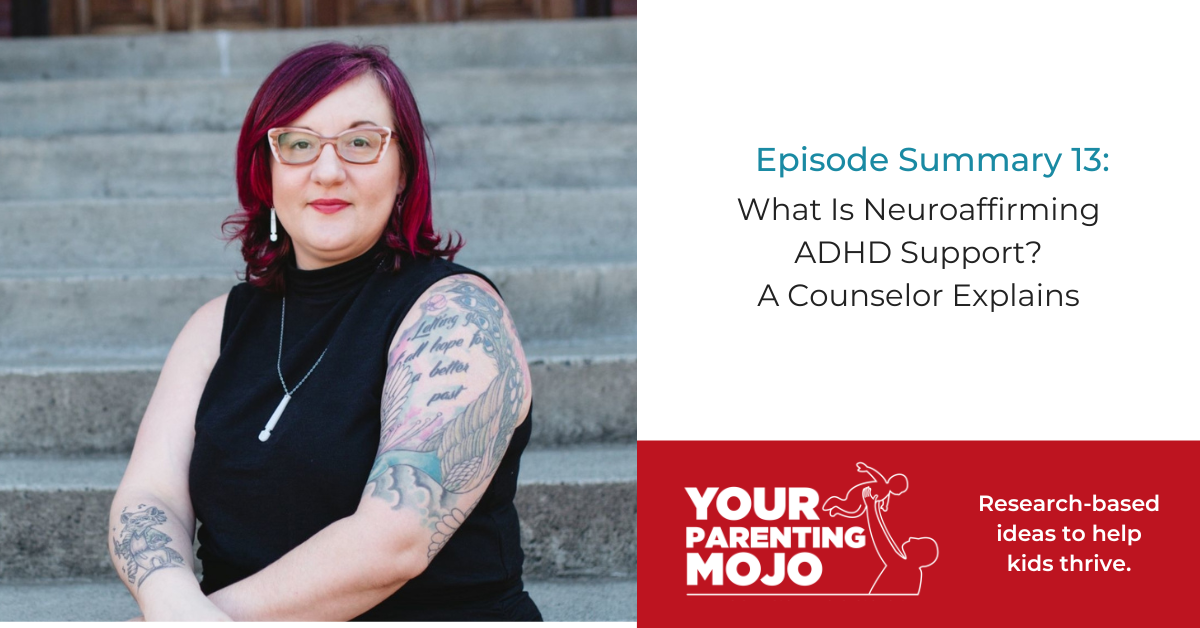
Episode Summary 13: What Is Neuroaffirming ADHD Support? A Counselor Explains
A while back I sat through an hour of Dr. Russ Barkley, a global expert on ADHD, walking through the statistics: more car accidents, more health problems, and a life expectancy he says is 7 to 13 years shorter, driven mainly by a lack of impulse control. When the hour was over, I remember thinking that if I had a kid with ADHD, I would be absolutely terrified.
Right after that, I took a second training, Becoming a Neuro-Affirming Clinician, hosted by B. Lourenco. The difference between the two couldn’t have been more profound. Barkley starts with executive function and asks how to fix it. B. Lourenco asks why executive function is hard in the first place, and what we can do to support people with ADHD that might involve medication, but might not.
In this conversation, B. Lourenco explains why she thinks ADHD starts with attention regulation, and what she says to Dr. Russ Barkley’s claim that impulse control drives that shorter life expectancy. We talk about Dr. Russ Barkley’s view that kids shouldn’t get any say in whether they take medication, and what a parent who desperately longs for quiet and predictability can do when their kid wants noise and novelty all day long.
Questions this episode will answer
What does neuroaffirming mean? Neuroaffirming approaches start from the idea that ADHD is one of the ways brains work, and that it has been around about as long as humans have. It takes out the shame, then looks for ways to adapt that fit how you work and for the strengths that come with ADHD.
Does ADHD shorten life expectancy? Dr. Russ Barkley says it does, by 7 to 13 years, driven mainly by poor impulse control. B. Lourenco agrees that health outcomes differ but disputes the explanation, because a doctor who sees only impulse control can miss co-occurring conditions that affect health.
Are kids with ADHD overmedicated? B. Lourenco says over-medication was real for a generation of kids: too many were medicated, and many were given too much. She also says medication helps a lot, but it doesn’t have to be the first or only tool.
Should kids get a say in whether they take ADHD medication? Dr. Russ Barkley says no; the decision is the parent’s alone. B. Lourenco points out that this denies children’s autonomy.
How can parents help children with ADHD? B. Lourenco shares two important ideas for a parent who is just starting to wonder: stop blaming and shaming yourself, because nothing is fundamentally wrong with you or your child. Secondly, build connections with people who will support you without the shame and judgment of the wider culture.
What you’ll learn in this episode
- Why B. Lourenco thinks ADHD starts with attention regulation in a nervous and sensory system that works differently, and why executive function struggles follow from that
- Why ADHD traits were useful for most of human history, and what changed in the last few hundred years
- What B. Lourenco says to Dr. Russ Barkley’s claim that impulse control drives a shorter life expectancy, and the co-occurring conditions a doctor can miss when that’s the only explanation
- Why over-medication was real for a generation of kids, and where medication fits as one tool among several
- What it can look like when a parent who wants calm and a child who wants noise and novelty both get to exist, including a mom break scaled to your child’s age
- Two things B. Lourenco would tell a parent who is just starting to wonder about ADHD for themselves or their child
Want to hear the full conversation?
The full conversation with B. Lourenco is available to Sustaining Supporters of the show and to Parenting Membership members. In it, B. Lourenco walks us through PINCH, a practical model for motivating a person with ADHD to do things like getting out the door and doing homework, and why leaving things until the last minute can be a strategy, even if it doesn’t have to be your only one.
We also look at the homework fight from a different angle, asking whether you value it or just think you’re supposed to, and why high school doesn’t have to take four years. B. Lourenco explains the social model of disability with her glasses analogy, and we get into how decisions our society has made about cars and the tax code create challenges for people with ADHD that have nothing to do with impulse control. And we talk about the risks of getting a diagnosis compared with the risks of going without one.
The whole episode is available in a private podcast feed immediately after you become a supporter of the show.
As a Sustaining Supporter, you’ll hear extended conversations like this one with the experts I bring onto the show, plus occasional bonus episodes with my own analysis that aren’t released anywhere else.
If you’ve been told the problem is your child’s brain, and something in this episode made you wonder whether that’s the whole story, this is where you hear the rest of it.
Click the banner to learn more.
Jump to highlights
01:34 Introduction: Jen’s contrasting experiences with Dr. Russ Barkley’s ADHD training and B. Lourenco’s neuroaffirming one
03:59 What’s in the full conversation for sustaining supporters, and the start of the interview with B. Lourenco
04:31 What the dominant “executive function deficit” framing of ADHD misses
07:35 Why ADHD traits were adaptive for most of human history and fit less well in today’s world
09:24 Responding to Dr. Russ Barkley’s claim that impulse control drives reduced life expectancy
13:09 Does more control ever help? Driving, rules, and why structure people will actually use beats control
15:02 Jen’s explanation of what “neuroaffirming” means, and how this shapes an approach to medication
17:44 Medication as a tool that doesn’t have to be the first or only support
19:05 When a parent who needs calm and predictability has a child who craves novelty and noise: neither is wrong
23:21 B. Lourenco’s advice for newly identified parents and parents of kids with ADHD: drop the shame and blame, and build connection
26:28 Jen’s wrap-up: mom breaks, the missing village, and changes for the margins helping everyone
Transcript
Having systems that help support people using potentially rules or methods of, quote, control could be helpful, but the overall idea of control being the thing that is needed, I don't think is helpful. And there's a couple of reasons for that. One is that it, again, puts the onus on the ADHD-er or the parent to do all of the things instead of the environment that they're in. And it continues to perpetuate this idea of, if you wanted to, you would, right?
Denise:
Hi, everyone. I am Denise, a longtime listener of Your Parenting Mojo. I love this podcast because it condenses all the scientific research on child development, compares it with anthropological studies, and puts it into context of how I can apply all of this to my daily parenting. Jen has a wealth of resources here. So if you're new to the podcast, I suggest you scroll through all her episodes. I'm sure you'll find one that will help you with whatever you're going through, or one that just piques your interest. If you'd like to get new episodes in your inbox, along with a free infographic on 13 reasons your child isn't listening to you, and what to do about each one, sign up at yourparentingmojo.com/subscribe. Enjoy the show.
Jen:
Hello, and welcome to the Your Parenting Mojo podcast. A while back, I did a certified ADHD professional intensive training course. Dr. Russ Barkley, who is a global expert on ADHD, spoke for an hour and walked through a whole bunch of statistics showing that people with ADHD are much more likely to be involved in car accidents, have health problems, and ultimately have a life expectancy that he says is 7 to 13 years shorter for people with ADHD than people without. And he says the main reason for all of that is a lack of impulse control. When that hour was over, I remember thinking if I had a kid with ADHD, I would be absolutely terrified. I went on to spend three episodes digging into Barkley's work and the contradictions in it. I looked at how his framework says ADHD is a deficit that should be controlled by medication, and how much money he's made from the pharmaceutical companies whose medications he promotes. But taking apart a framework only gets you so far. Kind of analogous to the rest of my work, it's not enough to know you want to parent differently from how your parents raised you. You actually need to know what to do when your kid can't move through a morning routine. And maybe you're also wondering if you're not actually lazy and unfocused as you've been told for so many years, but might even have ADHD yourself. Right after that first training, I did another training called Becoming a Neuroaffirming Clinician, and it was hosted by my guest today, B. Lourenco. The difference between those two trainings could not have been more profound. Barkley starts with executive function and asks, how do we fix it? B. Lourenco asks why executive function is hard in the first place, and what practical steps we can take to support folks with ADHD that might involve medication, but also might not. In this conversation, B. explains why she thinks ADHD starts with attention regulation and not executive function, and what she says to Barkley's claim that impulse control drives that shorter life expectancy. We talk about Barkley's view that kids shouldn't get any say in whether they take medication, and we get into what a parent who desperately longs for quiet and predictability can do when their kid wants noise and novelty all day long.
Jen:
My full conversation with B. is available when you become a sustaining supporter of the podcast for just $10 a month. In that full version, B. walks us through the PINCH model to motivate people with ADHD to do things like getting out the door and doing homework. We also talk about why leaving things until the last minute can be a strategy, but it doesn't have to be our only strategy. So let's get started. So welcome, B. It's so great to have you here.
B. Lourenco:
Thank you so much for having me. I'm delighted.
Jen:
So, oh gosh, I'm so looking forward to this conversation. So let's start with the dominant framework in ADHD, right? And that says the core problem that folks with ADHD have is poor executive function. So planning, self-control, follow-through, and it is the patients, if they're an adult, or their parents, if they're a kid, their goal is to manage or correct that. And I'm wondering, as you work with clients, what does this kind of framing about what ADHD is miss?
B. Lourenco:
Oh, gosh, a lot.
Jen:
If anything.
B. Lourenco:
You know, I mean, my first question, right, as you say that is, okay, but why is there a problem with executive functioning? Or we're just going to say that's what it is and we're good with that, and we're going to say that's the problem and fix it? That doesn't make any sense to me. So let's dig deeper, of course. So I think that's one of the core things that gets wrong is that it answers a question without looking at the why that lives underneath it, which is really where my answer to that question lives. And that's that ADHD is rooted in attention regulation differences. It's not a deficit. Anybody that lives with an ADHD brain or loves someone with ADHD brain knows that we can hyper focus, we can zoom in, it can be like, hello, what's going on, right? It's attention regulation. And that attention regulation is rooted in the person's nervous system and sensory systems being different. It's rooted in, a, sensory differences, making the world a busier, more intense place to exist and harder to tune out all of that intensity. And ADHD, if we look at its root in the human experience and how long it's been here, there's some theories that point to it being part of the the early hunter type of humans. And so if that's true, which I think it probably is, it makes sense that we would then have an interest-based nervous system, not one that is just going to do the thing because we have to do it, but rather we're going to go, what was that? Because that might mean food, right? That might mean survival. So it's about challenges in regulating attention due to a nervous system and sensory system that can't filter out and prioritize information the way that other people's do. So executive functioning problems stem from that. And if we're not looking at that-
Jen:
And for the vast majority of human history, it was adaptive is what you're saying.
B. Lourenco:
Exactly.
Jen:
Over the last few hundred years, it's become less adaptive.
B. Lourenco:
Right. Because we've sort of made this assumption of there being one way to be human rather than multiple ways of being human that served the greater population of humanity. So yes, absolutely adaptive, just not so, it doesn't fit the same in our current culture.
Jen:
Yeah. And so I'm guessing people who have been told that they have some sort of disorder that has to be fixed, that should be fixed, that they probably come in with some sort of set of thoughts and beliefs and ideas about themselves. What do you notice among the people you work with?
B. Lourenco:
Oh gosh. Well, especially if they didn't know that it was ADHD, I work with a lot of later in life identified folks. So they've lived their whole life not getting it right, not meeting expectations, not knowing that there was something fundamentally different about them. So the only sense that they've been able to make of their experience is that there's something fundamentally wrong with them, that they are broken, not like other people, incapable of being an adult. And all of that comes from the messages that they got as children and as adults, but certainly as kids. So regardless of the age, ADHDers are constantly getting messaging overtly and covertly that there's something wrong with us and that we should just be able to fix that thing that is wrong with us. If we cared enough, we would fix the thing that's wrong with us.
Jen:
Yeah, if we care enough and if we want to avoid some, you know, bad life outcomes, right? And I'm thinking about Dr. Barkley's work here before we start shifting into the neuroaffirming approach that drives your work. I know you're familiar with Dr. Barkley's work. Listeners who have been through my episodes on ADHD will also be familiar with this. And he's such an effective speaker, right? He's a highly rhetorically effective speaker. He makes the case for the harms that are likely to happen for people with ADHD, all kinds of terrible health outcomes, reduced life expectancy, between 7 to 13 years, driven primarily, he says, by the person's lack of impulse control. And right before I did your training, I did a certified ADHD professional training where he spoke for an hour in that training. And if I had a kid with ADHD after I sat through that, I would have been absolutely terrified. And so I'm wondering how you think about this topic that's different.
B. Lourenco:
Yeah, you know, it's really unfortunate because he gets some of it right in that the data does support that health outcomes are different and life expectancy is different. And those are very real things that we need to address and find out what's going on. But I can't subscribe to the idea that it's fully rooted in impulse control. And this idea, again, that if you could just control yourself better, you could live longer. You know, like, I'm laughing because that just sounds so silly to say as an ADHD-er that like, oh, is that all I have to do? I just have to control my impulses? Okay. And then what, sir? So it, you know, it's true that people who experience and live with ADHD have health outcomes related to things like self-medicating or, you know, other substance use that might just be like coping-related, right? It's very commonly known that a lot of ADHD-ers self-medicate with stimulants, right? So looking at those things, and then I think there's also something in, there's something missing in his work and in the medical model in general, and that's that there's a lot of co-occurring health issues with ADHD that also contribute to our life quality and our life expectancy. When we look at things like EDS and fibromyalgia and MCAS and all of those other things that we're learning. Yeah, yeah, yeah. So MCAS is mass cell activation syndrome. We've got Ehlers-Danlos syndrome or hypermobile spectrum disorder. And then we have fibromyalgia and other pain disorders. There's just a number of things, allergies, just a number of things that our bodies do just differently enough that can impact our life expectancy. And if we just say that it's impulse control, we're missing so much. And probably, right, if we've got a doctor who thinks that ADHD is rooted in impulse control and I come in with my health issues, the answer is going to be, well, stop doing that. Control yourself, whatever it might be, instead of looking at whether I have one of the many co-occurring things that could impact my life expectancy.
Jen:
Do you think there's any, like, I totally get that there's this other package of things that we also need to be considering. Is there any aspect of control, more control is helpful? For example, I'm thinking, you know, Russ Barkley talks a lot about driving infractions, right, and dangerous driving and driving being a highly rule-bound, rule-regulated behavior. When everybody follows the rules, it works pretty well. When some people have a hard time with that, it works less well. How do you navigate that?
B. Lourenco:
Yeah. What you're describing is the ADHD need for structure, right? We need some containment. We need to, while we might crave just a free-for-all, that doesn't actually work, right? That's not actually what our nervous systems need. And so, having systems that help support people using potentially rules or methods of, quote, control could be helpful, but the overall idea of control being the thing that is needed, I don't think is helpful. And there's a couple of reasons for that. One is that it, again, puts the onus on the ADHD-er or the parent to do all of the things instead of the environment that they're in, and it continues to perpetuate this idea of if you wanted to, you would, right? And sometimes it is impulse-related, right? I'm not denying that there are impulse-related things associated with ADHD. Do I think the answer is coming in with a boatload of control? No. It's structure that the person will actually use or buy into that is more helpful than control.
Jen:
I'm going to step in here for a minute because B. and I went on to talk about what neuroaffirming means, and that word may be new for you. A neuroaffirming approach starts from the idea that ADHD is on the spectrum of ways that brains can work and that it's been around for about as long as humans have. As B. said at the start, ADHD traits were useful for most of human history. They've become a problem mostly in the last few hundred years as schools and jobs and daily life were created around one really narrow way of paying attention. B. compared it to the way the American Psychiatric Association listed homosexuality as a mental disorder until nineteen seventy-three. Most of us now look back on that and wonder how anyone believed it, and she thinks the way we talk about ADHD will look similar someday. So a neuroaffirming coach starts by taking out the shame. We acknowledge the struggles you're facing are real, and a lot of them come from living in a that wasn't designed for your brain. From there you look for ways to adapt that fit how you work, and you look for the strengths that come with ADHD too. That's a really important part that often gets forgotten. And all of this shapes how B. thinks about medication. I asked her how she approaches medication as a tool and whether that's different for parents who were diagnosed as adults compared with parents who were medicated as kids and didn't have much say in it.
B. Lourenco:
You know, interestingly enough, I have a child with someone who was diagnosed and medicated as a child, and then I was later in life identified, and we have very different positions on medication as a result of that. And one of the big things is that it's really terrible how over-medicated folks were, and I don't just mean too many kids were given medication, but they were given too much medication. So I remind parents that had that experience that you were A. over-medicated and B. not listened to. And both of those things are different with your child.
Jen:
Although Barkley actually still says you shouldn't consider the child's perspective in whether they accept medication. They don't have a fully developed prefrontal cortex. They are incapable of making these decisions for themselves, and it is the parent's decision 100% alone.
B. Lourenco:
I would say that Barkley's perspective is very childish and denies the autonomy of children as fully developed humans that get to decide what works for them and doesn't.
Jen:
And he wrote the most comprehensive manual, right? He edited the most comprehensive manual that clinicians use, as well as the screening tests.
B. Lourenco:
Yeah, it's really unfortunate, right? It's really unfortunate. So I would say that over-medication is real, that your experience of what happened is real, and I don't want to minimize that. And also, we don't have to do the same thing with your child, right? We can learn from that and make sure your kiddo doesn't have the same experience. I would also say that while medication is considered a first line of defense or a first line of treatment or support, that's only because it has a sort of efficacy, meaning like pill, it works, pill, it works, whereas other things require systems, and we have to continue to maintain them, and we have to continue to support them. So if we can't do any environmental shifts, which some folks can't, medication is appropriate and makes sense as perhaps the first thing that we would do. However, I think that ultimately, it's a tool that helps a lot and doesn't have to be either the first thing nor the only thing that gets utilized, that there are systems and structures and support and psychoeducation and all sorts of other things that we can do without throwing medication at someone right away.
Jen:
Shifting gears a little bit, we think a lot about needs, and I do in my work and I do when I'm working with parents, and how a parent's needs matter and a child's needs matter, and neither one matters more than the other, and I'm thinking about the mismatch that can sometimes happen when a parent might need calm and predictability and is parenting a child who likes novelty and excitement. How do you help them to find a path where neither one of their experience is wrong and where both of them can get their needs met?
B. Lourenco:
Yeah. Well, I think certainly making it so that neither one is wrong is a really good place to start, especially if we look at things like sensory system stuff and recognizing you don't get to choose what your sensory needs are, they just are, right? And so if you need this type of environment and you cohabitate with someone that needs a different thing in their environment, that just exists and it doesn't make either person bad or good. At the same time, if we're dealing with a parent-child situation, we do have a scenario where neither one is more right or wrong, but one of them has a lot more experience regulating and understanding and living in their body than the other one. So there is an unequal balance of sort of responsibility as far as who's going to perhaps do more work here in regulating self-system and co-regulation. But that doesn't mean that ADHD parent has to just sacrifice themselves for the needs of their children and be in a room with constant noise if they're feeling like they're going to have a meltdown, that to me the amount of sort of responsibility to maintain the environment and do my own co-regulating is proportionate to the age and development of the child. So by four, five, six years old, a kiddo is able to understand that mom needs a break, I'm going to go in this room for 10 minutes, the timer is on, please don't knock on the door. I don't know, at four years old, maybe it's not 10 minutes, maybe it's five minutes, three minutes, right? Whatever it might be that's appropriate for that child. But the kiddo can start to learn at that developmental stage, oh, mommy is different from me, right? Like we're not actually the same. Mom's not just an extension of me, we're separate from each other. And so we can start saying like mommy's having a hard time and needs some quiet, I'll be right back. Or I would tell my kids all the time, I'm taking a mom break, and they knew that that meant I was disappearing for 10 minutes, I always come back. So I think there's ways to normalize what's happening and also take care of ourselves so that we can continue to attune and show up in a way that isn't like you're noisy and loud, stop it, right? Like you get to exist, but I do too. And then we're going to come back together.
Jen:
Yeah. As you're talking through that, it also strikes me that a lot of this comes from living in a culture where we only have our nuclear family around us. And so I, as a parent, am basically the only resource, maybe we have a co-parent who's around for some of the time as well, but I am the major resource that you have available to regulate yourself. And that is ultimately the problem. And so parents often say to me when I say that, well, that's great, but that is my life. And it can be so hard to realize at the moment that we find that we need a village, that we don't have it and that we have to build it ourselves if we want it, because it's not there. But ultimately I think that is part of the answer, right? Is that we can't do this alone.
B. Lourenco:
And we're not meant to. We really were never meant to. Yeah, I agree. We just have to change the world and then everything will improve for ADHDers and everyone else. Biggs?
Jen:
Yes. Yes. So on that note, if a parent is listening right now who maybe has been recently diagnosed with ADHD themselves or has a kid, maybe they're starting to wonder about it, just suspicions. What are things that you would want them to know maybe to start doing, maybe to stop doing to support themselves and their kid effectively?
B. Lourenco:
That's a good question. So I think really it's two things. One is stop blaming yourself and shaming yourself. If we think about this through the lens of we've been here for as long as humans have existed, there isn't anything fundamentally wrong with you. It just is. And diversity is part of how humans have survived. So it's useful, right? The shame and the blame is not useful. So that's the place that I really want folks to start with. And then there's actually kind of what you were describing, this place of how do we build connections with people that are going to honor what's happening for us and actually support us without bringing in shame, blame, and judgment that comes from the external culture, right? Who are our trusted people that we can call up and be like, if I don't get 10 minutes, I'm going to lose my mind. And then we put them on the phone with the kids so they can monitor for 10 minutes. Or we video call that person that lives across the country that we know is willing to hang with kiddo that we won't do very well if we're trying to do it alone. It's infinitely harder. And needing help doesn't make you bad. It makes you human.
Jen:
Yeah. Despite what capitalism would have us believe.
B. Lourenco:
Despite what? Despite. Yeah.
Jen:
Okay. Anything specifically related to kids with ADHD?
B. Lourenco:
You know, I think same thing. Like, don't blame yourself. You didn't do anything wrong, right? There's nothing wrong with your kid. And the sooner that you can affirm that, the sooner you can honor and respect your child for all of the delights that ADHD can bring, instead of just feeling bogged down by the challenges and the ways that our current systems don't support ADHD kids or parenting them.
Jen:
Yeah. Yeah. Thank you so much. It was a real privilege to work through this with you and to hear your perspective in the course. I was so glad it happened after I did the original one, which was not at all neuroaffirming. And to see, oh, there is another way. And this is much more aligned with my values and with creating a society that actually benefits everyone. So thank you for being here. I'm really grateful.
B. Lourenco:
Absolutely. Thank you so much for having me.
Jen:
So that was my conversation with B. Lourenco. And near the end of our time together, B. told us she used to say to her kids, I'm taking a mom break. And they knew she would go into another room for 10 minutes and that she would come back. It met her need for rest. And it also shows her kids she's a separate person with her own needs who does come back. But of course, a mom break only works if someone or something can hold things together for those 10 minutes. And many of us are parenting in a nuclear family where we are the main resource our kids have for calming down. And so when I say to parents, you know, consider taking a mom break, they often tell me, well, you know, that's great, Jen, but this is my life. There is no one who can cover for me. Because the village that most of us were told about does not exist where we live. And if we want one, we have to build it. I keep thinking about a video where Russ Barkley asked whether we're really going to change all of society so the 5% of the population who has ADHD can live better. And his answer to that is an emphatic and dismissive no. But I think the answer should be yes. Because changes made for people who live currently on the margins tend to make life easier for everyone else too. So when we set up mornings to help our ADHD child get moving, they tend to get easier for the whole household, including you. So figuring out those kinds of strategies is the kind of work that we do together in the Parenting Membership. You get a community of parents who are figuring all this out together. So you're not the only resource available anymore. We have an amazing nonjudgmental online community, small groups that meet weekly to make progress on goals they choose themselves, and monthly coaching calls with me, and so much more. It's $59 a month or $599 for the year, and we do have scholarships available. There's more information on the parenting membership at yourparentingmojo.com/parentingmembership. If you don't need that wraparound support for yourself, but just want to hear the full podcast episodes, like my conversation with B. Lourenco, and support my work on the podcast, you can do that at yourparentingmojo.com/support. Thanks so much for listening, and I will see you next time.
Denise:
I'm a Your Parenting Mojo fan, and I hope you enjoy the show as much as I do. If you found this episode especially enlightening or useful, you can donate to help Jem produce more content like this. Just go to the episode page that Jen mentioned. Thanks for listening.

About the author, Jen
Jen Lumanlan (M.S., M.Ed.) hosts the Your Parenting Mojo podcast (www.YourParentingMojo.com), which examines scientific research related to child development through the lens of respectful parenting.