
Why Your Preschooler Is Hitting, Biting, or Kicking (And What Helps)
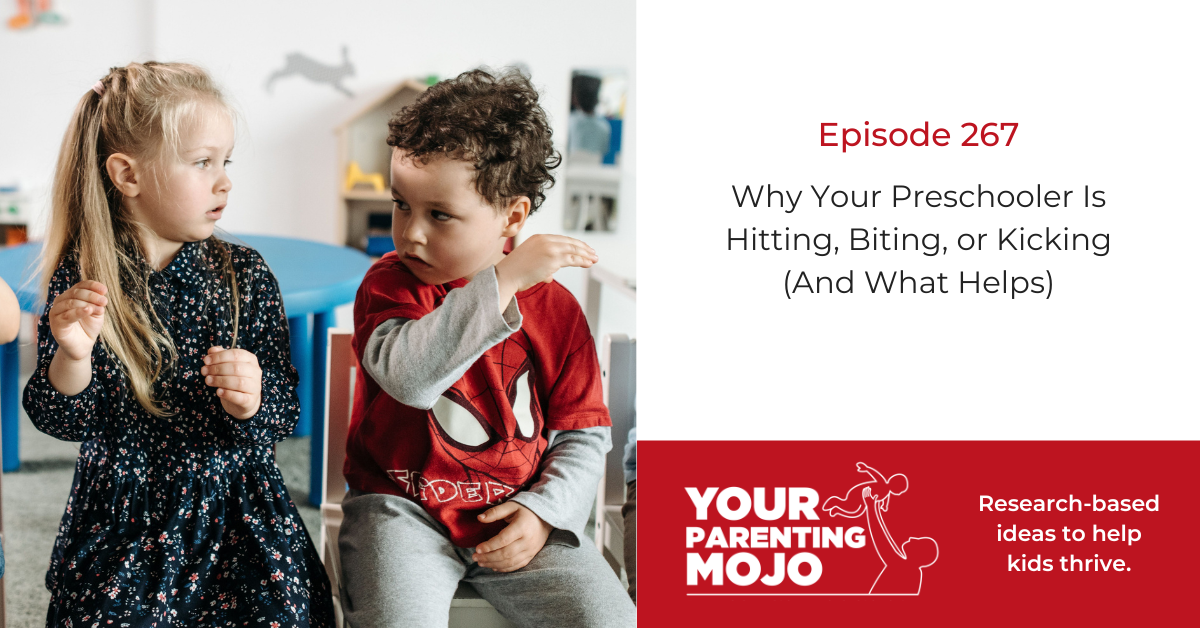
Your child’s preschool number shows up on your caller ID, and your stomach drops before you even answer. Preschool never calls with good news. Your kid hit someone at the sand table, or kicked a friend in line for the bathroom, and now you’re standing there wondering if you have to call another parent and apologize, and whether this is the start of your kid becoming the one nobody wants to play with.
The conversation you have that night probably isn’t the first one. You remind your child that we keep our hands to ourselves. Maybe there’s an early bedtime attached this time, to show them you mean it. Then the same thing happens again the next week, and you start to wonder what you’re missing.
In this episode, I walk through what’s actually driving hitting, biting, and kicking at preschool, both for kids who are dealing with a classroom that controls almost everything about their body for the first time, and for teachers managing a room of 20 kids with their own competing pressures. I share what happened when a child hit a teacher after being physically moved into circle time, and a moment from my own daughter’s classroom where a nap-time standoff got resolved without anyone losing. By the end, you’ll have a different question to ask than “how do I get the hitting to stop.”
Questions this episode will answer
Is it normal for preschoolers to hit? Hitting, biting, and kicking are common at this age, especially once a child spends most of the day in a classroom where someone else controls when they sit, move, and talk. That loss of control is often what’s underneath the hitting for three and four year olds.
How do I stop my 4 year old from hitting at school? Repeating “hitting isn’t okay” rarely works, because most kids already know that before the conversation happens. Look instead at what happened right before the hit, and what was building up earlier in the day.
What are some common behavior problems that 4-year-olds experience in school? Hitting, biting, and kicking often show up around transitions, circle time, and group activities, the exact moments where a child has the least say over their own body.
How to deal with challenging behaviors in preschool? Instead of treating the behavior itself as the problem to fix, it helps to look at what a child’s body and day were signaling right before it happened, including sensory overwhelm and a loss of autonomy.
How to handle disruptive behavior in the preschool classroom? For teachers managing a full room, a child’s need can often be met alongside a teacher’s own needs for competence, ease, and keeping kids safe, without one side having to lose.
How to manage behavior in preschool? The better starting question isn’t how to get the behavior to stop. It’s what’s happening in a child’s body and day that leads them there, for parents and teachers both.
What you’ll learn in this episode
- Why a preschool classroom is often the first place in a child’s life where an adult besides a parent controls almost everything about their body, and why that loss of autonomy can come out as hitting or kicking
- The story behind a child who hit a teacher during circle time, and what came out only after the fact about what led to it
- How to tell whether a child’s hitting or kicking is coming from a sensory issue, an autonomy issue, or something else, and how that changes what actually helps
- What teachers are usually working to protect when they enforce rules like Circle Time, including their own needs for competence, ease, and children’s safety
- How I worked out a nap-time standoff with my own daughter’s preschool that met her needs and her teachers’ needs at the same time
- A different question to ask instead of “how do I get this behavior to stop”
Behavior is a signal – here’s how to work with it
You already have the instinct to look past the hitting or kicking and ask what’s underneath it. What the Stop the Behavior Battles Masterclass adds is a repeatable way to find the answer in the moment, when your kid is already mid-meltdown and you don’t have time to think it through from scratch.
That’s the whole method: four steps you can walk through with your own kid’s situation, the same four steps you’ll watch a real parent named Clarice apply to her own son’s toy pickup standoff. Practice it enough times, and it starts to happen without you needing to stop and think through each step.
When you enroll, you’ll also get a 20-minute coaching session with Denise, our community manager and a credentialed coach, to help you narrow down the strategies most likely to work for your specific kid. And you’ll get an invitation to a live call with me on September 16, where I’ll share one of my own worst parenting moments and coach live on the spot.
Get the Stop the Behavior Battles Masterclass for $27. Click the banner to learn more.

Jump to highlights
01:10 Introduction to the episode’s premise: hitting, biting, and kicking at preschool
04:12 The autonomy shift kids face moving into a classroom, and hitting as a way to signal “I need some say”
07:59 Why kindergarten-readiness pressure pushes teachers and parents toward compliance over accommodation
11:03 Applying the “would I want to be treated this way” test to circle time and other classroom moments
13:33 The adult parallel: snapping at a partner after a hard day, and why we don’t extend kids the same grace
14:33 How parents can approach a teacher without blame, and requesting accommodations grounded in real needs
16:07 Jen’s own example: finding a nap-time compromise for her daughter that worked for both her and the teachers
17:00 Introducing the Stop the Behavior Battles Masterclass and what it walks parents through
Transcript
You see your child's preschool number come up on your caller ID and your stomach hits the floor. Preschool never calls about something good. Your kid bit another kid at the sand table. Or maybe they kicked someone in line for the bathroom. Or perhaps things looked like they were going fine from across the room until your kid hit a friend right in the middle of a game. And now you have to do the work to try and figure out, was your kid really the one who was at fault? Did the other kid do something to provoke your kid that the teacher missed? Do you have to apologize to the other kid's parents? Maybe your stomach is churning already just thinking about doing that. And if your kid keeps this up, are they going to end up being the one that nobody wants to play with? If they get kicked out of preschool, what other options do you have when this is the most affordable one available? If you're seeing difficult behavior like hitting, biting, and kicking at preschool, whether you're a teacher or a parent or maybe both, this episode is for you. And very soon we'll have another episode on what to do when those behaviors are showing up at home.
Adrian:Hi, I'm Adrian in suburban Chicagoland, and this is Your Parenting Mojo with Jen Lumanlan. Jen is working on a series of episodes based on the challenges you are having with your child. From toothbrushing to sibling fighting to the endless resistance to whatever you ask, Jen will look across all the evidence from thousands of scientific papers across a whole range of topics related to parenting and child development to help you see solutions to the issue you're facing that hadn't seemed possible before. If you'd like a personalized answer to your challenge, just make a video if possible, or an audio clip if not, that's less than one minute long that describes what's happening and email it to support@yourparentingmojo.com and listen out for your episode soon.
Jen:Hello and welcome to the Your Parenting Mojo podcast. I'm Jen. School just started for a lot of listeners and that means a good number of you are seeing hitting and biting and kicking show up at perhaps a whole new level than they have, at least in a while. By the end of this episode, you're going to know what to do so you can get a lot fewer of those dreaded calls from preschool. And you won't just have to remind your child that we keep our hands to ourselves and hope that it works this time. You'll have a way to see what's actually causing the behavior so you can respond appropriately rather than reacting. And there's going to be a whole lot in here that's relevant for teachers too. Misbehavior at school can come with a massive layer of embarrassment on the top. Nobody wants to be the parent who gets the call from preschool or their kid to be the one that other parents warn their kids about. The first move that we might consider is a conversation with our child where we remind them that hitting isn't okay. Perhaps we say it again a little firmer the next time. And maybe there's a consequence at home too. An early bedtime or a favorite toy put away for the night to remind them that you're not joking and this is important. And perhaps school is kind of asking you to do those things even if you wouldn't be doing them yourself. And then the same thing happens next week or maybe even the next day. And your kid already knew hitting wasn't okay before you talked to them. That conversation wasn't what was missing in this so it wasn't going to be the thing that fixed it. And the pattern just keeps on repeating. You get the call, you get the talk at pickup, a serious conversation and then the same thing happens the next week. So we're making a shift in this episode and the shift that we're making is we're no longer asking how do I get the hitting to stop? And we're going to start looking at what's happening in the child's day and in their body that's building up to that moment where they hit. For a lot of preschoolers a classroom is the first place in their life where an adult who isn't you, their parent, controls almost everything. Adult controls where they sit and how they sit and when they talk and when they move.
Jen:And if your kid has spent three years mostly deciding for themselves when to run around, when to go to the bathroom and now they're sitting crisscross applesauce on a rug for 20 minutes at a stretch, right, that's real change for them. It's a shift in their way that they can approach their needs for choice and freedom. Autonomy, which is in the language that I use, is one of the biggest things a young child wants and hitting or kicking can be one of the only tools that a three or four-year-old has for saying I don't have any say over what happens to my body right now and I need some of that. I was recently a guest on the Baby Manual podcast and the host, Dr. Carole Keim, talked about a time when her now teenage child was in preschool and had hit a teacher. And of course that was completely unacceptable behavior and a lot of emotional stuff came up for Dr. Keim when she heard about it because our identity as mothers is so closely tied to our kids' behavior. When our kids misbehave, it can threaten our sense of competence and worth not just as mothers but also as human beings. And of course the story that Dr. Keim heard from the teacher started with the moment when her daughter had hit the teacher and it only came out later that the child had been sitting outside the circle during circle time and a teacher had physically moved her body into the circle. And when we imagine an adult and a child in this kind of scenario it doesn't seem particularly remarkable, but I often find that a good test is to ask myself, would I like to be treated in this way? I might imagine myself at a loud party where I felt overwhelmed and I'd moved to a quiet room maybe to give my ears and my brain a break and someone who was physically bigger and stronger than me just picked me up maybe without even saying anything or maybe saying it's time to go back to the party now and deposited me in the middle of the noise again. And when we imagine it happening to an adult we can kind of see it's an obvious violation of that person's body autonomy. And it is for a child too, it's just that we don't see it that way. Because we have our plan, we have our idea of what the child should be doing and what's best for them. And I know this comes from a good place.
Jen:I remember my daughter's preschool holding an information night about kindergartens and making sure to communicate that kindergartens find graduates of that preschool to have high readiness for kindergarten. A big part of being ready for kindergarten is doing what you're told to do when you're told to do it. So when the teacher says it's time to sit quietly at your desk and work the kids do that. A child who is kindergarten-ready has had a lot of practice in preschool at hearing the teacher say it's circle time now come and sit crisscross applesauce and doing it. Even if they were in the middle of a project. Even if they don't feel like sitting in a circle today. Even if they're feeling overwhelmed. Being kindergarten ready means the child has learned that they are to do what an adult says even if that goes against what they know is right for their body. I know parents and teachers worry that if the child doesn't learn to sit still at circle time they won't do well in kindergarten and then they won't do in elementary school and middle school and high school and they won't get into college and do well in life. So the requirement that the child participates in circle time comes from teachers and administrators and even parents real concern for the child's well-being. And we have to acknowledge the teacher is also meeting their own needs here as well. They also want to be competent, and this is often linked to children's safety because competent teachers keep children safe and they probably have a need for ease as well. There may also sometimes be a need for power. Sometimes we can get the sense of satisfaction from getting another person to do what we want even if that goes against our stated values. And through doing a lot of teacher workshops after my book Parenting Beyond Power was released, I learned that many teachers get into teaching because they had awful experiences at home or at school when they were young and they become teachers as a way to right that wrong. And this can mean that many teachers only have a power-over model of adult-child relationships to use because they've never been in a collaborative adult-child relationship. They might have been trained in more collaborative methods, but I've coached teachers who have told me they can use that training when things are calm but as soon as the child's big behaviors come out they get triggered just like we get triggered by our own kids at home. This isn't a slight on teachers I'm just acknowledging that teachers are humans too with the same hurts and challenges that the rest of us have.
Jen:I'm not arguing that kids should do whatever they want far from it but I am suggesting that more often than not we can find ways to accommodate their needs while also meeting our needs as well. After all in my party scenario I was creating an accommodation by moving to a quieter room. I might also have made sure to arrive early when there were fewer people there and perhaps leave early too. I might even decide to take noise cancelling headphones or earplugs so I can be present but not get overwhelmed. We make all these accommodations for ourselves in so many aspects of our lives because as adults we're allowed to do that. But when we think about accommodations for kids unless it's for something like more time when they're taking a test we worry that they won't be able to survive in the real world if we accommodate them too much. Even though we adults are creating more accommodations for ourselves than we often allow our kids. The scenario with Dr. Keim's child had happened several years ago so I wasn't coaching her on it. If this situation had happened recently, I'd want to know was this a sensory issue? Did the child find it hard to be in a circle, keeping their arms and legs to themselves when they like to move around a lot? Do they find the noise level overwhelming and one way to reduce noise is to be a bit outside the circle? If so could they have sat on a ball outside the circle? Could a teacher have sat with them while the child was engaged with what was happening in the circle? Or was this really about a need for autonomy? Did the child want to make a decision about their body that felt good to them? Maybe they still had wiggles to get out and they weren't ready to sit still with their legs crossed but they didn't know how to express that in a way adults could hear. If this is the case obviously you can't have every kid deciding when they do circle time but maybe they could make a decision about whether they sit or stand or what fidget toy they hold or where they sit in the circle. Anything that is meaningful to them. It's so much harder to prevent a meltdown that's already in motion. It takes a real mindset shift to see that we have a role in these kinds of incidents and sometimes that role is the make or break factor. But it's an incredible opportunity for us to see how to pull a lever that we can actually control. It's a lot easier to change how adults show up in a situation than how our child shows up in a situation. If you're the teacher you're in the middle of the situation you can probably make a change directly. The real trick here if there is one is to not just see the immediate behavior as the thing to fix.
Jen:We get so many cultural messages that kids have to learn not to hit or bite or kick so it seems like that's the thing to fix. After all if the child wasn't hitting, biting, or kicking there wouldn't be a problem. It takes a lot more skill and humility to ask what happened right before the hit, the bite, or the kick and also what else had happened that day or what else is going on in the child's life. So you might be able to identify that a child with sensory issues gets dysregulated when they get jostled by other kids when they're lining up so then the strategy becomes you have them line up at the very front or the very back or off to the side a bit and so you meet their need for bodily comfort. You might observe they struggle with transitions so you give them a few extra minutes of notice or maybe emphasize what they'll enjoy about what's coming up next, and if there isn't anything they'll enjoy about what's coming up next then that's something to look at more closely too. You might stay physically closer to them for a bit of extra support or maybe pair them with a friend who will encourage them through it. There's no single best way to get a child to do a transition but one thing that can help is to observe what conditions help them to be successful when have they been successful in the past and then doing that more often. You're also going to look back earlier in the day and see if you can see stressful moments for them that they coped with at the time, but that ended up contributing to the hit, bite, or kick. You and I know that when our partner says something a little bit off at the end of the day and we snap at them it isn't really about what they just said it's really about the difficult interaction we had with them this morning and we didn't sleep well and work is super stressful and we're worried about our aging parents and the dishwashers acting up and so on and so on and so on. And if our partner responded to us in that moment by saying, you know I think your attitude really needs some work we don't snap at people it isn't nice then we might have some choice words to say in response. We might hope that they will care enough to connect the dots and see how the stress that we're experiencing is affecting us without us even having to fully explain it to them and then maybe they might say to us hey I can see you're having a hard time I'll put the kids to bed tonight so you can have some time to yourself or whatever else they know we would really appreciate. We know that we want that for ourselves, but somehow when kids are involved, we only focus on the behavior that we don't want to see and how do we change that? And I 100% acknowledge this is difficult in a classroom with 20 or more kids and you're trying to find ways to meet each child's individual needs and still have something left over for yourself.
Jen:When you can't do that it looks like it's your failure when really it's our failure as a society to provide adequate resources for you to do the job you could do if you had those resources. If you're listening to this as a parent then the hard part here is asking a teacher to try to think about changing their behavior instead of trying to change your child. I find the most helpful approach is to try to understand the situation without judgment. You're not trying to find out who's at fault. Nobody's at fault. You're just trying to find out what happened. Ultimately you're looking at what happened right before the behavior but also in the build-up to that process that maybe the teacher didn't see as immediately relevant. And you're also, you know about the situations that are happening outside of school as well. Maybe there's been a new baby, a move, something else that's impacting how your child shows up at school. And then once you have this more complete picture, you can see more clearly what each person's needs were. Remember that for teachers, competence, children's safety, and ease are likely to be important needs, but there may be others too. For your child, was it a sensory issue? Was it autonomy? Something else? And then you can make requests that are grounded in that understanding. Like would it be possible for my child to bounce on a ball at the back of the room with a teacher standing nearby? And if the teacher says no, which they may do, what you're really listening for is what need they're trying to meet that underlies that no. And you're adjusting the strategy to accommodate that. I remember using this approach when my daughter was about three. She was done with afternoon naps but there were many kids who were not and she felt really bored and frustrated when the teachers forced her to lie down. She needed play, and they needed competence in complying with state standards that required them to offer a nap. But they also needed ease because nap time was their break time. They didn't want her waking up the other kids and shortening their rest in the teacher's break. And together we agreed that Carys' mat could go in an area of the classroom that was a bit separated from the other kids. And if she didn't want to nap, she could play with soft toys that didn't roll so that they wouldn't disturb the other kids. And the teachers could easily see her through a window from the break room. And lo and behold, we found a way to meet everyone's needs. You just heard how this could have worked for Dr. Keim's daughter years ago and did work for my daughter as well.
Jen:But you've heard me talk a lot about needs over the years, and chances are it might still be hard to identify them in the moment. You understand it, but when you're under stress, you can't remember how to apply it. And that's exactly why I built the new Stop the Behavior Battles Masterclass. It's about an hour of video built around a real coaching session with parent Clarice that walks you through four simple steps to understand what's happening in a difficult situation with your child. You'll hear Clarice apply each of the four steps one by one to her situation of kids who won't tidy up their toys. And then I coach you on how to use what you've learned to apply the steps in your own situation. It's a lot easier to apply the knowledge when you've just seen one step done and you do it yourself and then you repeat it for the next steps. You'll get access to an online form where you can input your information and get it emailed right back to you. So at the end of the hour, you haven't just watched someone else being coached you have a doable plan that you built yourself for your own situation. It also comes with a one-page template so you can work through the steps on each new challenge without watching or listening to the recordings over and over. And there's a quick start guide that helps you to address common challenges. And finally, you get a 20-minute coaching session with my amazing community manager Denise, who is a credentialed coach in her own right and who has been around the podcast since the very beginning and she will help you identify even more strategies that meet both of your needs and focus in on the ones that are most doable and most likely to succeed. You don't have to figure out what is the right script to say to your child or the right consequence to give to get them to stop hitting, biting, and kicking at preschool. It all comes down to answering just one question. What need is this behavior communicating? Because from there you can find strategies to meet everyone's needs.
Jen:If you want the four steps to work through that question with your own child the masterclass is $27 and it is linked in the show notes is also available at yourparentingmojo.com/behavior. When you get the masterclass right now you'll also get an invitation to a live call with me on September 16th twenty twenty-six where I will share one of my worst parenting moments and I will also give you live support in applying the ideas. If you can't make it that day the recording will be up for 72 hours afterwards but registering early means you can be there live, ask me your question, and also meet other parents who share your values. Get all the details at yourparentingmojo.com/behavior and it works whichever way you spell behavior. I look forward to seeing you there.
Adrian:If you'd like Jen to address the challenge you're having in parenting, just email your one-minute video or audio clip to support@yourparentingmojo.com and listen out for your episode soon.

About the author, Jen
Jen Lumanlan (M.S., M.Ed.) hosts the Your Parenting Mojo podcast (www.YourParentingMojo.com), which examines scientific research related to child development through the lens of respectful parenting.