
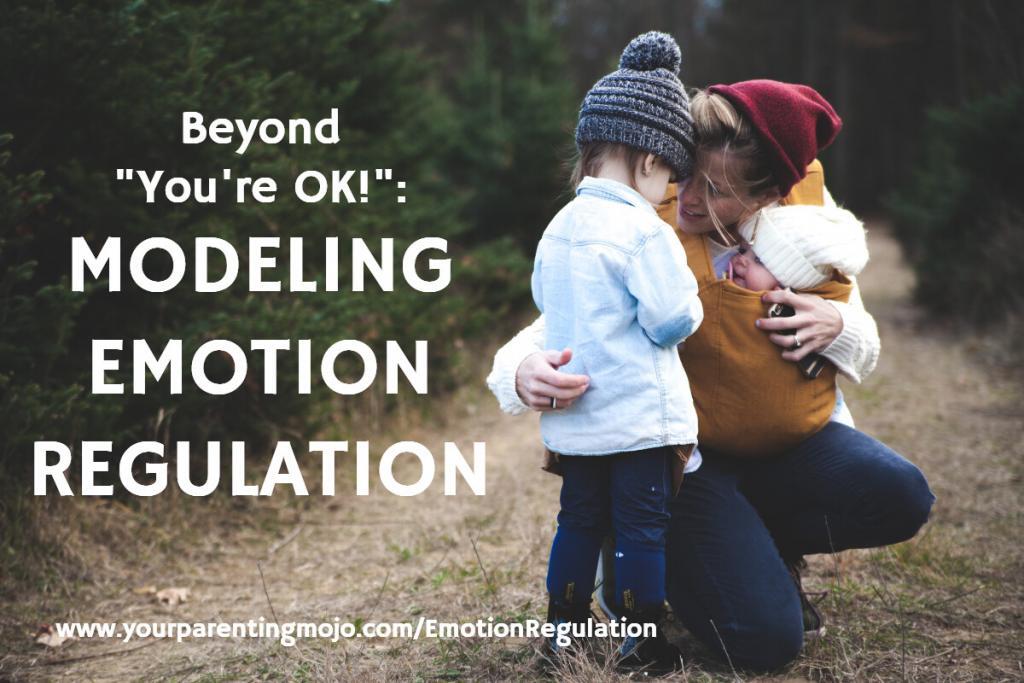
056: Beyond “You’re OK!”: Modeling Emotion Regulation
I hear a huge crash.
It’s my favorite glass vase. I hear “I didn’t mean to hurt it, Mommy! It just fell!” as I run full-pelt from the other end of the house.
It was a family heirloom passed down by my grandmother. I’ve asked her not to touch it a hundred times. I am beyond furious. “Please don’t be mad, Mommy. It was an accident.”
I clench my teeth. “I’m not mad.”
_______________________________________________________
What does my daughter learn from this exchange? How does my own emotional regulation affect what she learns about how to regulate her own emotions? We’ll learn about this in today’s episode.
Note that this episode is the second in the ill-fated experimental short episodes – we’ll be back to the regular length hereafter! In case you missed it, the first episode in this series was Three Reasons Not To Say You’re OK.
Taming Your Triggers
If you need help with your own big feelings about your child’s behavior, register for the Taming Your Triggers workshop.
We’ll help you to:
- Understand the real causes of your triggered feelings, and begin to heal the hurts that cause them
- Use new tools like the ones Katie describes to find ways to meet both her and her children’s needs
- Effectively repair with your children on the fewer instances when you are still triggered
Click the banner to learn more!

Other episodes mentioned in this show
- How parenting affects child development
- The impact of divorce on a child’s development
- How to scaffold children’s learning to help them succeed
Jump to highlights
00:00 The story of the broken vase, and a listener’s question about staying “unruffled”
03:16 Two strategies adults use to cope with stress: reappraisal versus suppression
06:40 Why a parent’s emotional suppression limits a child’s own reappraisal skills
09:03 Reimagining the vase story using reappraisal instead of suppression
12:13 Practical takeaways: the power of a pause before responding
References
Bariola, E., Hughes, E.K., & Gullone, E. (2012). Relationships between parent and child emotion regulation strategy use: A brief report. Journal of Child and Family Studies 21(3), 443-448.
Butler, E.A., Egloff, B., ,Wilhelm, F.H., Smith, N.C., Erickson, E.A., & Gross, J.J. (2003). The social consequences of expressive suppression. Emotion 3(1), 48-67.
Christenfeld, B., Gerin, W., Linden, W., Sanders, M., Mathur, J., Deich, J.D., & Pickering, T.G. (1997). Social support effects on cardiovascular reactivity: Is a stranger as effective as a friend? Psychosomatic Medicine 59, 388-398.
Cohen, S., & Wills, T.A. (1985). Stress, social support, and the buffering hypothesis. Psychological Bulletin 98(2), 310-357.
Gershoff, E.T., & Grogan-Kaylor, A. (2016). Spanking and child outcomes: Old controversies and new meta-analyses. Journal of Family Psychology 30(4), 453-469.
Gottman, J.M., & Levenson, R.W. (1992). Marital processes predictive of later dissolation: Behavior, physiology, and health. Journal of Personality and Social Psychology 63(2), 221-233.
Gross, J.J., & John, O.P. (2003). Individual differences in two emotion regulation processes: Implications for affect, relationships, and well-being. Journal of Personality and Social Psychology 85(2), 348-362.
Gunzenhauser, C., Faasche, A., Friedlmeier, W.& von Suchodoletz, A. (2014). Face it or hide it: Parental socialization of reappraisal and response suppression. Frontiers in Psychology 4, 992.
Kiel, E.J. & Kalomiris, A.E. (2015). Current themes in understanding children’s emotion regulation as developing from within the parent-child relationship. Current Opinions in Psychology 1(3), 11-16.
Kopystynska, O, Paschall, K.W., Barnett, M.A., & Curran, M.A. (2017). Patterns of interparental conflict, parenting, and children’s emotional insecurity: A person-centered approach. Journal of Family Psychology 31(7), 922-932.
Krantz, D.S., & Manuck, S.B. (1984). Acute psychophysiologic reactivity and risk of cardiovascular disease: A review and methdologic critique. Psychological Bulletin 93(3), 435-464.
Lansbury, J. Unruffled Parenting. Author. Retrieved from http://www.janetlansbury.com/2015/08/respectful-parenting-podcasts-janet-lansbury-unruffled/
Laurenceau, J.P., Barrett, L.F., & Pietromonaco, P.R. (1998). Intimacy as an interpersonal process: The importance of self-disclosure, partner disclosure, and perceived partner responsiveness in interpersonal exchanges. Journal of Personality and Social Psychology 75(5), 1238-1251.
Meeren H.K.M., van Heijnsbergen, C.C.R.J., & de Gelder, B. (2005). Rapid perceptual integration of facial expression and emotional body language. PNAS 102(45), 16518-16523.
Pennebaker, J.W. (1989). Confession, inhibition, and disease. Advances in Experimental Social Psychology 22, 211-244.
Rutherford, H.J.V., Wallace, N.S., Laurent, H.K., & Mayes, L.C. (2015). Emotion regulation in parenthood. Developmental Review 36, 1-14.
Tiedens, L.Z. (2001). Anger and advancement versus sadness and subjugation: The effect of negative emotion expressions on social status conferral. Journal of Personality and Social Psychology 80(1), 86-94.
Tromssdorff, G., & Heikamp, T. (2013). Socialization of emotions and emotion regulation in cultural context. In S. Barnow & N. Balkir (Eds.), Cultural variations in psychopathology: From research to practice (pp.67-92). Cambridge, MA: Hoegrefe Publishing.
Rime, B., Mesquita, B., Boca, S., & Philippott, P. (1991). Beyond the emotional event: Six studies on the social sharing of emotion. Cognition and Emotion 5(5-6), 435-465.
Roomer, L., Williston, S.K., & Rollins, L.G. (2015). Mindfulness and emotion regulation. Current Opinion in Psychology 3, 52-57.
Wang, M-T., & Kenny, S. (2015). Longitudinal links between fathers’ and mothers’ harsh verbal discipline and adolescents’ conduct problems and depressive symptoms. Child Development 85(3), 908-923.
Also published on Medium.
Transcript
We want our children to have the best chance to live fulfilling lives, but can you keep up with all the books and scientific research on parenting and fit the information into your own philosophy on how to raise kids? Welcome to Your Parenting Mojo, the podcast that does the work for you by investigating and examining respectful, research-based parenting tools to help kids thrive. Now, welcome your host, Jen Lumanlon. Hello, and welcome to the Your Parenting Mojo podcast. I want to start this episode by telling you a short story. I hear a huge crash. It's my favorite glass vase. I hear, I didn't mean to hurt it, mama. It just fell as I run full pelt from the other end of the house. It was a family heirloom passed down by my grandmother. I've asked her not to touch it a hundred times, and I am beyond furious. Please don't be mad, mama. It was an accident. I clench my teeth. I'm not mad, I say. So recently we talked through the first of the three ways that children learn about emotional regulation through our direct teaching. Things like saying, you're okay, when we can see they're clearly not. If you think about it, telling a child you're okay is an attempt to get them to suppress their emotions. While saying things like, I'm not mad, through clenched teeth, are an attempt to suppress yours. Now, why might we not want to do that? Recently, one of my podcast listeners emailed me with a question. He said, some parenting approaches slash experts advocate for remaining unruffled with children, and that we shouldn't let children's emotions impact our own, which allows us to stay unruffled. While others argue that parents should have and show their true feelings, because this is how children learn to understand their own and others' feelings, which is ultimately better for the child's development. When I started researching the answer to this question, I realized that it constitutes the second of three ways that children learn about emotional regulation through parental modeling. As I mentioned in our last episode in this series, the third way that children learn about emotional regulation is through the emotional climate of the family. And you can see our previous episodes on how parenting impacts child development, as well as impacts of conflicts and divorce on children for more information on that. So what can scientific research tell us about parental modeling of emotions? Well, we need to extrapolate a bit here because most of it has been done on couples and college students. We do know that social sharing of emotion through narrative and story is an important social skill, especially following an emotional episode. And self-disclosure is a critical component of intimate relationships. In a marriage, the practice of stonewalling, so suppressing the verbal, emotional, and backchannel behaviors like head nodding and eye contact, is linked to reduced marital satisfaction. Adults typically use one of two strategies to cope with stressful situations. They reappraise the situation to view it in a less stressful way, perhaps by taking an optimistic attitude, reinterpreting what they find stressful, and trying to get out of a bad mood rather than wallowing.
Jen Lumanlan:in the tone that I imagine a:Jen Lumanlan:This is why a parent's emotional suppression is directly linked to less use of reappraisal strategies by children. Some say a mother's influence is more important. Other researchers say it's the father's. Perhaps we agree that both are important because they've watched their parents suppress emotions and they need to see reappraisal modeled to know how to use it. The old adage to be the person you want your child to become is literally true. It's hard to believe that something as simple as responding authentically to your child and allowing your child to respond authentically to you can have such a profound effect, but it really does. So what should parents do in the heat of the moment? If you'd like to try to model emotional reappraisal rather than emotional suppression for your child, you can consider taking the following steps. Firstly, learn some common signs of tension that might indicate you're about to get angry, whether it's because your child was careless and fell over, which is going to make you late if they don't hurry up, or for other reasons. These might include tightness in your throat or chest, shallow or rapid breathing, clenching your jaw, and or having negative thoughts about yourself or your child. When you notice these signs, pause, take a single breath and ask yourself how you can best respond to your child in a way that honors both your and your child's needs. If your child fell, look for their reaction. If they're not crying, perhaps you don't need to say anything at all and a shared look would suffice. If possible, reframe your emotions into a more empathetic state, which assumes the child's best intention. So she was interested in the vase. She was probably trying to be gentle with it and it slipped. She didn't mean to break it. Then respond in a way that displays your true emotions, but doesn't minimize or try to suppress your child's emotions. So let me reimagine the story that I told at the beginning of this episode. I hear a huge crash. It's my favorite glass vase. I hear, I didn't mean to hurt it, mama. It just fell as I run full pelt from the other end of the house. It was a family heirloom passed down by my grandmother. I've asked her not to touch it a hundred times. I pause and take a deep breath and use that time to set an intention. The two things that are more important right now than the vase, which cannot be brought back is firstly, helping my daughter to learn something from this experience. And secondly, using it to positively rather than negatively impact our relationship.
Jen Lumanlan:So I say, oh, Carys, the vase is broken. That makes me so sad. Which is true because my anger turned to sadness during that one breath pause. It was a gift from my grandma. What happened? And then she might say, I was just touching it because it was so pretty and it fell. And then very gently I could say, didn't you remember that we talked about not touching it? And then she would probably say, yes, but it was so pretty. And then she would probably start crying if she wasn't crying already. And then I could say, oh dear, do you want to come sit on my lap? And then she could just sit there for a few minutes and I would hold her and comfort her and she would cry. And I would say something like, I'm here for you, but I wouldn't make any attempt to stop her from crying. And then after her crying decreases in intensity, I could say, can you tell me why you're crying? And she might say, I'm sad because the vase broke and I thought you would yell at me. And then I could say, I'm sorry you thought I would yell at you. I know I sometimes do. And I really do try not to. It scares you when I yell at you, right? And she'd say, yeah. And I would say, well, I'm trying to do better. I am really disappointed the vase got broken because I love my grandma and I don't have many things to remember her by. How are you feeling right now? And she would probably say, I'm feeling sad. And then I could say, I'm sorry you're sad. Is there anything I can do to help you feel better? And as we discussed in the last episode, for very young children, you might have to supply a couple of options that they can choose between because they may not be able to think of or articulate their own ideas, particularly in an emotional moment. So then she would say, would you show me your grandma's picture in your photo album from when you were a little girl? Because my daughter does love to do that. And I could say, I would love to do that. Should we get the one from when we visited her when you were a tiny baby and you burped when she was holding you and it made her laugh? And she would probably say, yeah. And she would run off and go and get the album. When you have some more time to think about this, when you're not in the thick of the moment, you can consider that reappraising your own emotions before you get stressed by something your child is doing or saying is a really powerful technique, but it can be really hard to do in the moment. The pause before responding is absolutely critical to giving you the time to do this. So to get in the habit, you could consider instituting a pause before you respond to your child in other ways as well. For example, before you say no to your child, this can allow you a moment to decide whether you really do need to say no or whether you could say yes instead. Secondly, we all know that spanking neither increases children's compliance with parents nor supports their emotional development. Then we were told that yelling is just as bad as spanking by researchers. Now we know that if we get angry and cover it up, our child might not learn how to regulate their own emotions. If you find yourself getting angry a lot, do try and get help for yourself. Don't forget to put on your own oxygen mask before helping others. And the final hint is to cultivate a practice of mindfulness. This was the same as we mentioned in the last episode on this topic, being present in and experiencing the moment right now, which can help you to institute that all-important pause as well as develop your own healthy emotional regulation skills. Thanks again for listening. The references for today's episode can be found on my website at yourparentingmojo.com forward slash reappraising.
Jen Lumanlan:And please do drop me a line at jen@yourparentingmojo.com if you have any thoughts about this trial of a shorter episode format. Thanks for joining us on this episode of Your Parenting Mojo. Please subscribe, rate, and review the show on iTunes and sign up for our mailing list at yourparentingmojo.com to receive a free gift. Seven relationship-based strategies to support your children's development while making parenting just a little bit easier on you. For more respectful, research-based parenting ideas to help kids thrive, we'll see you next time on Your Parenting Mojo.

About the author, Jen
Jen Lumanlan (M.S., M.Ed.) hosts the Your Parenting Mojo podcast (www.YourParentingMojo.com), which examines scientific research related to child development through the lens of respectful parenting.
Listening to your example of a healthy expression of emotions with your daughter (after the breaking the base) brought me to tears. I was not parented in a gentle way and I have committed myself to breaking the cycle of emotional abuse with my 17 month old. I’ve been using mindfulness meditation and therapy since pregnancy to work process my childhood and develop the skills I need to ensure a healthy relationship with my girl. I’ve read a lot so far, including transcripts of exchanges like the one you present. But hearing it out loud was very powerful. I felt sorrow for myself as a child for not being spoken to this way. And I felt excitement and joy and hope for my daughter as I have vowed to teach and model emotional regulation. Thank you for this experience. I love your podcast. It is exactly what I need. I went on and reviewed you on iTunes after I dried my tears and finished hugging my daughter.
With love and gratitude,
Ashlee Barwell
Ashlee, thank you so much for sharing your story. I wasn’t parented like this either. I’m working on an episode on intergenerational parenting issues and will reach out to see if you have any questions I can try to answer.