

Episode Summary 09: Is Your Child’s Diagnosis Reliable? The DSM Explained
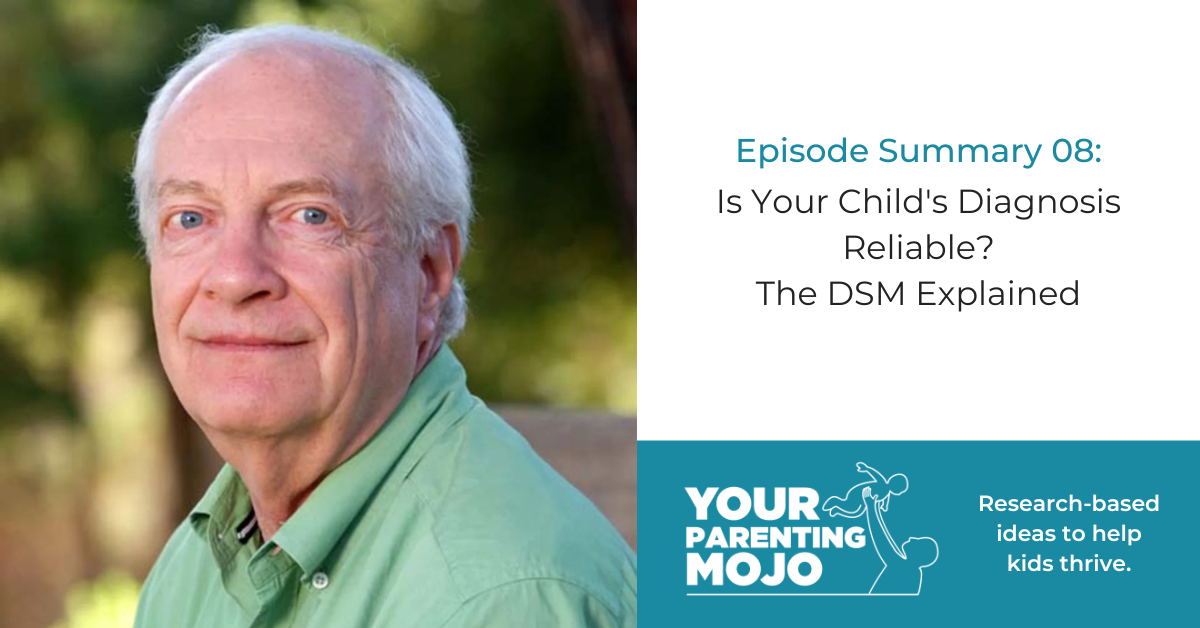
When a doctor hands your child a diagnosis, it can be a relief – finally, an explanation for their behavior! But sociologist Dr. Allan Horwitz has spent decades studying how psychiatric diagnoses are made, and what he’s found raises serious questions about how much weight that label should carry.
In this episode, Dr. Horwitz walks through how the Diagnostic and Statistical Manual (DSM) – the manual that defines every mental health diagnosis – was built less on scientific research than on professional politics, institutional pressure, and the practical needs of insurance companies.
He traces how depression went from a diagnosis given to a small fraction of the population to one of the most common diagnoses in the world, and explains exactly what happened to reliability when the DSM-5 was tested in real clinical conditions.
He also looks at how the same behaviors get labeled very differently depending on a child’s age, race, class, and cultural background – and why that matters for every parent trying to figure out whether a diagnosis is actually helping their child.
This episode won’t tell you to reject diagnosis outright. But it will give you the critical knowledge to ask better questions when a label is offered for your child.
Questions This Episode Will Answer
What is the DSM and why does it matter for my child?
The DSM is the manual psychiatrists and psychologists use to diagnose every mental health condition. It determines what insurance will cover, what services your child can access, and what label follows them through school and into treatment.
Who created the DSM and who controls it?
The American Psychiatric Association publishes the DSM, but its diagnostic criteria were largely shaped by a small group of people – predominantly white men with ties to pharmaceutical companies – whose process looked more like sausage-making than science.
Why is DSM-5 criticized by researchers?
Field trials for DSM-5 showed reliability had actually declined from earlier editions. For some of the most common diagnoses, including major depression and generalized anxiety, agreement between clinicians was barely better than chance.
Is a psychiatric diagnosis actually reliable?
Reliability means two different clinicians would give the same patient the same diagnosis. Research on the DSM-5 shows this is far less consistent than most parents assume – and a reliable diagnosis still isn’t necessarily a correct one.
Are children being overdiagnosed with mental health conditions?
Research shows that the youngest children in a classroom are significantly more likely to receive a psychiatric diagnosis than their older classmates, especially for ADHD – suggesting that what’s being measured is developmental maturity, not a mental disorder.
Does the DSM apply equally to children from different cultural backgrounds?
The DSM was built on a Euro-centric framework, and critics argue it pathologizes behaviors that are normal or valued in many Global Majority cultures. This has real consequences for how children from different backgrounds get diagnosed and treated.
Why do mental health diagnoses focus on the individual instead of their circumstances?
The DSM is deliberately designed to identify disorders within a person rather than look at the conditions around them. It makes sense that a person going through a relationship breakup might feel sad, angry, and/or uncertain about the future. That doesn’t mean they’re ‘depressed.’ Dr. Horwitz explains what that choice costs – and who pays the most.
What You’ll Learn in This Episode
- Why diagnosis serves the psychiatric profession and the insurance system in ways that don’t always help the person being diagnosed
- How the shift from psychoanalysis to the DSM-3 in 1980 dramatically expanded who could be diagnosed with depression – and why that shift was driven by professional rivalry, not new science
- What reliability and validity actually mean in psychiatric diagnosis, and why the numbers from DSM-5 field trials alarmed even people inside the system
- How the people who built the DSM criteria handled disagreements – and why the process Dr. Horwitz describes is so different from what most parents imagine
- Why a child’s birthdate relative to their classmates can predict their likelihood of receiving a psychiatric diagnosis
- How socioeconomic status shapes not just whether a child gets diagnosed, but when they take their medication and why
- What the removal of the bereavement exclusion in DSM-5 tells us about the direction the system is heading
- Why the same behaviors that get a child diagnosed with ADHD in the US might get that child’s family into therapy in the UK instead
- What Dr. Horwitz thinks would actually make a difference for children’s mental health – and why the most effective interventions are rarely the ones being offered
Your Triggers Aren’t a Diagnosis. But They’re Worth Understanding.
This episode makes the case that the mental health system focuses on only what’s happening inside a person instead of looking at the broader circumstances around them – mostly to sell us more drugs.
In reality, our struggles are a combination of the challenges we’ve experienced in the past (and how we’ve learned to handle them), and our situation today. We have to see both pieces to make sense of where we’ve been, and learn new tools for what’s happening now.
When your child’s behavior sends you into a reaction you regret later, a diagnosis or prescription may not help as much as understanding what’s underneath that reaction and where it came from.
That’s exactly what the Taming Your Triggers workshop is built to help you do. In 10 weeks, you’ll learn why you react the way you do, how to meet your own needs so you have more capacity for your kids, and how to respond from your values instead of your history.
Click the banner to learn more

Jump to highlights:
02:14 Introduction to today’s episode
03:44 Why do we diagnose mental illness, and whose interests does the diagnostic system serve? Dr. Allan Horwitz explains that diagnoses maintain psychiatry’s legitimacy and prestige as a medical profession, regardless of the knowledge behind each diagnosis.
05:10 Patients now often expect specific diagnoses before treatment even begins.
14:27 People experiencing sadness from job loss or relationship endings can benefit from medication, but to get prescriptions, you need a diagnosis of a disorder, even when the response is completely expectable given the circumstances.
15:39 The DSM locates suffering within individuals rather than examining broader social circumstances.
19:00 Wrapping up.
21:25 An open invitation to join the Parenting Membership.
Transcript
Why do we diagnose? What's the purpose of putting a label on someone's experience, someone's suffering?
Dr. Allan Horwitz:I think basically psychiatry and by implication the other mental health professions see themselves either directly or indirectly as part of medicine and diagnoses are perhaps the central aspect of any medical specialty and they're really essential to maintain the not just the prestige but the legitimacy of any profession and certainly psychiatry sees itself as a medical field and therefore diagnoses are absolutely essential regardless of the degree of knowledge that is behind each diagnosis.
Jen Lumanlan:Wow, it's kind of interesting that you're starting with the benefits to the psychiatric profession rather than the benefits to the person who's being diagnosed which is exactly where I thought you would go but wow right?
Kelly:Hi, this is Kelly Peterson from Chicago, Illinois. There's no other resource out there quite like Your Parenting Mojo which doesn't just tell you about the latest scientific research on parenting and child development but puts it into context for you as well so you can decide whether and how to use this new information. If you'd like to get new episodes in your inbox along with a free infographic on 13 reasons your child isn't listening to you and what to do about each one, sign up at yourparentingmojo.com/subscribe. If you'd like to start a conversation with someone about this episode or you know someone who would find it useful, please do forward it to them. Thank you so much.
Jen Lumanlan:Hello and welcome to the Your Parenting Mojo podcast. Today I'm talking with sociologist Dr. Allan Horwitz about something fundamental in our series on mental health which is why do we diagnose mental illness at all and whose interests does the diagnostic system actually serve? We focus on the question was the Diagnostic and Statistical Manual, the DSM, designed to help patients or to serve other purposes? Dr. Horwitz has documented that the DSM-3, which was the nineteen eighty revision that changed psychiatry from psychoanalysis-based to an apparently scientific profession, was primarily built for insurance reimbursement and professional legitimacy. Committee members were told not to pursue scientific rigor because it would “give insurance companies an excuse not to pay us”. Dr. Horwitz's research with Dr. Jerome Wakefield shows that emotions like sadness are designed to respond to loss when you lose a job or a relationship. Feeling sad is not a disorder. It's your emotional system working the way it's supposed to work but the DSM labels those normal responses as depression. As you listen, notice how Dr. Horwitz describes the purpose of diagnosis. He starts with this professional legitimacy not benefit to patients and pay attention to his point that to get prescriptions you need a disorder which reveals this bind that we're in. So welcome Dr. Horwitz, it's so great to have you here.
Dr. Allan Horwitz:Yes, well nice to be here.
Jen Lumanlan:So I wonder if we can start with a question that seems kind of obvious when you think about it, maybe it isn't. Why do we diagnose? What's the purpose of putting a label on someone's experience, someone's suffering?
Dr. Allan Horwitz:Well I think basically psychiatry and by implication the other mental health professions really see themselves either directly or indirectly as part of medicine and diagnoses are perhaps the central aspect of any medical specialty and they're really essential to maintain the not just the prestige but the legitimacy of any profession and certainly psychiatry sees itself as a medical field and therefore diagnoses are absolutely essential regardless of the degree of knowledge that is behind each diagnosis.
Jen Lumanlan:Wow, it's kind of interesting that you're starting with the benefits to the psychiatric profession rather than the benefits to the person who's being diagnosed which is exactly where I thought you would go but wow, great.
Dr. Allan Horwitz:Yeah well the benefits to the person who's getting the diagnosis is well for one thing I mean most people rely on third parties to pay for their treatment and no third party will pay for treatment unless there's a diagnosis so certainly that's at the most basic level what patients are getting out of it and secondly I think patients expect to get diagnoses in the past decade or two they even know what diagnoses they will be getting even before they start treatment and now I think perhaps parents bring their children in and the parents pretty much know what diagnosis they expect to get.
Jen Lumanlan:Yeah so it's less about sort of information for the person who's receiving the diagnosis and it's really kind of an administrative thing right it frees up money for treatment it provides legitimacy to the psychiatric profession it creates funding sources for researchers to study things it's like there's a lot of these administrative things that are happening around it rather than there's a real benefit to the person who's receiving the diagnosis necessarily.
Dr. Allan Horwitz:Yeah, I mean it's absolutely essential in practical terms whether the extent to which it is you know based on knowledge and actually applies to the particular individual is a whole other question.
Jen Lumanlan:Yeah okay and I wonder if we can trace some of those issues using depression as an example and I know that the way depression is diagnosed has changed a lot in the last 50, 60, 70 years or so we have an in-depth conversation with Bob Whittaker coming up on that and I know I know you've worked with him in the past but I wonder if you can trace just sort of the way depression was something that was diagnosed in two or three percent of the population to now it's much more common than that.
Dr. Allan Horwitz:Yeah, well back before the DSM-3 which was implemented in nineteen eighty before that time psychoanalysis would have been the dominant perspective in psychiatry and in other mental health professions as well. Depression was not central to psychoanalysis it was based on anxiety was the all-encompassing tradition and depression would have played at best a very minor role and to the extent it did it would have focused really major depressions very serious often debilitating sorts of symptoms that only a relatively small number of the population would have experienced. That totally changed in nineteen eighty and the reason it changed was the DSM-3 perhaps its major goal was to really overthrow psychoanalysis. The implementers of the DSM-3 in particular Robert Spitzer saw a need to I don't think destroy is too strong a word but to destroy psychoanalysis and to do that they had to destroy anxiety and the way they went about doing that was to split anxious conditions into a number of subcategories none of which dominated the other. So I mean so anxiety was chopped up into well not just well generalized anxiety, social, phobias, particular phobias, just a number of different kinds of conditions. In contrast they did exactly the opposite to depression where the criteria were loosened enough so that not only what used to be psychotic depression certainly would be included but just about any degree of sadness that could have happened after you know any expectable kinds of things people undergoing a divorce or a relationship split up people who've lost their jobs that the criteria only required a two-week duration so that it would be expectable that a very large proportion of the population would experience depression as its newly defined in the DSM-3 and so that is exactly the opposite of what they did with anxiety. Unsurprisingly you have rates of depression soaring and what rates of any individual anxiety condition are declining the overall anxiety category is mildly increasing but nowhere near the extent to which depression is increasing and the only exception that is made is bereavement that is after somebody has died I mean naturally people are going to experience sadness inability to sleep difficulties, appetite difficulties I mean these are natural reactions to bereavement so the DSM-3 does exclude bereavement but it doesn't exclude any other kind of life. And even that in the DSM-5 in two thousand fifteen bereavement exclusion goes as well and that even bereaved people are now considered to be depressed and not bereaved.
Jen Lumanlan:Yeah and I know there was a huge disagreement over that bereavement exclusion because you've mentioned some other potential causes of people potentially having a hard time right they go through a divorce they lose their job and the DSM purports to be sort of what they call theory neutral right there's they don't look at well why is the person experiencing this these feelings and with the bereavement exclusion they're like oh yeah well sometimes it's okay to look at why they're having these feelings but unless somebody died the rest of the stuff is not really relevant. What do you make of this whole sort of theory neutrality and the idea that we shouldn't look at the causes of why people are having these feelings?
Dr. Allan Horwitz:Well I mean it's one thing to have a theory of why people develop some sort of mental disorder but it's a whole another thing to explore the immediate causes of what led them to develop their symptoms and it's often just very apparent for why someone would be depressed, you don't need any elaborate theory to know that if people are you know undergoing you know a breakup of a romantic relationship that it's completely unsurprising that they would experience depression as well as anxiety about you know what's going to come next. And so the problem for the people involved with the DSM is well if you push that view well pretty soon you're going to have far fewer patients and yet rates of disorder are going to be in steep decline and you know it's not professions in general don't operate to diminish their client base, they do the opposite which is to increase their client base and the depression diagnosis was ideal for that with the exception of bereavement which they finally got rid of in two thousand thirteen.
Jen Lumanlan:Right because if we can say well, you're not depressed because you lost your job you're not depressed because you their relationship ended. Then all of a sudden, the number of people who are actually depressed shrinks rapidly is what you're saying is that right?
Dr. Allan Horwitz:Yeah, yes and certainly people who get depressed in situations we would naturally expect them to be. I mean romantic breakups job losses bereavement can benefit from taking drugs for example I mean that can help. The problem is to get prescriptions you need a disorder I mean so in a sense it's hypocritical but in another sense it's completely expectable.
Jen Lumanlan:Yeah, I guess I'm also curious from your perspective as a sociologist though right, you're looking much broader than the individual and I want to know what you think about this idea of locating suffering within the individual instead of looking at the broader systems that the individual lives within. How do you think about the DSM in relation to an individual suffering versus the broader environment?
Dr. Allan Horwitz:Yeah well, the DSM is certainly not a manual that a sociologist would write that as you say I mean we're really situate individuals within the broader social and cultural you know frameworks in which they operate. The mandate of psychiatry and the other mental health professions is very different, they're just inherently much more individual focus and they really have no choice but to be I mean that's what gives them their legitimacy. And I wouldn't expect a psychiatric manual I mean they could do more to bring in the social and cultural considerations for sure but you wouldn't expect it necessarily individual focus because that's what mental health professions deal with are individuals.
Jen Lumanlan:Doesn't it dramatically shift the way we might think about supporting the person right? I'm just thinking again back to that potential single parent who's serving lunch to the folks on that committee and Bob Spencer and you know if we perceive her as depressed we give her antidepressants and tell her you know hope you feel better but if we see all of these other social circumstances that she's surrounded by, then it becomes more appropriate to try to change those certain social circumstances rather than medicate her and tell her you know the problems in your brain and when your brain is fixed then you won't feel depressed. So what do you think about the idea that by using this diagnostic system we are focusing on an individual suffering when actually that suffering exists within the system and we might do better to change the system?
Dr. Allan Horwitz:Yeah, well in an abstract way I would absolutely agree with that. In a more concrete way, I think therapists are quite limited as to what they can do to change the situations and circumstances. They can offer advice, they can offer drugs, they can do things to help the individual but there's not really very much they can do to change the circumstances of say the person that you mentioned.
Jen Lumanlan:Okay what do you wish they could do?
Dr. Allan Horwitz:Well, you know ideally would get that individual you know a better job, better working conditions that you know help with their child care. I mean the kinds of things that really have very strong impacts on any individual's mental health but is not so much in the purview of therapy as it's practiced now.
Jen Lumanlan:Yeah, could be an interesting shift to consider about what is in the purview of a therapist and the psychiatric system. So that was sociologist Dr. Allan Horwitz talking about why we diagnose. So here's a recap of what we heard. Diagnosis exists primarily to maintain the psychiatric profession's legitimacy and enable insurance billing. The DSM-3 released in nineteen eighty deliberately broadened depression criteria to capture just about any degree of sadness after common life events. As Horwitz put it professions in general don't operate to diminish their client base and the subsequent revisions to the DSM have not changed this trajectory. The bereavement exclusion showed that the psychiatrists understood that context matters, that grief is normal not pathological but they never extended that logic to job loss, to divorce, to poverty and of course even the bereavement exclusion was removed in two thousand-thirteen. When I asked about addressing circumstances instead of just medicating individuals, Horwitz acknowledged that would be ideal right better jobs, child care support, the things that have really strong impacts on mental health but he said that's not so much in the purview of therapy as it's practiced now. So what does this mean for you?
Jen Lumanlan:Well first when a professional suggests the diagnosis you might ask is this a disorder or a normal response to difficult circumstances? The system needs a diagnosis for billing but that doesn't always mean the label is accurate. Secondly, I want you to know that mental health diagnoses often happen in a 20-minute intake in a primary care practitioner's office not through the careful evaluation with a mental health professional over multiple sessions that should happen and this creates both some risks and some opportunities. The wrong diagnosis can mean that you or your child gets the wrong treatment and if a primary care practitioner thinks your child has ADHD but actually it's anxiety then stimulants could be a disaster. But you can also use diagnosis strategically to access support. It's pretty easy to get a depression diagnosis and from there you may be able to access quite a bit of support that wouldn't be available without the “depression”.
Jen Lumanlan:Third consider whether treatment addresses the actual problem. So if your child is feeling anxious because of real threats in their environment medicating the anxiety doesn't fix the circumstances. The mental health system was built to serve professional interests not your interests or your family's interests and knowing that helps you to navigate it strategically. In the full conversation we talk about how childhood diagnosis emerged as a business opportunity for pharmaceutical companies, how the DSM-3 was created through committee arguments over deli lunches rather than scientific processes and how diagnosis patterns differ by race and class. The full episode is immediately available when you join the parenting membership which is now open for year-round for enrollment at yourparentingmojo.com/parentingmembership. Thanks so much for listening and I look forward to continuing this series with you soon.
Kelly:Hi I'm Kelly Peterson from Chicago, Illinois. I'm a Your Parenting Mojo fan and I hope you enjoy the show as much as I do. If you found this episode especially enlightening or useful you can donate to help Jen produce more content like this and also save us both from those interminable mattress ads you hear on other podcasts. Then you can do that and also subscribe on the link that Jen just mentioned. Thanks for listening.

About the author, Jen
Jen Lumanlan (M.S., M.Ed.) hosts the Your Parenting Mojo podcast (www.YourParentingMojo.com), which examines scientific research related to child development through the lens of respectful parenting.