
SYPM 005: Getting Confident About the Decision to Homeschool
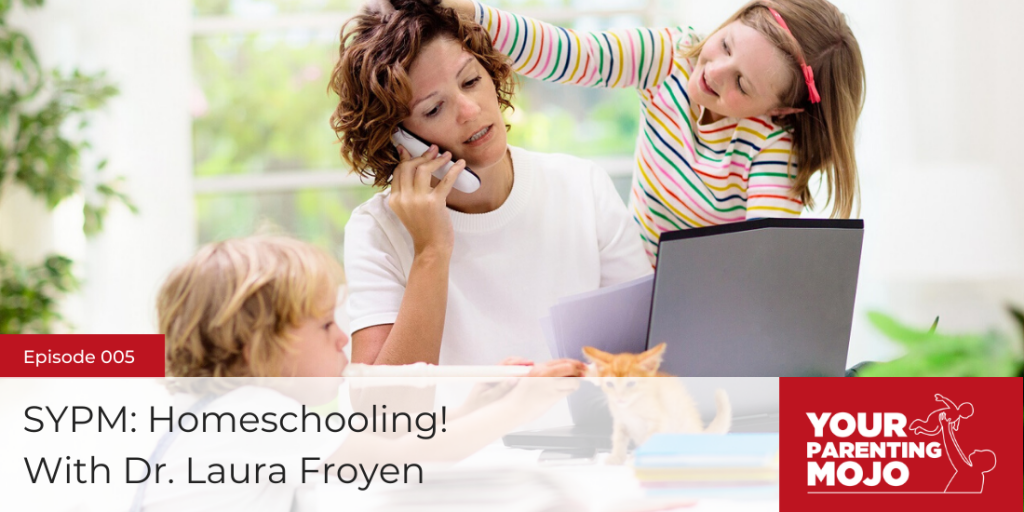
School districts are starting to make plans to reopen – some with sneeze guards between desks; some on reduced schedules to accommodate the amount of space needed for social distancing, while some are going online-only for the Fall semester.
How will your child cope with this?
Did your child adapt well to online learning when schools closed? Will they find it relatively easy to see their friends but not be close to them? There are some children for whom these arrangements work well, but for others parents see big trouble ahead.
What are the options? Even if you’ve never considered homeschooling as a realistic option in the past, it might now be the tool that gets you through the next few months. But are you terrified that you don’t know everything your child needs to know? And how could it possibly work for your family?
Join me for a conversation with Dr. Laura Froyen, who is considering homeschooling her two children next semester – even though she has a Ph.D. in Human Development and Family Studies and wrote a dissertation on supporting young children in learning to read, she’s nervous that she doesn’t know everything she needs to know – so if you’re worried about this you’re certainly not alone!
We look at what we know about how long children actually spend learning in school (the answer is going to shock you!), how you can work AND homeschool, and how you can get confident that you really can support your child’s love of learning – even if you know your child will eventually go back to school.
Click the banner to learn more about The Confident Homeschooler:
Jump to highlights
01:30 Introduction to the episode and guest Dr. Laura Froyen
06:24 Letting go of the idea that someone else knows the “right” things to learn
17:15 Rethinking math: using curriculum as a tool
21:39 Willpower struggles, and why an imposed curriculum won’t work for this family
30:23 How much of the school day is actually spent learning
32:52 Making the schedule work: creative approaches from other homeschooling families
36:05 What the Confident Homeschooler course covers
39:32 Getting a reluctant partner on board with homeschooling
Transcript
Hi, I'm Jen and I host the Your Parenting Mojo podcast where I critically examine strategies and tools related to parenting and child development that are grounded in scientific research and principles of respectful parenting. In this series of episodes called Sharing Your Parenting Mojo, we turn the tables and hear from listeners. What have they learned from the show that's helped their parenting? Where are they still struggling? And what tools can we find in the research that will help? If you'd like to be notified when new episodes are released and get a free guide to seven parenting myths we can safely leave behind, seven fewer things to worry about, subscribe to the show at yourparentingmojo.com. You can also continue the conversation about the show with other listeners in the Your Parenting Mojo Facebook group. I do hope you'll join us. Welcome to Sharing Your Parenting Mojo. We are here with Dr. Laura Froyan today to discuss the topic of homeschooling. She's thinking about whether and how to do it over the next few months. And as we were chatting about it, we figured that some of the things that she's thinking about right now are probably similar to some of the things that other parents are thinking about too. And so we thought, why not just get on a call and discuss them live and share what we're thinking and what we're learning with other people as well. So that's kind of what we're going to do today. So welcome, Laura. Do you want to tell us a bit about yourself and your background first?
Laura:Absolutely. Thanks for having me and agreeing to answer my questions, Jen. So I'm Dr. Laura Froyan. I have my PhD in human development and family studies with a specialization in couple and family therapy. I am currently a peaceful parenting and respectful relationship coach and course creator, but I started right out of grad school in an academic job. And so I did my dissertation on how family processes influence the home learning environment and children's early literacy skills. I am a big believer in delaying reading, teaching active reading, teaching until an age developmentally appropriate age. I've always been deeply curious and, you know, interested in the prospect of homeschooling, but then also not sure if I could ever handle doing it. I have a very strong willed personality. I tend towards control. It's something that being in the respectful parenting world is a constant exercise in letting go for me. My oldest daughter is my best teacher in that way. So I guess I just, I'm so glad that I get the chance to learn from such an expert on this as I'm trying to make a really conscious and informed decision for my family.
Jen Lumanlan:And I think the thing that stuck out to me when you were saying that you wanted to talk about this was that you have a PhD in a related topic and you've studied reading and you still feel unsure about how to best support your child in learning to read. And so when parents are thinking, oh my goodness, I don't know how I'm going to even do this. How do I even support my child? They're not alone, right?
Laura:Even, even you're struggling with this. Like, no, I'm literally an expert in how parents support their kids and learning to read at home. And it's still like, my youngest is five. She just turned five. She had a quarantine birthday and she would be learning to read if she went into 5k in the fall. And I am so intimidated at the idea that, you know, so we homeschool for this next year or for just the fall or kind of whatever it ends up looking like, that she'll go into a school system and not, you know, I'm worried about her being behind because like, it's, we're not in a Scandinavian country where she'd be allowed to learn at her, you know, reading at a developmentally appropriate age. We're in the U.S. And it's the reality of it. And so, yeah, no, of course, parents are not alone in this. I think, like, I think I have a couple of things that are, I'm a completely normal parent. Like, even like all of us are, you know, we all, the experts make mistakes. We have questions, we need support and it's okay.
Jen Lumanlan:Yeah. Yeah. Awesome. Well, thank you for owning that for all of us. And yeah, I definitely mess up too. And we figure things out as we go and we move on. And we adjust and we move on. So there's something so intense about the idea of like teaching your kids.
Laura:Yeah. You know, like, I mean, I feel so much more relaxed about parenting just because I know like we're resilient, like our relationship is resilient, like attachment relationships are built to be resilient and, and open, but there's just something so intense about being charged with our child's learning, you know? And yeah. So I'm looking forward to hearing about that from you about like, what are my options and approaches to homeschooling? What do I need to be thinking about? Yeah.
Jen Lumanlan:Yeah. Okay. Well, let's start there because I think that's a really nice place to start. And it's so interesting what you say about needing to teach my child. And that's such a kind of a Western idea based from someone who has been through school. And I went through school, you went through school. We have this idea that our, the teacher's role is to know everything that there is to know, and they hold the knowledge and the child's job is to kind of wait there with this ready and open mind. And the teacher pours the knowledge out of their jug into the student's vessel. And that's how knowledge is transferred. And so when we're thinking about different approaches to homeschooling, I kind of think on a continuum where traditional schooling is kind of at that end of it is at one end of it. And then there's a whole continuum of potential approaches to the other end where we just see learning as part of life. And so if we kind of talk through what are some of those, well, anything that's curriculum driven is based on this idea that the teacher knows what there is to know and their job is to teach the child. And so when you're doing this at home, I mean, there are books that you can buy of 100 curriculum options and you can go through and you can pick one that covers all the subjects that you want to study. And you can pick, you can just decide to focus on reading and math and just buy those ones. There's any combination of these things that you can do and build your own approach to it. But it is based on the idea that somebody somewhere knows the essential things that children need to know. And you're kind of saying... I don't even believe that.
Laura:I don't even believe that. I know.
Jen Lumanlan:Yeah. And by saying, I'm going to go with that approach, you're essentially saying, I do believe that. I do believe that there is a set of skills that somebody has decreed is the right skills for children to have. And I don't know what that set of skills is. So I'm going to trust somebody else. I'm going to outsource that aspect of the decision making. And so when we do that, what we're doing is we're kind of absolving ourselves of responsibility for needing to know everything our child needs to know. And that can feel good. That can feel like a weight off our shoulders that somebody else has decided this stuff is important. It's not just me. And if I follow this, my child will know what they need to know.
Laura:Yeah. You're speaking to me because I'm such a perfectionist, a recovering perfectionist. I work on my perfectionism every day. But like, I sometimes get paralyzed in doing something new because I want to do it the right way. Yes. I have this concept that there is a right way. And if I could just know the right way and do it the right way, it would be right. And I have dedicated my children's life to trusting them. Why wouldn't I trust them in their education and their learning process? It's just there's this big disconnect. Is there a process of unschooling yourself?
Jen Lumanlan:Yes, there is. There is. Honestly, there is. And that's the reason. You're feeling this cognitive dissonance. That's the word. Yeah. Yeah. I mean, you know one thing. You believe it to be true. And yet you grew up in a system that taught you that another way was the right way to do things. You feel in your bones that trusting your children is the right thing to do. But you were told in school for a couple of decades that you don't trust children, that you tell children what they need to learn. And you were told what you needed to learn. And that's why you're feeling this. That's why you're having such a hard time with this. And we're not alone. I was lucky enough to see this when my daughter, Karis, was, you know, she was two or three at the time. And I thought, OK, well, if I believe this about learning, how can I put her in that environment? And so I had years to figure this out. And now parents are, they're feeling this discrepancy and they have weeks to figure it out. And so.
Laura:There's a sense of urgency.
Jen Lumanlan:woman who lived in the early:Laura:Yeah, so in the past couple months of being at home with my daughter, we, you know, so part of like with my older one, like we're both stubborn. And so like even as much as I kind of wanted to homeschool, like when she turned three, I was like, that's not going to work for us. You know, like we just butted heads. Like even if I ever tried to teach her something, like she knows I'm a feelings doctor. Like that's what we say, like a therapist is a feelings doctor. She would much rather learn about emotions and feelings from her guidance counselor than from her mother. You know, like it just like there was just multiple relationships. Like it got too complicated. Anyway, so when we got into kind of our safer at home order as we were learning at home, her teachers would assignments that she was not interested in doing. And it was this big battle. And my relationship with her was way more important. And so we just didn't do them. And she's a very self-motivated learner. And I sat down with her teacher about two weeks in and I was like, this is not working for us. I'm happy to turn in what she's writing and reading kind of on her own, but I'm not going to make her do these assignments. And her teacher was like, that's totally fine. Like all I care about is that she's writing and reading, really. And like, so today she had some assignments from her teacher where they were given a virtual field trip to an aquarium, like an aquarium in Georgia. And all of her assignments, her math, her reading, and her writing were all based on that. And she like loved it. She loves marine biology. She loves ocean life. She did way more than what was required of her. She filled her notebook with like four small space writing, like full of pages and math problems and like, I mean, just facts and stuff. She did above and beyond what was asked because it was interesting to her. And I just, like, I can see us doing that. What do you want, you know, what do you want to do today? Like, what would be good for you today? Like, I can see us doing that. It's just hard. It's scary to think about, like, especially like with math. I think math is the thing with her because she loves it and she likes learning about it. She likes to do worksheets. I just don't know how that all fits in. I don't know.
Jen Lumanlan:Sorry, that was a lot. Yeah, no worries. And I think that in a way the teacher got lucky that she picked the topic that your daughter is interested in. If she had picked the desert, then your daughter probably would have said, I don't care about the desert. I don't want to do this. I'm not doing it. And you would have been in your usual battle. And the reason that it didn't go that way is because the teacher landed on something that happened to be of interest to her. Probably half the class doesn't care about marine life.
Laura:Yeah, to be clear, I don't battle with those things. Like, I drop the rope and if she says, I'm not doing it, I say, okay, great, we'll do something else. And then she ends up writing a book about the spells that she's inventing for whatever. Oh, sweet. And I just turn that into her teacher.
Jen Lumanlan:Yeah, and there are a lot of parents who think, well, if the teacher is saying you need to do this, you need to do this. And they don't realize that you can say to the teacher, you know what, this isn't working for my child. We're going to do something different. And that probably as long as you're achieving the goal, the teacher's goal is to have your child spend some time doing writing. They actually don't care if you engage with the lesson or not. So that kind of illustrates the idea that when the child is interested in something, they will learn it. And so then you've went on to talk about math and that gets to, do you need a curriculum? I think you had told me that your daughter really likes the way math is taught in school, right? The common core math that they're doing right now.
Laura:I love it too. I wish I had been taught that way. I mean, you know, in the eighties and nineties learning math, like my teachers made me sit on my hands to do math. Yeah. So that I couldn't count on my fingers. And I like went through, I mean, Jen, like my freshman year of college, I filled an entire workbook with the sentence, my ability to do math does not define my worth as a person, like an entire notebook, just writing it out. Like as I was studying for the calculus final that I was failing, you know, like, I mean, like, I don't want that for my kids. And she loves math. She has all these great strategies, but I don't know them. Like I literally don't know the strategy.
Jen Lumanlan:Yeah.
Laura:Nobody ever taught me that. Yeah. Yeah. I'm good at math by the way. Like I'm a statistician. I love stats. I'm good at math. But I was in that message early on in traditional school that I wasn't.
Jen Lumanlan:Yeah. I remember experiencing that as well when I was taking the GMAT to try and get into business school, which ended up not doing for one of the reasons was because I flunked the GMAT because I could get to the answer on a problem. But yeah, kids in American schools had been taught a certain way of getting to the answer fast. And the whole point is to get to the answer fast. You can get onto the next question and get more hard questions. And so I would show it to my husband who grew up in American schools and he would say, Oh yeah, you just do this thing. I was like, nobody ever told me that. And so, yeah, we do, we do have this fear that we're going to miss out on something if we don't follow a curriculum or if we don't do math in the right way or, and I would say that to that, you don't need a curriculum. A curriculum is really for the parents. Peace of mind to know that you're not missing something, but if your daughter loves the way that common core math is taught, then go buy a common core math curriculum. If you just do a Google search for common core math curriculum, you'll get a hundred workbooks pop up and you can order them. And if she's already reading and she really loves doing these workbooks, then that could be a quiet time activity while you work or take personal time or whatever it is. If she needs help, maybe she has the opportunity to bring it to you or to another parent and have some kind of exchange over it. But yeah, I mean, the point is don't ever use curriculum. The point is to use curriculum where it makes sense to use it. So we're not saying that the people who made the curriculum really do know everything that needs to be known, but the, Hey, I'm really interested in this and I really liked the way this is taught and I want to do that. I want to do more of that. So I'm going to use it as a tool rather than as the way. Yes. The way or the framework. Yeah, for sure. And so there is no one right way of teaching math or any subject. There are going to be kids in your daughter's class who can't stand common core math. There will be kids in your class when you were learning math that the way they were teaching it then really resonated with them. And they didn't care if they had to sit on their hands. And so we have this idea that there's one right way to teach reading. There's one right way to teach math when there really isn't, there's the right way for that child. And so if your child loves common core, do common core. If your child can't stand common core math, don't do common core math. I interviewed a math tutor for the course that I have just released called the confident homeschooler. And he recommended some apps and some games that you can play with to increase math literacy. And if you feel as though you're out of your depth in this, the couple of strategies he recommended are firstly, take a look at the end of the workbook to see where you're going to end up. And then secondly, if you wanted to skim read a lesson or two ahead of where your child is, then you're doing what you need to do. You don't need to know everything there is to know about math to be able to teach your child effectively. So does that feel reassuring at all?
Laura:Absolutely. I think that sometimes like, again, my perfectionism gets in the way and I'm like, I'm going to do unschooling. I'm going to do unschooling all the way. You know, I like this idea that I can, I can follow my child's interests and I can support her and I can trust her. And sometimes trusting her will lead us to a curriculum that works for her. Yeah.
Jen Lumanlan:And classes as well. We're not saying never be in a class like environment. If the most effective way to learn something she wants to learn is through a class, sign up for the class. The point is she got to choose. Nobody else said to her, you will learn this because it's important. She decided it was important. That's the critical shift.
Laura:Got it.
Jen Lumanlan:Okay. Yeah. That feels really good. You want to talk about your willpower and her willpower?
Laura:Oh, you know, I think that like we butt heads. Like, so if I have an agenda, she knows it. Like any little hint of an agenda. And I think a lot of kids are like this. Kids are very clued in to our agenda. You know that, right? Like, I mean, they totally are. And, but when she senses an agenda, like this big pushback, it's a big infringement on her identity and her autonomy. And she, you know, and so like, I think that that's why I've always just kind of written off homeschooling as an option for us because I was worried that it would complicate our relationship or put too much strain on our relationship, on a relationship that is always already like, you know, like that I have to work at to stay connected and loving and calm and peaceful with, within it. It's not effortless. With my other daughter, it's much easier to be calm and silly and like my best parenting self with her. Like she's just invites me in, in that way. My other one invites me into work on all of my rough edges. Call me to healing and it's hard. I've always been worried that homeschool wouldn't work. And now I find myself in this situation where like, I can't in good conscious send her to a school where she's not going to be able to hug her kids, her friends. She's not going to have the arts or any of the best parts of school where she's not going to be able to have recess. Like I can't do it to her. Like it would, I feel like it would be traumatic for her. And she already has some trauma in her history. And so, you know, like I'm facing this thing like, and I'm going to have to do it and I'm going to have, you know, I don't know. So I don't know if there's a question there, but I, yeah, yeah.
Jen Lumanlan:I can feel the hesitation on the, well, I can feel that you feel stuck. You see that this environment in school, even if school was going really well before that school, as it's going to need to be for at least the next few months is not going to work for your child. And you're also worried about the alternative, which may not work for you or your child. And it's a scary spot to be in where you're trying to choose between two options that seem, that both seem scary and have things that seem deeply wrong. And so I think any kind of curriculum based learning where you're going to impose a curriculum is not going to be successful here because of your willpower issues, because you're saying anytime she senses that you have an agenda, that she is going to push back. Well, a curriculum is an agenda. A curriculum is your agenda as a parent saying, these are the things that you need to know. You're going to learn them. What's going to happen when you say that to your daughter?
Laura:No, I'm never going to say that. And I will never want to. No, I will never. Yeah.
Jen Lumanlan:So your challenge as a parent then is to let go of this idea that anybody really knows the set of things that we need to know, because really nobody does. We can take a guess now, but in 15 years when she's graduating from high school, the world is going to be so different. I mean, just think of the changes that have happened in the last 15 years and the skills that people need now that are different. We're not even going to be able to imagine the careers that she's going to be applying for. And so, so our challenge is firstly, let go of that idea. And then secondly, to let go of the idea that we need to prove that learning is happening, that if you haven't done a certain number of pages in a workbook, then learning hasn't happened. If this isn't hard, if you're not struggling with this, then you're not learning. And instead, embrace the idea that learning can be fun and learning doesn't have to be you telling her things or you telling her what to learn, but instead that she can lead that process. And oh my goodness, when she truly understands that, that this is something that you are not even allowing her to lead, but you're saying, you know what? I'm not the sage on the stage here. I'm not going to tell you what to learn. I'm your guide on the side. And whatever it is that you decide that you want to explore, my job in this is to connect you to resources and to help you achieve what you want to achieve. When she realizes that, I mean, just with your anecdote about the aquarium and how above and beyond she went on a, you know, a simple school assignment, there's going to be no stopping her.
Laura:No, I, you know, and it's funny, like we already do that. So I was schooled in a, I'm in a traditional public school, but my dad was a high school environmental science and biology teacher. And I grew up on a 400 acre Prairie in Iowa. So like anytime I wasn't in formal schooling, I was out on the Prairie with my dad, like absorbing everything I could like, and learning within a context of like, of just like nature-based learning. I mean, even like history and politics, like we talked about within the context of environmental science. I mean, so I was like, I feel like I was partially unschooled as a kid and like never lost curiosity and wonder. I'm sorry.
Jen Lumanlan:It sounds like that was really important to you. And it's, it's really formed a big part of who you are. It is.
Laura:And my daughter is never happier than when we're at grandma and grandpa's farm. Like that is the place that she is most alive. And I want that for her, you know, right after a few weeks into our quarantine, we were on a nature walk and the moss was in various stages of blooming and giving off spores. And we just spent like an hour in the woods looking at moss and learning about it, getting curious about it. Like, why is it on this side of the tree and not on the side of the tree? Like, where is it growing? Like, why are, you know, look at these different species. What do you notice about them? Like just like really deep into it. And like, as we were walking home, she took my hand and she said, mom, we were learning today, weren't we? Yeah, we were. And she said that was fun. I didn't know learning could be fun that way. And that broke my heart that at seven, you know, she already, I don't know. Like, I don't want that for her. Sorry. Yeah. Like I want like a deep love of learning and an intense curiosity and passion. Like those are what I want for her in terms of her education process. I don't think she's getting it in public school.
Jen Lumanlan:Yeah. I don't know. Sorry. Yeah. It is really hard. And because we went through this ourselves and everybody else is going through it, probably all of your friends are putting their kids in school. And so it's kind of the thing to do. And so we go along with it and we say, okay, well this, this is what there is. I couldn't homeschool so school is what there is. And now we're being forced to look at things differently and to consider is school going to work for my child when we may never have asked ourselves that question before. And then when we do that, we realize the kind of skills that we want our children to have, the kind of feeling that they have when they're learning and the idea that learning is fun and that they get to choose and who knows. And I'm not saying that Moss is going to be the thing that launches her career, her knowledge of Moss, but maybe she does end up following up on that. Maybe you can bring some of it home and look at it under a microscope. Or Kara says a piece of Moss that's been hanging out in the bathroom for months now and you pour water on it, it comes back to life. You walk away from it for three weeks and it kind of looks like it's dying and you pour water on it, it comes back to life. And well, what ideas does that spark and where could we go with that? And it's that process of being able to follow your own ideas about what you want to learn that's so important. But also, I mean, how much is this going to deepen your relationship with her? When she sees you as her partner in this, in a partner in crime, in a way, you're there to help her and support her, not to tell her you need to learn this. You need to go to school because it's everybody else is doing it because it's the right thing to do. Because that's how I learned because it's the only way, you know, I'm not trying to vilify school here. I think one of the particular tragedies of school is that the system is filled with talented, passionate teachers who are basically told you need to do it in this way. We're not going to allow you any freedom to do it in a different way. And by the way, you're going to be accountable for the results. I mean, that's just. So if we could harness teachers, energy and passion and knowledge into something that allowed them to teach things children were interested in. Oh my goodness. I would put care in school in a heartbeat, but now we're in this special time period where we can't do that particularly. I think homeschooling can be an amazing alternative. So what are some of your big concerns beyond the curriculum stuff? Like what, what are you worried about? Are you worried at all about screen time or anything like that?
Laura:I mean, I think there's a little bit of worry around screen time. My kids self-regulate around screens pretty well. I think my older daughter, again, with the math, she loves math games like prodigy and green box. Like there's some great math games. She loves those and would spend more time on them probably then would be good for her because she hyper-focuses and gets eye aches and stuff with it. But I think one of my like bigger concerns too, is that like, I'll be working from home while they are doing this school thing. I have like, I have my own business that I'm trying to get set up at this point in time so that it runs itself a little bit more when fall comes. And I, I feel a little bit worried. Like, am I going to be able to get my business ready and get like ready for schooling them like all at the same time, you know? And then once we're in the midst of it, are we going to be, you know, am I going to be have time to like have alone time or have downtime, which is also important for me to, in being a balanced respectful parents. Like I have to take good care of myself and like, and so I just like, I wonder about balancing and all of those things.
Jen Lumanlan:Yeah. Yeah. I interviewed a bunch of homeschooling parents for the confident homeschooler course and yeah, there's no single solution to that issue and different parents will find solutions in different places. I think one thing that can take an enormous amount of stress off. This is the idea is sort of letting go of the idea that all of the time that children spend in school is spent learning and that to be a successful homeschooler, you need to be teaching for the same amount of time that they would be learning in school. There was a fantastic analysis done by a teacher from the UK and she said, okay, well the school year is this many hours. Now we're going to subtract the amount of lunchtime, the amount of break time, the amount of time it takes to get set up in the morning, take roll call or whatever it's called in whatever country you're in. The last 10 minutes of the day where you're talking about homework and the periods of time where people are just not focused on the teachers trying to get their attention back again, you know, the drifting off time because nobody can focus for an hour at a time without taking a break, the school play, the daily assembly. I don't know if that's the same in the US, but in England, they're assembly time every day where you go and sing hymns. And that was why I learned to play the recorder actually, because I didn't want to sing hymns. And so once you subtract all that down, I mean, you're going to, you're probably not even going to believe the number that's left, but it's less than an hour. It's less than an hour a day.
Laura:I believe that totally.
Jen Lumanlan:Yeah. Yeah. And so if you are working with your child on school related stuff, on stuff that feels like learning, I mean, putting aside the fact that that life is learning, but if you're doing sort of activities that are focused on something your child wants to learn for an hour a day, or even if it's curriculum based for an hour a day, you're doing as much as they're getting in school. And so there shouldn't be this big focus on, Oh my God, they're learning for five hours a day in school. How am I going to stand in front of them for that time with flashcards? And this is going to be so stressful. And so that, what that leaves is the idea that, well, okay. So they're only learning for an hour a day. What are they doing for the rest of the time? And so that's where you need to think creatively about your schedules. And I've seen this done when I talked to homeschoolers, they see it done in so many different ways. Dual professor household where they stack their courses on opposing days. One parent is home with the child all the time. If you run a business, then you can get your child more involved in running that business. I talked to a woman who was running a business and she had a five-year-old and the five-year-old was coming up with new ideas for things that she could sell. I mean, what more of an education could you ask for that than true entrepreneurial experience at age five? This is not a lemonade stand. This is how our family makes money. And so really the main environment where it's a struggle is where to both parents, if there are two parents at home or one parent, if there's only one parent at home has to be at a certain place, that's not at home for a number of hours a day, then it becomes more difficult, particularly if that's five days a week. Because if you're, you can switch off childcare with other families and kind of form an informal co-op and your child goes to their family for some of the time you take there some of the time, but that only works if you're available some of the time. So where you have to be out of the house for a lot of hours a day, it becomes difficult. But other than that, there are ways to make it work. And a lot of it is related to supporting your children's ability to play independently and be able to do that for periods of time.
Laura:Yeah. Which luckily I have been doing since they were babies.
Jen Lumanlan:Not everybody has. So that can be a transition for sure. I'm not going to sugarcoat it and say, you're going to say to your kid, okay, it's time to play independently and they're not going to interrupt you. Yeah. And before you go onto calls with clients, you're probably going to need to put a sign on the door and some snacks somewhere and make sure that they know that you're not to be disturbed when that sign is on the door, no matter what happens, unless somebody is actually dying. But the rest of the time that you're open to being disturbed, if it's absolutely necessary.
Laura:Yeah. So we had good practice with that.
Jen Lumanlan:So it is doable.
Laura:Yeah, it is doable. I think this was really helpful, Jen, in like talking it through. I think, I think I might need a little bit of like hand holding and not getting caught in perfectionism and like all of those things. And I'm already in your child's learning mojo. I love that. I think that's going to be really helpful and supportive. But I'd love to hear a little bit about the Confident Homeschooler course that you mentioned a couple of times. Like, I don't, tell me a little bit about it.
Jen Lumanlan:Yeah. Well, it's basically for parents who are where you are right now. And they're thinking, okay, I see what's going to happen in school. Even if I love school before, even if my child loves school before this, what's going to happen in the next few months is not going to work for my child. What option do I have? And walks you through the main elements of making that decision. I had years to think about this. And when you have that time, you can do a whole lot of really deep kind of philosophical discussions with yourself, with your partner and just sitting with it and thinking, okay, how do I really feel about this? And, but we're not in that place right now. We're in a place where we need to make a decision in a period of a few weeks. And so what are the key things that you need to know to be able to do that? And why is this so difficult for you? We dig into some more of the ideas that we talked about that, about the dissonance between the way we were raised and the decision we're trying to make right now. Okay. If we decide to do this, what are the approaches that we can take? How do we pick a curriculum? If we just can't get that idea out of our heads that we need somebody to help us through this, how do you even pick a curriculum? I have an interview with the woman who wrote the book on how to pick a curriculum. I feel like, okay, I can do it all except the math. The math is beyond me. I have an interview with a master math tutor who walks you through. Okay. How do you get comfortable with this, with this idea that you actually can support your child's math learning?
Laura:I think that I need that. Like that would be worth the whole course for me right now, because I think that's my biggest block. I have so many limiting beliefs around math. Yeah.
Jen Lumanlan:So we'll get you through that. And then if we can say, okay, but can I get comfortable with this idea of not using a curriculum? What does that even look like? You had mentioned de-schooling for parents. Yeah. We have a whole interview with an expert on de-schooling. What does that even mean? The idea that we have this so deeply ingrained in our minds of what school needs to look like, what learning needs to look like, even the school calendar, where there's this period of learning in the autumn is a period of learning in the spring. And then we're off in the summer. That was designed so that kids could be at home, helping their parents harvest in the fields. We don't harvest in the fields anymore. Some people do the vast majority of children are not spending their summers harvesting in the fields. And so we can re-imagine the calendar of what learning looks like. We can have chunks of learning and breaks if we want to, or we can just say, you know what? All of life is learning. What does that look like for our family? And so moving you towards this idea of, okay, how can I get truly comfortable with this? What do homeschoolers want me to know? What are parents who have been doing this for a while want me to learn? I have a whole interview with parents just saying, here's the thing I wish I had known before I started. What do they want you to know so that you don't make the same mistakes that they did so that by the end of the course, and you can do, you can do the core content in an evening or two. If you want to dig deeper into the expert interviews and the homeschooler interviews, you can spend a little more time with it. But by the end of this really tightly focused course, you're going to be able to say, you know what? This is doable. I can do this. I don't have all the pieces yet. And that's honestly where the Your Child's Learning Mojo membership comes in after that is if you know enough to say, okay, I can do this, I can get started. And then when you actually get going, you're probably going to realize, ah, I'm probably going to need a little more help with this aspect of it. I don't know exactly where to find more resources. How do I recognize learning when it's happening? And that's where the membership piece really comes in on the back end and supports you through the whole thing rather than just the decision making up front.
Laura:Okay. So I have a quick question. So my husband and I are not always on the same page.
Jen Lumanlan:You're not? No.
Laura:No, I mean, but that's normal, right? Like it's normal. But like, so like, I feel strongly about this. Like if I take this course with you, Jen, can my husband go through the materials?
Jen Lumanlan:Oh yeah, absolutely. Yeah. Yeah. And some people may find their partner doesn't want to, they're just not open to doing it. Yeah. I mean, share the login information with your partner. Absolutely. With anyone else in your family and have them go through it too, if they're interested in doing it, it's possible that your partner's not going to want to do that or not going to have the time to do that. And in that case, what I would say is to sit down and have a conversation with them about why they feel that way. And if they are saying, I love school, and I want my kids to have that experience of school. Well, why is that? What is it about school that you love so much? You know, my husband was not on board with this approach when we started. He loves school. And so when you have a conversation about what is it you love about school? Well, I like spending time with my friends. Well, I'm not saying that when we homeschool, we're going to be standing in front of our daughter with flashcards for six hours a day. No, I mean, we're in this weird period right now where socializing is more difficult, but there are still ways to do it, ways to do it remotely. But absolutely we're going to be socializing. We're going to be out at park dates. We're going to have co-ops. If formal ones where we pay and she goes and spends time with other kids, informal ones where we switch off houses, we're not shutting her in a closet. And so if you can understand why it is your partner's resistant, not just that they're drawing a line in the sand and saying, we're never going to homeschool, but what's underneath that, what are their values around learning and what was their experience in school? If we can truly understand that, then we can say, okay, well, we can do that too when we're homeschooling, it just looks a little different. And then you might find that your partner's more willing to consider it as an option.
Laura:Okay. That's really helpful. You know, I loved school growing up. I have always loved learning. I could have been in like, when I was finished my PhD, I was like, well, what should I get my PhD in now? I couldn't be in school always. I love being in school. It was not the same for my husband. He's also a professor and has his PhD, you know, school and learning was always a means to an end for him. And he recognizes that he doesn't want that for our kids. Cause he never had interactions like I had with my dad where learning was where curiosity and wonder were valued, like as a core value, they were in my family. And like, he wants that for our kids, even though he never really experienced it as a child. Yeah.
Jen Lumanlan:And so he's probably in a spot where he, he sees that he wants something different. He just doesn't know how to do it. My husband's the same. He was paid 20 bucks to get an A and recognizes the negative impact that that's had on his willingness to learn, but he wants something different for our daughter and yeah, he's drawn to school cause it's what he did. It's what he went through and he enjoyed spending time with his friends. But if we can address what are the things you loved about school and the experience you want our child to have, there are probably ways we can have that experience with homeschooling too.
Laura:Yeah. I think that my husband's reluctance is like, he doesn't want to put it all on me. And you know, he like an egalitarian approach to our roles is really important to us as a couple as for our values. And I think he knows he'll be working outside of the home. He's a, you know, he is a tenured professor and he knows he has to keep those things going. And so I think he's worried about it being uneven too. So yeah, it's hard. I don't know.
Jen Lumanlan:Yeah. But maybe there are ways that he can relieve other aspects of burden from you about, it's about broadening the conversation. It's not, well, if we're homeschooling, you need to teach 50%, I need to teach 50% is that here are the things we need to do to keep our family running. If you want to help and thank you, thank you for not wanting to put all this on me. Here's something I wish I didn't have to do so that I could spend more time doing this. Would you be willing to help with that? Relieve the burden on you? He feels like he's contributing. He is contributing and we get to where we need to go as a family. So yeah, so many potential paths forward that can work. If you can broaden your vision of the pie and the problem that needs to be solved beyond the immediate one. Yeah. All right. Well, I hope you're going to take the course and come on in and see just what it's like to imagine a different solution and not just conceptually, but physically, practically, how is this going to work for our family?
Laura:I definitely need that. So absolutely.
Jen Lumanlan:Awesome. All right. Well, thank you so much for talking this through with us. I hope that even this answered some questions, some niggling issues. And are you feeling a little more comfortable with it than you were before?
Laura:This was so helpful. Yes, absolutely. And I really hope it was helpful for the folks who get to hear this too. But yeah, it was, it was very helpful. You relieved quite a few of my fears and worries.
Jen Lumanlan:Yeah. And I think there's super common fears as well. We all want the best for our children. We all want to know that we're doing everything we can to set our children up for success. And it can be hard to get out of that mindset of, well, school is the thing that my child needs to be successful and think about it a little differently. And if we can kind of open up the realm of possibilities of ways we can think about learning, we realize that it is possible. And not only possible, but it can be an amazing, amazing experience for our families too. I hope other parents are hearing this and feeling reassured as well. So thanks for taking the time to talk with us, Laura. It was really great to see you.
Laura:Thanks for having me and holding space for my questions.
Jen Lumanlan:Thanks so much. And so if anyone's listening to this and thinking, yeah, I want to know more about this, you can find more information about the Confident Homeschooler at YourParentingMojo.com forward slash Confident Homeschooler. I hope to see you there. And join the Your Parenting Mojo Facebook group for more respectful research based ideas to help kids thrive and make parenting easier for you. I'll see you next time on Your Parenting Mojo.

About the author, Jen
Jen Lumanlan (M.S., M.Ed.) hosts the Your Parenting Mojo podcast (www.YourParentingMojo.com), which examines scientific research related to child development through the lens of respectful parenting.