
How to Build Real Childhood Independence
Key Takeaways
- Trade school enrollment is rising as more young people question whether college is worth it, even as most parents still expect it.
- How does the economy affect parenting? Rising costs and job uncertainty shape parenting choices, often without anyone saying so directly.
- Parents respond to uncertainty two ways: wanting kids financially secure, or wanting them to become who they’re meant to be.
- The third parenting option: stay fully involved but guide differently, instead of directing everything or stepping back completely.
- How to give your child autonomy: ask the question you’d normally answer yourself, then let them figure it out on their own.
- Letting kids handle real responsibility, mistakes included, is what childhood independence looks like in practice.
- A child’s confidence holds up best when built through real independence in decision making, not praise. Step in only when needed, then step back.
My daughter Carys runs a small pet-sitting business. One of her clients has a house that’s been under renovation for longer than anyone in the neighborhood can remember. Out back there’s a shed. That’s where the cat lives, in a space that once held six cats at once. The owner is going to visit their daughter for a few days and doesn’t have anyone else to ask.
Carys said yes.
The shed sits further from our house than most of her jobs. More walking, more time out of her day. She decided on the spot to charge less than her usual rate. She told me she figured the owner probably didn’t have anyone else who’d take the job for what they could pay.
She’s ten.
Why a Growing Number of Young People Are Questioning College
For most of the last thirty years, the message to kids was steady: get good grades, go to college, get a good job. That message is getting harder to square with what young people are watching happen around them.
Trade school enrollment at public two-year schools grew almost 20 percent between 2020 and 2025, according to the New York Times. A four-year private college degree now runs close to two hundred thousand dollars, roughly double what it cost three decades ago. And in one recent survey, 71 percent of Gen Z respondents said vocational school carries more stigma than college. Only 7 percent of their parents said they’d prefer their kid go the trade route.
Kids are more open to trades than their parents are. That gap explains part of why fewer of them go straight to college the way past generations did, and why more of them are starting to ask if they have to.
What This Has to Do With How You Parent
Money pressure doesn’t stay outside the family. When college keeps getting more expensive and the job market has gotten less predictable than it used to, that pressure shows up in the choices parents make, sometimes without anyone saying so directly. This is one piece of how the economy affects parenting: a parent who’s worried about their own job security is going to see their kid’s future differently than a parent who isn’t worried about that right now. Neither reaction is wrong. It’s just what happens when uncertainty moves into a house.
Two Ways Parents Respond, and Both Come From Love
Watch enough parents make decisions about their kids’ futures and you’ll notice two instincts show up again and again.
One instinct watches for whether a kid will be able to stand on their own two feet: steady income, safety, a way to pay rent without help. This is the instinct behind a lot of the pushback described in that same New York Times piece. LaDonna Glass, now an electrician apprentice in Arkansas, said that in high school she was seen as a strong student, and the people around her expected more from her than a trade job. She came to believe that skipping college would mean she’d failed. Ryan Shikhman, an HVAC technician on Staten Island, said his high school counselors talked about college constantly, and his family pushed him toward business or finance instead. Both of them eventually chose a different path anyway. Both are now doing skilled work they say they enjoy, and doing it well. The pushback they got came from people who wanted them to be okay.
The other instinct watches for who this kid is becoming, and whether the world is a little better because they’re in it. This is closer to what showed up with Carys and her sliding scale pricing, more on that below.
Most parents hold some of both instincts, and the two don’t always point the same direction. That’s what happens when you care about more than one thing at once.
The Third Option: Occupying the Role Differently
There’s a version of parenting where you hand your kid a plan and expect them to follow it. There’s another version where you step back completely and hope things work out. Neither one is really about your kid. One is about the plan you had in mind, and the other is about how uncomfortable it is to watch them struggle.
There’s a third option: staying fully in the role of parent, but doing it differently. Guiding instead of directing. This shows up, in small ways, throughout how Carys built her pet-sitting business, which I talked about in more detail on the podcast.
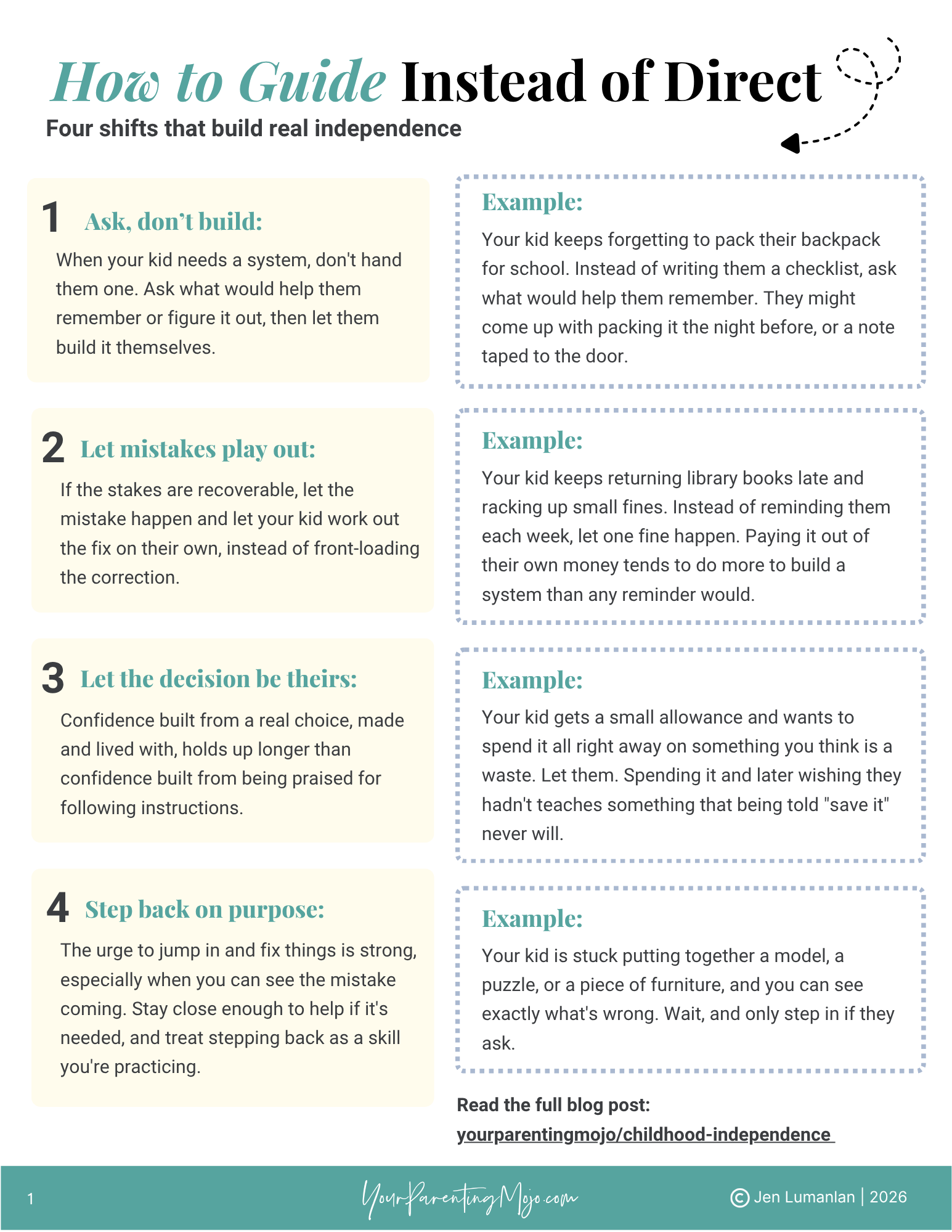
Click here to download How to Guide Instead of Direct
What it looks like to support a child’s choices
When Carys started taking on clients, she had a hard time keeping track of details. What each pet eats. Where the key is hidden. The code for the alarm. I could have built her a system and handed it to her. Instead, I asked her what would help her remember it all. She’d seen a pet sitter online use an intake form, so she built one. I helped her think through which questions to include. She’s the one who designed it, and she’s the one who still uses it.
If you’re wondering how to give your child autonomy in a moment like this: ask the question you’d normally answer yourself, and let them figure it out on their own.
Letting kids handle real responsibility
The first time Carys sat for a neighbor’s cat, she forgot to bring her intake form and couldn’t remember the alarm code. The alarm went off. The next visit, she brought the form, but got the order wrong pressing the disarm button, and the alarm went off again.
I could have told her, right from the start, to bring the form every single time. It would have saved everyone a headache. Instead, she worked it out for herself, after two false alarms and an understandably rattled neighbor. The next time she sat for that family, she brought the form to every single visit, and nothing went wrong.
How to raise a confident, capable kid without managing every outcome
When Carys set her prices, we talked about how different families have different amounts of money to work with. Without any prompting from me, she decided to offer a sliding scale, ten to thirty dollars a day, and let each family choose what fit their situation. That decision was hers, not mine.
She made a real call about her own business and lived with what it meant. Confidence is more likely to endure when children experience themselves as capable decision-makers, rather than simply being praised for doing what they’re told. That’s a different kind of independence in decision making.
Knowing when to step in and when to step back
The instinct to jump in and fix things is strong. I noticed it watching Carys design a system for animals she was responsible for feeding. Most parents notice a version of it watching their kid choose a school, a job, or a path that looks nothing like the one they expected.
You can best support your child’s growing need for autonomy by staying close enough to help if it’s needed, and letting the decision itself belong to your kid. That’s a skill you build the same way your kid builds independence, by practicing it in situations where the stakes are real but not catastrophic.
This is the kind of shift we work through, situation by situation, inside the Learning Membership.
Where to Start
If you want help figuring out where to step in and where to step back with your own kid, that’s what the Learning Membership is built for.
Parent Kathryn D. shared this about the membership: “I love finding inspiration in the membership. It’s helped me to be less directly instructive and do better at observing.”
Click the banner to learn more.
Frequently Asked Questions on Child’s Autonomy and Independence
1. Should I make my child go to college?
There’s no single right answer, but the choice doesn’t have to be handing your kid a fixed plan or stepping back entirely. Trade school enrollment is rising, and more young people are questioning whether a four-year degree is worth the cost, now close to $200,000 at private schools. The more useful question is how you’ll support your kid through whatever path they choose, staying involved without directing every decision.
2. Why doesn’t Gen Z go to college?
Cost is a major factor. A four-year private degree now runs close to $200,000, roughly double what it cost three decades ago, while trade school enrollment at public two-year schools grew almost 20 percent between 2020 and 2025. Even so, most parents still expect their kid to go to college: only 7 percent say they’d prefer a trade path, even though 71 percent of Gen Z say vocational school carries more stigma than it deserves.
3. How does the economy affect parenting?
Money pressure doesn’t stay outside the family. When college costs keep climbing and the job market gets less predictable, that pressure shapes the choices parents make, sometimes without anyone saying so directly. A parent worried about their own job security may see their child’s future differently than a parent who isn’t worried about that right now. Neither reaction is wrong, it’s what happens when uncertainty enters a household.
4. How do I give my child autonomy?
Start by asking the question you’d normally answer yourself. When my daughter Carys needed a way to remember pet-care details for her sitting business, I asked what would help her remember, rather than building the system for her. She found an example online and built her own intake form. Giving autonomy often looks like handing over a real problem instead of a real answer, then trusting your child to work through it.
5. How do I get my child to be more independent?
Give them real responsibility with real stakes attached. When Carys started pet sitting, she forgot her intake form twice and set off a client’s alarm both times. I could have told her to bring it every visit from the start. Instead, she worked it out herself after living with the result. Making a decision and handling what comes from it is what builds independence.
6. How do I raise confident and capable children?
Confidence holds up best when it comes from making a real decision and living with it. When Carys set her pet-sitting prices, she chose to offer a sliding scale on her own, with no prompting from me. That choice was hers to make and hers to live with. Research on self-determination theory backs this up: children who experience themselves as capable decision-makers tend to build more durable confidence than children who are simply told they did well.
7. How should I best support my child’s growing need for autonomy?
Stay close enough to help if it’s needed, but let the decision itself belong to your child. That’s harder than it sounds, since the instinct to jump in and fix things is strong, especially when you can see a mistake coming. Treat it as a skill you build the same way your child builds independence: by practicing in situations where the stakes are real but not catastrophic.
8. How do I support children to make their own choices?
Let the choice truly be theirs, even when you’d choose differently. Carys decided on her own to offer a sliding scale for her pet-sitting clients, charging less for a client who had no other options. That wasn’t something I suggested or approved in advance. Supporting a child’s choices means resisting the urge to steer the outcome, trusting that a decision made and lived with teaches more than one handed down.
References
Conger, R.D., Conger, K.J. and Martin, M.J. (2010), Socioeconomic Status, Family Processes, and Individual Development. Journal of Marriage and Family, 72: 685-704. https://doi.org/10.1111/j.1741-3737.2010.00725.x
Deci, E. L., & Ryan, R. M. (2000). The “What” and “Why” of Goal Pursuits: Human Needs and the Self-Determination of Behavior. Psychological Inquiry, 11(4), 227–268. https://doi.org/10.1207/S15327965PLI1104_01
Grolnick, W. S., & Ryan, R. M. (1989). Parent styles associated with children’s self-regulation and competence in school. Journal of Educational Psychology, 81(2), 143–154. https://doi.org/10.1037/0022-0663.81.2.143
Holtermann, C. (2026, July 13). In turning to trade school, gen Z confronts an enduring stigma – The New York Times. The New York Times. https://www.nytimes.com/2026/07/13/style/gen-z-trade-school-careers-ai-college.html
Joussemet, M., Landry, R., & Koestner, R. (2008). A self-determination theory perspective on parenting. Canadian Psychology / Psychologie canadienne, 49(3), 194–200. https://doi.org/10.1037/a0012754
Lumanlan, J. (2025, August 3). 251: Why Your 8-12 Year Old Should Start a Business (And How to Support Them Without Taking Over!). Your Parenting Mojo. https://yourparentingmojo.com/captivate-podcast/kids-starting-business
Lumanlan, J. (n.d). Learning Membership. Your Parenting Mojo. https://yourparentingmojo.com/learningmembership/

About the author, Jen
Jen Lumanlan (M.S., M.Ed.) hosts the Your Parenting Mojo podcast (www.YourParentingMojo.com), which examines scientific research related to child development through the lens of respectful parenting.