
7 Things Children Do That Parents Read as “Wants” (And the Needs They’re Pointing To)

Key Takeaways
- What parents dismiss as children’s “wants” – attention-seeking, resistance, ignoring requests, arguing – are almost always needs expressing themselves the only way a child knows how.
- Examples of children’s needs include connection, belonging, comfort, play, autonomy, and respect.
- You’ve probably heard that all behavior is communication. The thing it’s trying to communicate is the child’s need, which helps you to meet their need rather than just redirecting the behavior.
- When children can’t find ways to meet their needs, pressure builds and comes out as the behavior that’s driving you up the wall.
- Identifying your child’s needs is key to getting everyone’s needs met more of the time. When a child’s need for connection is met earlier in the day, bedtime tends to go more smoothly. When a child’s need for autonomy is met, resistance tends to decrease.
- When you name the need instead of addressing only the behavior, more solutions appear – ones that work for both of you.
If you read the first post in this series, you already know that what parents call needs are often strategies – one specific way they’re hoping a real need will get met. “I need the house under control” points to a need for ease. “I need you to unload the dishwasher” points to a need for support or partnership.
This post is about the other side of that equation. Because most of us grow up not understanding our needs we don’t know our own needs – or our kids’ needs either. “They just want attention.” “They just want to play.” “They want to control everything.” This sounds like a child who makes incessant demands. But in almost every case, the want is a need – expressing itself the only way a child knows how.
What Are Needs And Why Do Children’s Needs Look Different From Adults’?
If you haven’t read the first post in this series, here’s the short version: in Nonviolent Communication (NVC), needs are the conditions every person requires in order to thrive – not just physically, but in their relationships and in their sense of themselves in the world.
Children have some of the same needs as adults – connection, autonomy, rest, and safety (although many parents find their needs for ease, mental space, and self-care are most prominent!).
But there’s an important difference: children don’t yet have the language to name what they need. A parent who is longing for rest can say “I’m going to sit down for five minutes” – and set up the conditions to make it happen. A two-year-old who is longing for connection can’t say “I need more closeness with you right now.” What they can do is follow you from room to room, melt down at bedtime, or grab their sibling’s toy, so you pay attention to them.
The behavior is the communication. And the question ask every time is: what need is this behavior pointing toward?
The needs list is organized into eight categories that apply to children and adults alike: Connection, Peace, Honesty, Meaning, Safety, Autonomy, Relaxation/Leisure, and Physical Well-Being.
Kids with strong sensory needs might not be able to do anything before their need for comfort is met. Many Autistic kids feel much more settled when their needs for order and consistency are met. Most parents I work with have strong needs for rest, ease, and collaboration.
Different people, different needs – but we all have them in some form.
7 Things Children Do That Parents Read as “Wants” – and the Needs They are Really Pointing To
Just as what parents call needs are often strategies pointing to something deeper, what parents dismiss as their children’s wants are almost always needs.
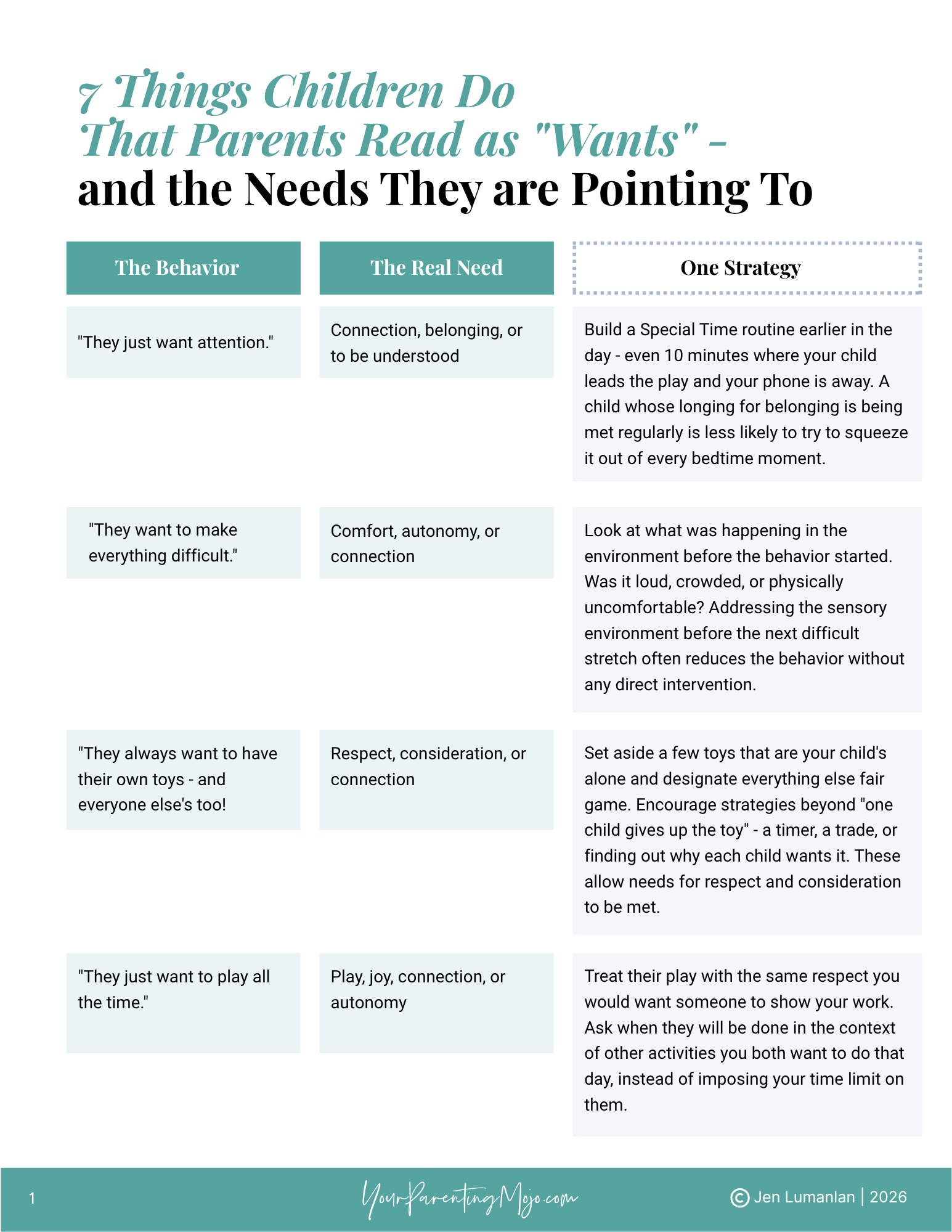
1. “They just want attention.” (Stalling at bedtime, clinging at school drop-off, following you from room to room)
Underlying need: Connection; belonging; to be understood
A child who stalls at bedtime or refuses to separate at school drop-off is longing to feel like they belong – that they matter to you and that you truly get them. The behavior tends to intensify when that sense of belonging has been harder to come by, and ease up when it has been more present.
One strategy: Build a Special Time routine earlier in the day – even 10 minutes of uninterrupted time where your child leads the play and your phone is away. A child whose longing for belonging is being met regularly is less likely to try to squeeze it out of every bedtime moment.
2. “They want to make everything difficult.” (Hitting, screaming, refusing to get dressed, melting down over small things)
Underlying need: Comfort; broad autonomy; connection
A child who seems to go from zero to sixty in no time may have been dealing with too much or too little sensory input for hours before the meltdown. Your request or your “no” is often just the last straw, not the real cause.
We also know that when we have a hard time, the thing that happened in the moment was just the last straw, not the actual source of the pressure.
Finally, kids often ‘try to make things difficult’ when they want to connect with us, because it’s an effective strategy to get our attention.
Strategies to try: Look at what was happening in the environment before the behavior started. Was it loud, crowded, or physically uncomfortable? Was your child cold, hungry, or in clothes that bothered them? Addressing the sensory environment before the next difficult stretch often reduces the behavior without any direct intervention.
If we’re seeing behavior that looks like ‘they want to make everything difficult’ across a broad array of situations, it’s worth checking to see if the child is asking for a much greater ability to make decisions that are important to them.
A Special Time routine can help you rule out connection as the underlying need; if the behavior persists, then there are other needs at play too.
3. “They always want to have their own toys – and everyone else’s too!” (Inability or unwillingness to share/be flexible)
Underlying need: Respect; consideration; connection
‘Sharing’ is a really hard concept for young children who don’t have a great awareness of time! As far as they can tell, the instruction to “Share!” means: “Give up the toy you’re enjoying playing with, with no clear idea of when you’ll get it back.” It’s no wonder kids resist!
Strategies to try:
This blog post on sharing goes into much greater depth on how to approach this issue.
Be honest about time yourself: if you’re asking your child to wait five minutes, say: “I’ll be there in five minutes,” not “Just a sec!”. Then make sure you’re there within five minutes – this helps children to learn a sense of time.
Set aside a few toys that are your child’s alone, and designate everything else fair game for everyone to play with.
Encourage children to develop strategies other than “one child gives up a toy when the adult says so.” The children might be able to use a timer themselves; they can learn strategies to make waiting easier; or if you can uncover why each one wants the toy, another toy might be substitutable. All of these strategies allow needs for respect and consideration to be met.
It is possible that toy-taking is a bid for play with their sibling/peer, or for connection with you (if you appear as soon as their sibling cries because the toy was taken). Special time can help if this is the case.
Finally, sharing gets easier as more cognitive development comes online. It won’t be like this forever!
4. “They just want to play all the time, but I need to cook dinner.” (Resisting transitions away from play, ignoring requests, saying “just one more minute” repeatedly)
Underlying need: Play; joy; connection; autonomy
Most of us were taught when we were children that play is a waste of time, so we devalue it. We prioritize work and make sure it comes first: if our child asks us to play, we might say: “I can’t; I need to work/tidy up/cook dinner.” Play (and rest!) are rewards we have to earn and can access if and only if all the work gets done.
But play is how children learn. It is their work, and their work is just as valuable as ours.
Strategies to try:
Treat their play with the same respect you would want someone to show your work. Ask when they will be done (in the context of other activities you both want to do that day), instead of imposing your time limit on them.
If your child really appreciates play, bring to mind a task they often resist. Work with them to create a menu of playful ways you can approach it together. (Note: this only ‘works’ if there aren’t other needs at play as well, e.g. autonomy.)
Try playing (and resting!) more often yourself – maybe even before you do chores!
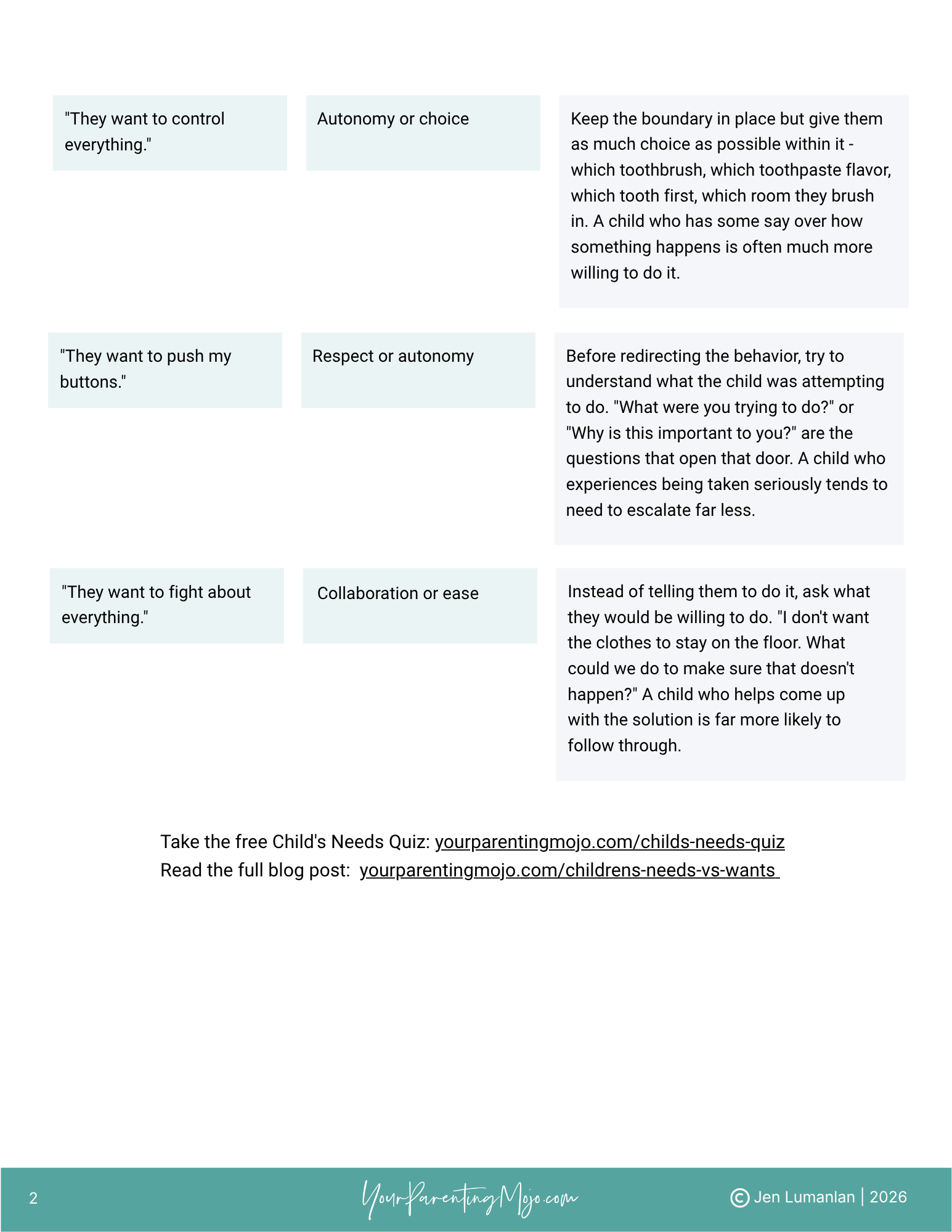
5. “They want to control everything.” (Refusing to brush teeth, resisting getting dressed, saying no to things that seem reasonable)
Underlying need: Autonomy; choice
A child who resists toothbrushing or getting dressed is not trying to make your life harder. They are longing for a say over things that have a meaningful impact on their lives.
When parents say “I need you to brush your teeth,” that is a strategy to meet a need for the child’s physical safety – not the need itself. The child has needs too, and choice is often one of them.
Strategies to try:
Some issues really are about health and safety. In that context, try to find as much flexibility as you can within the framework of making the activity happen. Which toothbrush, which toothpaste flavor, which tooth first, which room they brush in, and potentially whether they brush twice a day or only once. A child who has some say over how something happens is often much more willing to do it.
6. “They want to push my buttons.” (Tantrums, hitting a sibling, not stopping when asked, doing the exact thing you just said not to do)
Underlying need: Respect, autonomy
A child who tantrums or keeps doing the thing you just told them to stop may be longing to be taken seriously – for their experience and perspective to be considered rather than overridden. A tantrum is often a signal that something is really important to them (when you’ve ruled out basic physical needs: hunger, tiredness, sensory input).
One strategy: Before redirecting the behavior, try to understand what the child was attempting to do or communicate. “What were you trying to do?” or “Why is this important to you?” are the questions that open that door. A child who experiences being taken seriously tends to need to escalate far less.
7. “They want to fight about everything.” (Resisting chores, arguing back, refusing to cooperate with simple requests)
Underlying need: Collaboration, ease
Resistance to chores or simple requests is often more about the child’s longing to feel like a participant rather than a subordinate. What looks like a child refusing to put clothes in the hamper is often a child who wants to be part of figuring out how the household works – not just handed a list of rules to follow.
One strategy: Instead of telling them to do it, ask what they would be willing to do. “I do not want the clothes to stay on the floor. What could we do to make sure that does not happen?” A child who helps come up with the solution is far more likely to follow through with it.
And if they still resist, the task may be too difficult for them. If you have a need for collaboration, work together to find a task your child is willing and able to help with. My daughter found making her lunches under time pressure on weekday mornings to be overwhelming. So I make her lunch and she unloads the dishwasher, which requires much less mental effort and meets her need for ease.
Every child has a mix of needs that shows up again and again that drive most of their behavior most of the time. The free Child’s Needs Quiz helps you identify which needs tend to be loudest for your child, and what you can do to meet them.
What Happens When Needs Aren’t Met?
This is when you start to see behaviors you don’t like.
A child looking for connection might do things you’ve told them not to do, because they know this gets your attention.
A child who needs autonomy will refuse to do what you ask, stomp around as they do what you ask, or have a meltdown.
A child who needs movement will bounce off the walls.
The problem with telling them not to do the behavior is that the pressure stays in place. You redirect the hitting and something else comes up. You stop the meltdown and the next one arrives sooner than you expected. The need is still there, asking to be met.
The less we attend to what’s underneath the behavior, the more the behavior intensifies. And the more we can learn to recognize what a child is longing for, the more the behavior starts to make sense and the more we can help.
How to Identify What Your Child Needs
One of the most common things parents discover when they first work with a needs framework is that they don’t always know what their child needs in a given moment. The behavior is clear, but the need underneath it is harder to locate.
Start by ruling out the basics. Is your child hungry, tired, or physically uncomfortable? These physical needs – food, rest, comfort – are often the starting point, especially for younger children. When those are met and the behavior persists, look further.
From there, the needs list is a practical reference. The needs list is organized into categories you can move through quickly, even in a difficult moment. The picture version is particularly useful with children – you can point to pictures together and ask “I’m wondering if you’re needing some of this right now?” This gives children language for what they’re experiencing before the behavior escalates.
The Child’s Needs Quiz helps you identify which needs tend to show up most often for your child, so you’re not starting from scratch every time a difficult moment arrives.
Final Thoughts
What parents dismiss as children’s wants are almost always needs – expressing themselves the only way a child knows how. A child who won’t share is longing for respect or connection. A child who seems to make everything difficult may be dealing with a sensory environment that’s already at capacity before you’ve even asked them to do anything.
When you can see the need underneath the behavior, the behavior stops being something to stop and starts being something to respond to. And when both people’s needs are held with equal care – yours and your child’s – then you’re no longer trying to change their behavior; you’re in a relationship where both of your needs are met more of the time.
Get More Support
Reading about needs is one thing. Using the framework in the middle of a meltdown is another.
The Parenting Membership is where the framework becomes a practice. Each month covers a specific area of parenting grounded in peer-reviewed research. Module 1 focuses specifically on difficult behavior: how to see it coming, what need is underneath it, and how to navigate it collaboratively rather than reactively.
You also get direct access to monthly group coaching calls where you can bring your specific situation – the child who won’t cooperate with getting dressed, the sibling conflict that seems to have no solution, the bedtime routine that’s eating an hour every night – and work through it with real support.
Parent Stacey shared this about the membership:
“I enjoy being part of the parenting community. The modules have given me useful reflection. Understanding different needs in my child has reduced conflict. The coaching and groups have been the most influential.”
Click the banner to learn more

Frequently Asked Questions on Children’s Needs
1. What are childhood emotional needs?
Children have the same universal human needs as adults – connection, safety, autonomy, rest, and more. When those needs aren’t being attended to, behavior is usually the signal. A child who hits may be longing for connection. A child who refuses may be longing for autonomy or predictability. The free Child’s Needs Quiz helps parents identify which need tends to drive their child’s behavior most – and what to do about it.
2. What is an example of a child’s want that is really a need?
A child who won’t stop following you from room to room seems like they just want attention. But that behavior is almost always pointing to a need for connection or belonging. A child who fights about brushing their teeth seems like they want to be difficult. Underneath it is often a need for autonomy – a say over something that is important to them.
3. What happens when children’s needs aren’t met?
When a child’s need isn’t being attended to, pressure builds and comes out as behavior we don’t like. Hitting, clinging, refusing, melting down, fighting about everything are almost always signals. Addressing only the behavior leaves the pressure in place. A different behavior will show up soon enough. The question to ask every time is: what need is this behavior pointing to?
4. How do you explain needs and wants to kids?
Children learn needs language by hearing adults use it. When you say “I’m feeling overwhelmed by the noise right now; I need some mental space,” you’re giving your child the vocabulary and permission to do the same. The picture version of the YPM needs list is also a practical tool – pointing to pictures together helps children name what they’re experiencing before the behavior escalates.
5. How do you identify what your child needs?
Start by ruling out the basics – hunger, tiredness, and physical discomfort are often the starting point, especially for younger children. From there, the needs list is a practical reference organized into categories you can scan quickly. The Child’s Needs Quiz helps you identify which needs show up most often for your child so you’re not starting from scratch every time a difficult moment arrives.
References
Craig, A. How do you feel? Interoception: the sense of the physiological condition of the body. Nat Rev Neurosci 3, 655–666 (2002). https://doi.org/10.1038/nrn894
Lumanlan, J. (2026, June 28). Attention-Seeking Behavior in Kids: The Surprisingly Simple Fix Most Parents Miss. Your Parenting Mojo. https://yourparentingmojo.com/special-time-parenting/
Lumanlan, J. (2022, October 9). 169: How to take care of yourself first with Liann Jensen. Your Parenting Mojo. https://yourparentingmojo.com/captivate-podcast/liann/
Lumanlan, J. (2018, July 25). An age-by-age guide to teaching your child to share. Your Parenting Mojo. https://yourparentingmojo.com/sharing/
Lumanlan, J. (n.d-a). Needs list. Your Parenting Mojo. https://yourparentingmojo.com/needs/
Lumanlan, J. (n.d-b). Identifying Your Child’s Needs Quiz. Your Parenting Mojo. https://yourparentingmojo.com/childs-needs-quiz/
Walden, M. (n.d.). The purpose of NVC. The Center for Nonviolent Communication. https://www.cnvc.org/about/purpose-of-nvc

About the author, Jen
Jen Lumanlan (M.S., M.Ed.) hosts the Your Parenting Mojo podcast (www.YourParentingMojo.com), which examines scientific research related to child development through the lens of respectful parenting.