
7 Things Parents Call Needs (And the Real Needs Underneath Each One)

Key Takeaways
- A need is what every person requires to feel grounded, connected, and at ease. We all have different needs, but we all have needs!
- Examples of needs include autonomy, connection, partnership, rest, ease, and competence (often in parenting).
- A want is one specific strategy for meeting a need. The same need can almost always be met in more than one way.
- What parents call needs – “I need you to tidy your room,” and “I need a break” – are often strategies pointing to real needs like ease, rest, or competence.
- When we long for our needs to be met, we can become frustrated, angry, and resentful.
- Identifying your needs is key to getting them met. When you have a need for connection, talking with a friend will meet your need more effectively than eating a pint of ice cream. (When you need indulgence, the ice cream is a more effective strategy!) A needs list helps you identify your needs efficiently.
- When you name the real need instead of pushing for one specific strategy, more potential solutions appear.
I remember saying to my daughter when she was about two: “You WANT to play, but I NEED to cook dinner.”
It feels true at the moment. The cooking is urgent; we have to eat. Playing is optional – it can be done once chores are complete. One is a need, one is a want – and I decide which is which.
But then I learned the way I was thinking about it was making it harder for me, not easier.
In Nonviolent Communication (NVC), needs are what every person – adult or child – requires to feel grounded, connected, and at ease. And what we tend to call our “needs” as parents – getting dinner cooked, having the house under control, getting everyone out the door – are often wants, or strategies: one specific way we’re hoping a real need will get met.
Meanwhile, what we tend to dismiss as our children’s “wants” – play, physical closeness, having a say, being taken seriously – are needs too.
This post focuses on the parent side of that equation: seven things parents call needs that are strategies pointing to something deeper. If you want to explore what’s underneath your child’s behavior, the next post in this series covers that too.
What Are Needs?
In NVC, a need is something people require in order to thrive, including physical needs like food and water, and intangible ones like respect, meaning, and connection.
The needs list organizes these into eight categories:
- Connection: acceptance, belonging, love, empathy, trust, being understood
- Peace: calm, ease, order, harmony, respect
- Honesty: authenticity, integrity, presence
- Meaning: growth, creativity, learning, purpose, competence
- Safety: consistency, physical and emotional security
- Autonomy: choice, freedom, independence, space
- Relaxation/Leisure: play, fun, rest, joy, mental space
- Physical Well-Being: food, water, sleep, exercise, self-care
Note that this list is not exhaustive – it’s intended to be an approachable starting point for overwhelmed parents.
Evidence indicates that needs of autonomy, competence, and connectedness are somewhat universal, although individuals have variations in how strongly they show up.
What Is the Difference Between Needs and Wants?
A need is what you require to feel connected, purposeful, and at ease. A want, or strategy, is how you picture that need getting met.
Mara Glatzel, author of Needy: How to Advocate for Your Needs and Claim Your Sovereignty, described it this way in a conversation on the Your Parenting Mojo podcast: the need is the what, and the want is the how. The need might be rest, mental space, or ease. The want is the specific form you are hoping that need arrives in.
I might express a need for mental space by saying: “You need to be quiet,” or “I need you to stop jumping on the couch.”
When I frame my want as a need, I end up working against my child. When I instead identify my need for mental space, I come up with many potential options to meet my need, depending on the child’s need:
- My child continues jumping on the couch and I move to another room (‘works’ if the child needs movement/play)
- My child continues jumping on the couch and I wear earplugs (child: movement/play)
- I ask if my child is willing to jump on the trampoline outside (child: movement/play)
- I offer to read a story to my child or propose some other quiet activity (child: connection – they were jumping when they know it’s prohibited to get your attention)
- I ask if my child is willing to stop jumping on the couch so I can stay in the room (child: movement/play, connection)
- I reorganize my day so I arrive at the end of it with more mental capacity
One parent told me: “The idea that I could change my behavior to meet my need was revelatory.”
When we understand what need we’re trying to meet, and what need our child is trying to meet, 90+% of the time we can find strategies to meet both of our needs.
7 Things Parents Call Needs – and the Real Needs They’re Pointing To
Each of these sounds like a need. And it is – just not the one you think. Underneath each one is a deeper longing and when we understand that, we’re more likely to get it met.
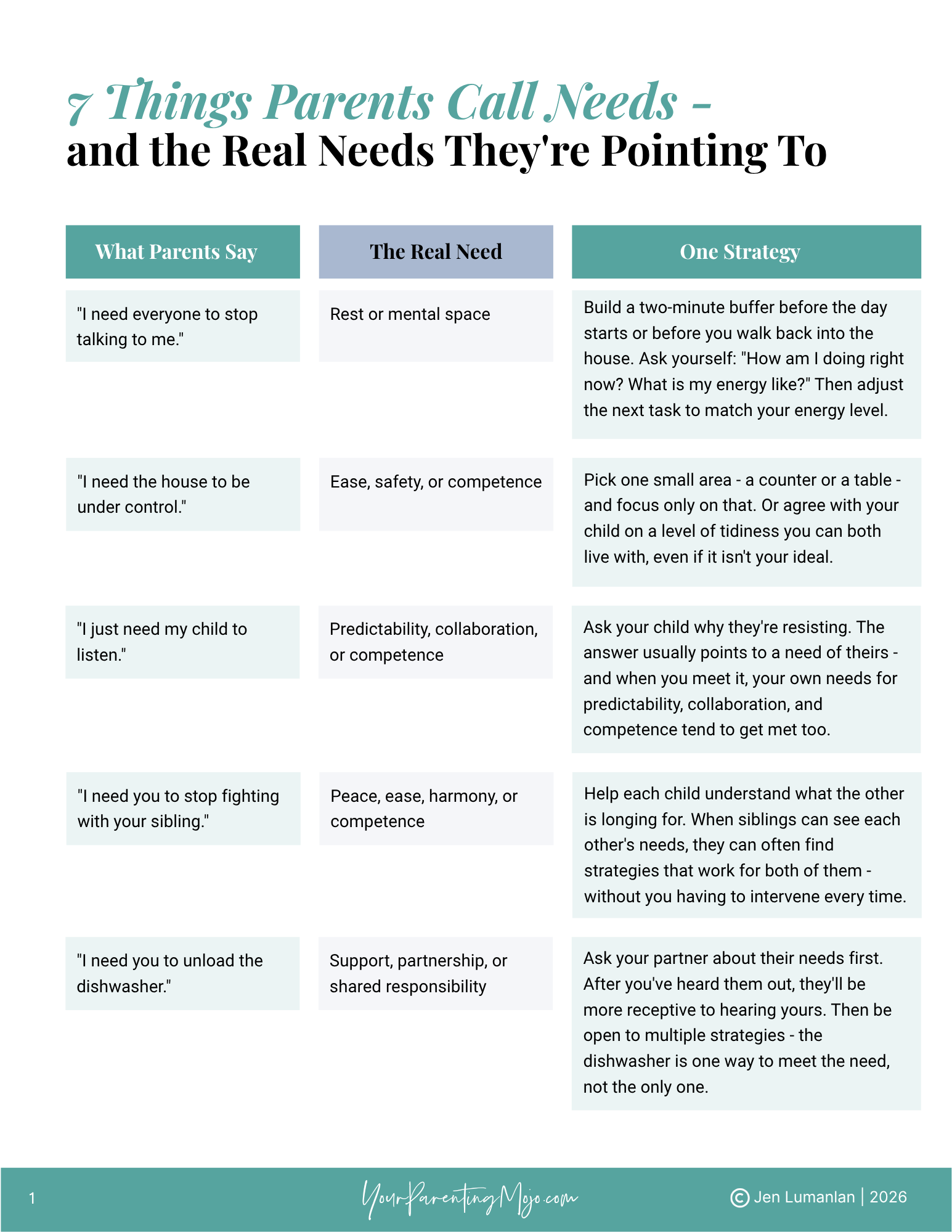
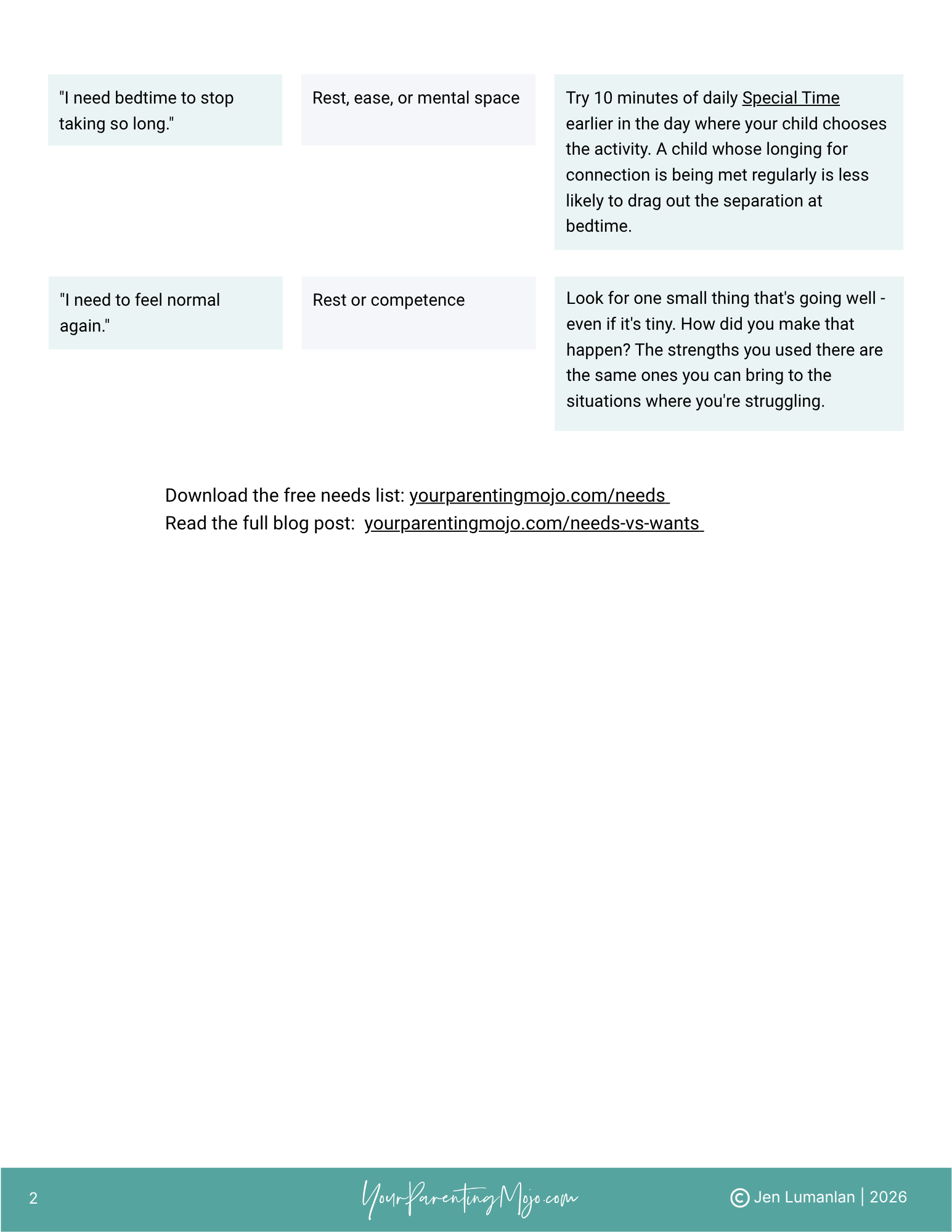
Click here to download the 7 Things Parents Call Needs – and the Real Needs They’re Pointing To
1. “I need everyone to stop talking to me.”
Real needs: Rest; mental space
When this shows up, our needs for rest and mental space are likely severely depleted. A moment of quiet and solitude allows you to re-regulate if you’re triggered by your child’s behavior, and reconnect with your values.
Strategies to try:
- Mara Glatzel says ‘rest’ is anything that gives you more energy than it takes to do it. Adding time to connect with other adults, take a class in something you enjoy, and move in a way that feels good to you may benefit you more than additional sleep.
- Assess how your energy is doing overall. If the only thing you can do at the end of most days is collapse in front of Netflix, try to adjust your day to reduce the demands on you.
- Build a two minute buffer between one demand and the next. Before the day starts, or before you walk back into the house after work, pause and ask yourself: “How am I doing right now? What is my energy like?” Then adjust the next task to account for your energy level.
- Try to match your tasks to your energy level. Do tasks you find demanding in periods of the day when you have more energy, and save the ones you find easy for when you have less capacity.
2. “I need the house to be under control.”
Real need: Ease; safety; to be perceived as competent
A chaotic environment can make it hard to think and hard to feel steady for some people. Getting things ‘under control’ is one strategy pointing to a real need for ease.
And stepping on tiny LEGOs can hurt! When you can’t move through your environment without hurting yourself, your need for safety isn’t met.
We judge people, and we expect others to judge us, by the condition of our living environment and we worry that people will think we’re incompetent if our space isn’t tidy.
Strategies to try:
- Pick one small area – a counter, a table, a corner of the room where you work – and focus only on that. That can help you to get some of the mental benefits of order without having to tidy your whole space
- Agree with your child on a level of tidiness you can both live with, even if it isn’t your ideal. One example: their LEGOs stay in their room, and there’s a clear path from the door to the bed.
- Accept that their need for play is valid and important, and that reflects positively on your competence in parenting (so they don’t have to tidy up)
3. “I just need my child to listen.”
Real need: Predictability; collaboration; competence
This statement can point to several different needs depending on the moment:
- Predictability – you want to be able to count on transitions going smoothly.
- Collaboration – so you’re more on the same team.
- Competence – you want to feel confident in parenting – that you’re doing this right.
Strategies to try:
Each of these needs can be met by working to understand your child’s needs, which is why they’re resisting doing what you’re asking. Remember parent Chrystal, whose child would refuse to get dressed every morning. When Chrystal asked why she didn’t want to get dressed, her child said: “Because I like knowing you were the last person to touch my clothes in the morning” (need for connection).
When Chrystal met her child’s need for connection by helping her get dressed, Chrystal’s own needs for predictability, collaboration, and competence in parenting were met too.
4. “I need you to stop fighting with your sibling”
Real need: Mental safety; peace; ease; harmony; competence in parenting
Sibling fighting pushes our buttons in several ways.
If we had a difficult relationship with our siblings, it might remind us of hurts we suffered at their hands.
If we have a great relationship with our siblings, current conflict might cause us to worry that our own kids won’t have what we have.
And when we’re constantly intervening to keep the peace it’s hard to meet our needs for peace, ease, and harmony.
Strategies to try:
Parents often think they either have to tell their kids how to settle every squabble – or leave them to completely sort things out by themselves.
I advocate for a middle path: when siblings understand why the other is doing things they find irritating (in other words, when they understand their sibling’s needs), they can often find strategies to meet both of their needs.
Mom Adrianna couldn’t go to the bathroom without her kids tearing each other’s hair out. She started by meeting 5-year-old Bodhi’s needs more of the time. Then Dad Tim joined in too. One day, 3-year-old Remi started coloring on Bodhi’s paper, which previously would have provoked armageddon. Bodhi said: “Do you want connection because we haven’t played yet today? Shall we play together and then you can color on your paper and I’ll color on mine?”
These kids picked it up quickly…it’s more common for parents to scaffold by asking each child how they feel and what their needs are, and supporting them in hearing the other. This episode walks you through it step by step.
5. “I need you to unload the dishwasher”
Real need: Support; partnership; shared responsibility
I once picked a fight with my husband because he didn’t unload the dishwasher. Ultimately it wasn’t really about the dishwasher; I had needs for support and partnership that I didn’t know how to articulate. Waiting for my partner to notice my needs (or picking fights over wants/strategies) are not very effective ways of getting needs met – and tend to build frustration, anger, and resentment instead.
Strategies to try:
Sit down with your partner and ask about what’s going on for them first. What needs do they have that they’d like help getting met? After you’ve uncovered their needs, they’re going to be much more receptive to hearing about your needs, and supporting you in meeting them.
Be explicit about your needs, but try to be open to multiple strategies to meet them. My partner could have helped me meet my needs for support and partnership by unloading the dishwasher…or by taking our daughter out so I could work, or cooking a meal, or going grocery shopping… If he didn’t like unloading the dishwasher, there were still ways he could have supported me.
The more we can be open to multiple strategies, the more likely we are to get our needs met.
6. “I need bedtime to stop taking so long.”
Real need: Rest; ease; mental space; self-care
Parents often feel frustrated when daily routines seem to take foreverrrrr…especially at the end of the day when our capacity is low. And our kids can seem intent on dragging these routines out for as long as humanly possible.
The needs lens helps us to understand why: extra-long routines often happen right before a separation (preschool/school; bedtime), which often points to a need for connection.
Strategy to try:
Special Time is one of the most powerful tools we have to address attention-seeking behavior in kids. When we snap at our spouse, we know it isn’t really about what our spouse just said or did – but everything that was said and done this morning, yesterday, last week, and last year (remember: it’s not about the dishwasher). So the fix isn’t just related to the specific situation either.
This presents an opportunity – we can use 10 minutes of consistent daily Special Time where your child gets to choose what you play to improve your connection, and it doesn’t have to happen at bedtime when you’re depleted!
This post and printable walk you through exactly how to do it.
7. “I need to feel normal again.”
Real need: Rest; competence
This one tends to come up in difficult periods – after a new baby, during a challenging stretch with a child, or when burnout has set in. The real need is to feel competent again – to have some part of daily life be manageable and not overwhelming.
Strategies to try:
- Remember that you’re a whole person, not just a parent! Do an activity you used to enjoy before you had kids.
- Go out with your partner or meet up with a friend and do not talk about your kids for the entire time.
- Create more rest by going to bed earlier, doing mindfulness practice while you help your child get to sleep, doing an activity you enjoy…
- Look for something that’s going well – even if it’s small. How did you make that happen? What strengths did you use, and how can you use those in situations where you’re struggling?
Final Thoughts
What parents call needs are strategies – one specific way each person is hoping a real need will get met. And when you can see that, it stops being about pushing for one specific outcome and starts being about what could work.
When you can step back from a specific strategy and ask what need is underneath it, you change what the problem looks like. The seven examples in this post are a starting point, but the same reframe works anywhere you find yourself stuck.
The needs list is a good place to start. If you want to go deeper into how to use feelings alongside needs, the feelings list has the words you need to name what’s going on.
And if you’ve ever found yourself thinking “they just want attention” or “they just want to play” – the same reframe works for your child too. The next post in this series walks through seven things children do that parents read as wants, and the needs they’re really pointing to.
Links to books are affiliate links, which means I receive a small commission that does not affect the price you pay.
Free Parenting Resources to Help You Get Started
Everything mentioned in this post is available for free in one place. The needs list and feelings list come in printable and picture versions you can use yourself or with your child. You can also find other helpful downloadables like The 5-Step Special Time Guide and How to Resolve Parenting Arguments.
Click the banner to learn more.
Frequently Asked Questions About Needs and Wants
1. What is the difference between needs and wants?
A need is what every person requires to feel grounded, connected, and at ease. A want is one specific way you picture that need getting met. In this framework, wants are strategies – and there are almost always multiple strategies that can meet the same need. When you know the need underneath the want, you have more options than pushing for one specific outcome.
2. What is a list of needs?
This needs list organizes universal human needs into eight categories: Connection, Peace, Honesty, Meaning, Safety, Autonomy, Relaxation, and Physical Well-Being. Each category includes specific needs like belonging and trust under Connection, or rest and mental space under Relaxation.
3. What is an example of a need vs. want?
A parent saying “I need the house to be under control” sounds like a need. But getting the house under control is one strategy – a want – pointing to a need for ease or safety. A parent saying “I need a break” is pointing to a real need for rest. In each case, knowing the need opens up more than one way to meet it.
4. What happens when needs aren’t met?
When a need isn’t being attended to, pressure builds. In adults, that pressure shows up as irritability, exhaustion, or resentment.
5. How do you identify your needs?
Start with your body. Tension, a clenched jaw, or exhaustion behind your eyes are signals that something is running low. From there, scan a needs list and look for the word that resonates.
The needs list is organized into categories so you can move through it quickly. A simple daily check-in – “How am I doing right now?” – also builds the habit of noticing before the pressure builds up. You will likely find that similar needs crop up for you (rest, ease, self care, mental space) over and over, which means you don’t have to look at the list every time.
6. How do you meet your needs?
Start by naming the real need rather than pushing for one specific strategy. Once you know the need, more strategies become available. The longing for rest doesn’t only get met by an hour alone – you might be able to rest doing an activity you enjoy, or connecting with a friend. For needs that involve other people, try stating your need and asking for help in meeting it – this makes it much less likely you’ll experience frustration, anger, and resentment.
Resources
Chen, B., Vansteenkiste, M., Beyers, W. et al. Basic psychological need satisfaction, need frustration, and need strength across four cultures. Motiv Emot 39, 216–236 (2015). https://doi.org/10.1007/s11031-014-9450-1
Lumanlan, J. (2026, June 28). Attention-Seeking Behavior in Kids: The Surprisingly Simple Fix Most Parents Miss. Your Parenting Mojo. https://yourparentingmojo.com/special-time-parenting/
Lumanlan, J. (2026, March 29). 261: Why Your Kids Fight (It’s Not What You Think). Your Parenting Mojo. https://yourparentingmojo.com/captivate-podcast/sibling-conflict-resolution/
Lumanlan, J. (2024, April 14). 209: How to get on the same page as your parenting partner. Your Parenting Mojo. https://yourparentingmojo.com/captivate-podcast/parentingpartners/
Lumanlan, J. (2023, June 11). 186: How to meet your needs with Mara Glatzel. Your Parenting Mojo. https://yourparentingmojo.com/captivate-podcast/needy/
Lumanlan, J. (2022, May 1). 155: How to get your child to listen to you. Your Parenting Mojo. https://yourparentingmojo.com/captivate-podcast/listen/
Lumanlan, J. (2019, July 7). 094: Using nonviolent communication to parent more peacefully. Your Parenting Mojo. https://yourparentingmojo.com/captivate-podcast/nvc/
Lumanlan, J. (n.d-a). Feelings list. Your Parenting Mojo. https://yourparentingmojo.com/feelings/
Lumanlan, J. (n.d-b). Needs list. Your Parenting Mojo. https://yourparentingmojo.com/needs/
Rosenberg, M. B. (2003). Nonviolent Communication: A Language of Life.
Saxbe, D. E., & Repetti, R. (2010). No Place Like Home: Home Tours Correlate With Daily Patterns of Mood and Cortisol. Personality and Social Psychology Bulletin, 36(1), 71-81. https://doi.org/10.1177/0146167209352864
Walden, M. (n.d.). The purpose of NVC. The Center for Nonviolent Communication. https://www.cnvc.org/about/purpose-of-nvc

About the author, Jen
Jen Lumanlan (M.S., M.Ed.) hosts the Your Parenting Mojo podcast (www.YourParentingMojo.com), which examines scientific research related to child development through the lens of respectful parenting.