
112: How to Set up a Play Room
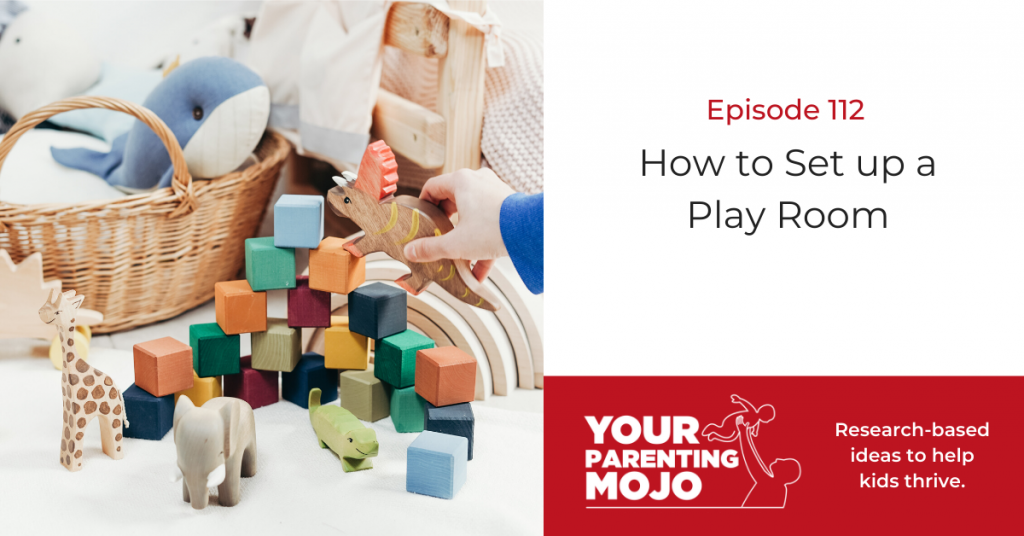
One of the things people email me wanting to know about most often is “what does the research say about how to set up a play room? What toys should I buy that will have the greatest benefit for my child’s learning and development?” I’d actually been putting off doing this episode for a while, in part because the research base on this topic is thin on the ground – but also because the idea just made me kind of uncomfortable. I mean, we’ve survived for tens of thousands of years without play rooms – or even dedicated toys, never mind the incredibly beautiful and expensive ones that are available now! – what could I really say about this? Well, now’s the time. Perhaps it shouldn’t surprise you that this episode is coming in the middle of our series on the intersection of money and parenting. I hope it offers you some reassurance about how to set up your own play room – if you choose to and are able to. And even more reassurance if you choose not to or can’t.
Other episodes on this series
This episode is the second in a series on the intersection of parenting and money. You can find other episodes in this series:
- 038: The Opposite of Spoiled
- 105: How to pass on mental wealth to your child
- 107: The impact of consumerism on children
- 115: Reducing the Impact of Advertising to Children
- 118: Are You Raising Materialistic Kids?
Jump to highlights
00:03 Introduction and framing: the privilege embedded in even asking how to set up a playroom
01:39 How play and toys vary across cultures, from Ghana to the Kalahari to Mexico
06:25 A quick review of the researched benefits of play: executive function, language, social skills, and more
10:05 Dr. Doris Pierce’s study on mothers as “stage managers” of children’s play
16:47 Why subscription toy boxes rarely deliver on their promises
20:43 A 2012 study on which toys prompted the highest-quality play, and what it reveals about assumptions tied to socioeconomic status
25:16 Electronic toys: why they rarely deliver on educational promises, and the Baby Einstein refund case
29:03 How parents shape gender preferences through play, tone, and which toys get positive attention
35:10 Digging into Disney princess research and what stereotypical play is linked to later on
39:19 Why survival-based reasoning shows toy specifics matter far less than we think
References
Arnold, J. E., Graesch, A. P., Ragazinni, E., & Ochs, E. (2012). Life at home in the twenty-first century. Los Angeles: UCLA.
Boe, J.L., & Woods, R.J. (2018). Parents’ influence on infants’ gender-typed toy preferences. Sex Roles 79, 358-373.
Choi, K.W.Y. (2016). On the fast track to a head start: A visual ethnographic study of parental consumption of children’s play and learning activities in Hong Kong. Childhood 23(1), 123-139.
Coyne, S.M., Rasmussen, E.E., Linder, J.R., Nelson, D.A., & Birkbeck, V. (2016). Pretty as a princess: Longitudinal effects of engagement with Disney princesses on gender stereotypes, body esteem, and prosocial behavior in children.
Dauch, C., Imwalle, M., Ocasio, B., & Metz, A.E. (2019). The influence of the number of toys in the environment on toddlers’ play. Infant Behavior and Development 50, 78-87.
Fine, C., & Rush, E. (2018). “Why does all the girls have to buy pink stuff?” The ethics and science of the gendered toy marketing debate. Journal of Business Ethics 149, 769-784.
Ginsburg, K.R.,; AAP COMMITTEE ON COMMUNICATIONS, AAP COMMITTEE ON PSYCHOSOCIAL ASPECTS OF CHILD AND FAMILY HEALTH. The importance of play in promoting healthy child development and maintaining strong parent-child bonds. Pediatrics 2006. doi:10.1542/peds.2006-2697
Ionas, A.C., Dirtu, A.C., Anthonissen, T., Neels, H., & Covaci, A. (2014). Downsides of the recycling process: Harmful organic chemicals in children’s toys. Environment International 65, 54-62.
Lewin, T. (2009, October 23). No Einstein in Your Crib? Get a Refund. The New York Times. Retrieved from: https://www.nytimes.com/2009/10/24/education/24baby.html
McReynolds, E., Hubbard, S., Lau, T., Saraf, A., Cakmak, M., & Roesner, F. (2017). Toys that listen: A study of parents, children, and internet-connected toys. Proceedings of the 2017 CHI Conference on Human Factors in Computing Systems. ACM.
Pellegrini, A.D., & Smith, P.K. (1998). The development of play during childhood: Forms and possible functions. Child Psychology & Psychiatry Review 3(2), 51-57.
Pierce, D. (2000). Maternal management of the home as a developmental play space for infants and toddlers. The American Journal of Occupational Therapy 54(3), 290-299.
Sherman, R. (2016). Conflicted cultivation: Parenting privilege, and moral worth in wealthy New York families. American Journal of Cultural Sociology 5(1-2), 1-33.
Strand, D.A., Utne-Palm, A.C., Jakobsen, P.J., Braithwaite, V.A., Jensen, K.H., & Salvanes, A.G.V. (2010). Enrichment promotes learning in fish. Marine Ecology Progress Series 412, 273-282.
Trawick-Smith, J., Wolff, J., Koschel, M., & Vallarelli, J. (2015). Effects of toys on the play quality of preschool children: Influence of gender, ethnicity, and socioeconomic status. Journal of Early Childhood Education 43, 249-256.
Wohlwend, K. (2015). Playing to belong: Princesses and peer cultures in preschool. In R. Hains & M. Forman-Brunell (Eds.), Princess cultures: Mediating girls’ imaginations and identities (p.91-114). New York: Peter Lang.
Yogman M, Garner A, Hutchinson J, et al; AAP COMMITTEE ON PSYCHOSOCIAL ASPECTS OF CHILD AND FAMILY HEALTH, AAP COUNCIL ON COMMUNICATIONS AND MEDIA. The Power of Play: A Pediatric Role in Enhancing Development in Young Children. Pediatrics. 2018;142(3):e20182058
Transcript
Hi, I'm Jen, and I host the Your Parenting Mojo podcast. We all want our children to lead fulfilling lives, but it can be so hard to keep up with the latest scientific research on child development and figure out whether and how to incorporate it into our own approach to parenting. Here at Your Parenting Mojo, I do the work for you by critically examining strategies and tools related to parenting and child development that are grounded in scientific research and principles of respectful parenting. If you'd like to be notified when new episodes are released and get a free guide to seven parenting myths that we can safely leave behind, seven fewer things to worry about, subscribe to the show at yourparentingmojo.com. You can also continue the conversation about the show with other listeners in the Your Parenting Mojo Facebook group. I do hope you'll join us. Hello and welcome to the Your Parenting Mojo podcast. Today we're covering a topic that listeners have been asking me for ages, which is how to set up a playroom. And if you hear some trepidation in my voice, it's because there's a lot of trepidation in me. And if you also think it's an incredible coincidence that this episode is coming hot on the heels of a couple of episodes exploring children and consumerism, then I'm sorry to say this is not a coincidence. I was uncomfortable enough with this topic that I felt I really couldn't do this episode without covering those other topics as well as a counterpoint. And the main reason I'm uncomfortable is, of course, that even having the wherewithal to ask the question, how do I set up a child's playroom, represents an absolutely enormous amount of privilege. It says that the person asking the question has so many resources they can devote an entire room in their house to nothing but child's play. And on top of this, they have enough resources to equip the room with a sizable proportion of whatever toys I suggest that the scientific literature says are necessary to bring about a positive outcome for their child. But when my listeners ask for something, I do try my best to deliver. So here we go. So while we've discussed the benefits of play on the show before, in an interview with Dr. Stuart Brown, who's the director of the National Institute for Play, we haven't specifically looked at toys and play or the role of parents in play. And it turns out that the concept of parents getting involved in children's play or directing children's play or providing materials for children's play is something that's pretty much unique to Western educated, industrial, rich, democratic or weird countries, plus Japan as well, and possibly China's heading in this direction, too. For ethnographic evidence on this topic, we look to our old friend, Dr. David Lansi, who gathered hundreds of ethnographic studies on child development in his book, The Anthropology of Childhood.
Jen Lumanlan:Dr. Lansi reports that Sisala parents in Ghana regard an interest in children's play as beneath their dignity. Even the face-to-face position where the baby's held facing the mother that's so common in Western cultures is very rare elsewhere. Western scholars consider talking to and playing with the infant essential to promote the bond between mother and child, but this activity is rare in so many cultures as well. The K'ung people who live on the Western edge of the Kalahari Desert not only don't play with their children, but believe that this practice may be harmful to the child's development because children learn best without adult intervention. Gusi children in Kenya may try to get their mother to play or talk, but will be ignored because the mother believes that responding would just be pointless as the child is not a valid human being until it reaches the age of sense, which happens at around six or seven. A little closer to home, interaction between Mexican children and their parents tends to take place through shared work activity rather than child-centered play. And of course, all of these approaches are in stark contrast to the recommendations provided to parents in Western countries. The American Academy of Pediatrics clinical report on this topic is called The Importance of Play in Promoting Healthy Child Development and Maintaining Strong Parent-Child Bonds, implying that play has some kind of unique qualities in promoting these parent-child bonds that can't be replaced by other activities, when anthropological evidence shows that this bonding can occur through other kinds of activities like shared work as well. Dr. Lancey goes on to try to understand the gulf between societies where mothers simply don't play with children and those where the absence of play between mothers and children is seen as an indicator of clinical abnormality. He sees the discrepancy as primarily driven by parental goals rather than needing to keep the child out of the way or involve them in productive work as soon as possible. Western parents are responsible for developing literate children who have high levels of concentration, self-discipline, emotional self-control, persistence in the face of failure, cooperation with others, attention to adults and to the material that adults deem necessary for children to learn so they can be successful in school. And Dr. Lancey says, quote, In several Asian cultures, parents also use play didactically to socialize the child to restrain its own desires and adopt a cooperative and deferential attitude towards others. A fail to achieve these goals brings scorn on the parents and humiliation for the mother and could have a materially negative result for the parents if they don't instill enough filial piety and gratitude in the child that will prompt the child to care for the parents for the remainder of their lives and beyond. End quote. And of course, in addition to school readiness, parents manage children's play for other reasons like living vicariously through their children's experience in sports as we segregate players by age and deliberately develop their skills and self-confidence. A hundred years ago, children would manage their own games and they wouldn't worry about who wins and who loses or most of the time, even if the game was finished. So it's against this rather strange backdrop where play is found to be something that children from most cultures enjoy, even if they aren't permitted to do it much, contrasted with Western cultures where parents organize and direct the materials of play and the actual games that we situate this episode on how to set up a child's playroom. And so before we get to the toys themselves, for those of you who haven't listened to episode 57, which was what is the value of play, and it has been a long time, let's just do a really quick review of the evidence on the benefits of play itself.
Jen Lumanlan:And there are a lot of them. We can count improvements in executive functioning, including cognitive flexibility, inhibitory control, working memory, as well as language development, early math skills, social development, peer relations, physical development and health, creativity, reasoning about hypothetical events and an enhanced sense of agency. So there's a lot there. If we think back to the introduction to this episode just a few minutes ago, we can see how well these skills line up with our goal to raise children who are successful in school. A number of these studies do look at play outside of the parent-child relationship, and some specifically look at play where children are provided with objects and, quote, minimal adult direction, and find more creative play where adults aren't standing over the child, or maybe even sitting next to the child telling the child what to do. And this also brings us to an important definition about what play is. While different scholars use different definitions, one of the most commonly agreed upon criteria is that play doesn't seem to serve any immediate purpose. Children engage in it for the sake of it, just because it's fun. And by extension, if an adult is trying to teach the child something, then it isn't play. In fact, some researchers see this presence of an adult who is minimally intrusive rather than engaged in the play as a contextual cue to play itself. So play is important and useful to children, although play in itself may not be inherently critical to children's development. But what about individual toys? Is there any evidence looking at the impact of the number or types of toys that are available to a child and the child's outcomes? Well, most of our children are fortunate enough to own toys. In one ethnography of 32 families' homes in Los Angeles published in two thousand twelve, the authors reported that family homes had an average of 139 toys visible to researchers, with most homes having at least 100 and some as many as 250. And it's not clear to me whether the researchers looked in closets or not. They didn't specifically note the presence or absence of playrooms, but the book does include hundreds of absolutely fascinating photos, many of them photos of the material clutter that sometimes seems to threaten to take over our homes. And also noted that, quote, it is not unusual to find kids' art and Disney-themed images in public rooms of homes, giving them a very child-centered look that would have been rare during the middle decades of the 20th century, when there was far more emphasis on the presentation, on formality in the living room, dining room, and even kitchen areas, end quote. And how much does all this children's stuff cost? Well, in the US, in the mid two thousandths, we spent about $24 billion on toys each year. I can imagine it's gone up since then, about $3.1 billion specifically for infant and preschool toys. The average family spent about $240 on toys and games each year, and grandparents spent $500 each year on gifts for grandchildren. But the most telling statistic to me is that the US represents 3.1 percent of the world's children, but 40 percent of the global toy market. OK, so let's talk about how toys are used in the home, and then we'll get specifically to the kinds of toys that children have. One researcher visited a set of 18 mother and infant pairs once a month when the infants were aged between one and 18 months. So, yes, this is definitely a small sample size, but the extended visits with each family, rather than dragging them into a lab one time and telling them to play as you would at home, which is how most of this research is done, and the duration of the visits over 18 months yielded some really interesting information. The researcher, who's named Dr. Doris Pierce, did the study for her dissertation in occupational therapy, and she was interested in learning more about the relatively unrecognized work that mothers do in managing the play objects and play spaces of infant toddlers in the home.
Jen Lumanlan:And once again, she says this is, quote, critical to child development, end quote, because occupational therapists so rarely encounter the child in their home environment, so don't have much understanding of how the techniques they prescribe are actually used in the home. Dr. Pierce saw mothers as, quote, the stage managers behind the play scene in the home, end quote. And she saw them as consistently engaged in positioning the infant and toddler for play, selecting toys, setting up the play space, monitoring for safety, controlling access to the areas of the home. She says it's work that requires judgment, decision making and ongoing manipulations of the physical environment. And when you put it in terms like that, suddenly it makes it so much clearer to me why we feel so exhausted at the end of the day, when as far as an outsider or even our partner is concerned, we haven't really done anything. So Dr. Pierce found that new mothers often rely heavily on the messages from commercial toy manufacturers to make toy selections and use these to make sure their child has access to as many toys as possible that can aid their development. First time mothers were most likely to fit into this category and have ideas about what they ought to buy, although these opinions were often based on the design and labelling and marketing of toys. But another group of mothers who often had less money available to spend on toys tended to let their children mainly play with household objects and told Dr. Pierce that they didn't believe commercial toys were important in the infant's life. I thought there was some interesting rationalisations going on there on both sides. So parents who could afford toys rationalised their decision to buy them by saying it was in their child's best interest, while parents who didn't have money rationalised their inability to buy toys by saying they didn't believe toys were important for children's development and thus it was in their child's best interest not to have them. More experienced mothers often had a store of outgrown toys from previous children and were better able to offer an appropriate toy at the right age for a child, which is a puzzle that first time mothers sometimes struggled with. It seemed like the primary way mothers decided the child had developmentally moved on from the toy was when the mother found she could no longer leave the child with the toy and expect the child to be entertained while she did housework nearby. The mothers would often rotate the toy selection to try and maintain the child's interest so she could step away and get the work done around the house that our culture requires be completed. Once the children became mobile, the kitchen cupboards often became an important source of toys, particularly while the mother was cooking or washing dishes. And then as the child matured into a toddler, toys like shape sorters and books and puzzles and other educational toys made an appearance, at least in the upper income homes. Dr. Pierce noted it was usually the mother who tried to engage the child and play with these toys rather than the child playing with them independently. Of course, this kind of interaction is deeply embedded in our culture as well. When we play to try to engage our child with an educational toy, we're passing on a message about who holds knowledge and who needs to develop knowledge and that what the adult knows is valuable and what the child knows or discovers by themselves may be less valuable and that children should listen to what adults are telling them.
Jen Lumanlan:And all of these lessons are preparing children for success in school where they must learn that it doesn't really matter what questions they have, that providing the answer to a question that somebody else has deemed important is what constitutes knowledge. I do want to add a side note about something that I've been wondering about and that may have been bugging you as well. We have a number of toys made from recycled plastics in our house. And I know from my work in sustainability consulting that chemicals in plastics and particularly recycled plastics are not amazing for our health. So phthalates are added to plastic toys to increase flexibility and durability, but they've also been shown to have negative impacts on liver, kidney and reproductive systems. Experiments in rats have found that two kinds of phthalates have increased the incidence of many reproductive malformations by more than 50 percent and also reduced the size of men's testicles. Polybrominated diphenyl ethers, which I think I'm saying that right, were freely added to toys before the year two thousand seven, when new regulations restricted the amount that could be in each toy because this chemical has thyroid disrupting properties. But now we're not using that. We're using phosphate flame retardants instead, which are neurotoxic and carcinogenic. And you might be asking what these chemicals are doing in toys. And the answer is they're added to the plastic for whatever its original use was. And they stay in the plastic when it's melted down and reshaped into a toy. So it seems as though, yes, these chemicals are very much present in these toys made from recycled plastics. But just the presence of a chemical isn't the only thing that matters. As the saying goes, it's the dose that makes the poison. And the news on this front may be actually as depressing as it is reassuring. Even if children put toys from recycled plastics in their mouths, the amount of exposure to these chemicals that they get is an order of magnitude lower than the exposure they receive through breast milk. And as they get older, the exposure they get through touching toys with their hands and then putting their hands in their mouths is two orders of magnitude lower than their exposure to the chemicals through ordinary household dust. So it's good news that worrying about chemicals in toys made from recycled plastic shouldn't be our top priority because due to the way we're living our lives, our children are getting exposed to these chemicals anyway. So once the toys are in the house, Dr. Pierce found that it was usually primarily the mother's role to offer the toys to the child. And as the child got older, this shifted to arranging the toys for the child's use. And this was a defining factor in the infant's experience of the home, no matter whether the family had a lot of money and lived in a large home or had less money and lived in a small home. Each home play space was unique, but the most common arrangement was that toys were most highly concentrated next to the kitchen, which is where the mother spent the most time working. And of course, this way of organizing the home and the play space is highly unusual in the rest of the world. We do see parallels in Japan where mothers often find themselves isolated in high rise apartments with their infant while the husband goes to work. But the home is filled with hard surfaces, sharp corners, electricity, tiny objects everywhere. And only one adult is available for the vast majority of the day to keep the child safe, keep the home tidy, play with the child. And this is just something that in most cultures people would think is absolutely batty. In Dr. Pierce's study, toys most commonly enter the house through the mother's purchases at toy stores, although six of the 18 infants in the study also had toys mailed to them every six weeks from a club that had been promoted in a parent magazine. And in another aside, I want to point out there are a number of these kinds of subscription toy services available now. And if you're considering subscribing to one, then I really would advise you to save your money. I really don't like that the companies offering these products prey on parents' fears that their children must be appropriately stimulated at all times or they will likely fail to reach developmental milestones on time because there's plenty of research showing that developmental milestones really don't tell us much about the individual child at all. All they tell us about is some theoretical average child who doesn't really exist.
Jen Lumanlan:A particular child might be ahead on one milestone and behind on another. And even if they're a bit behind, it doesn't matter at all because they might still catch up. And even if they don't, that's not a huge problem because every person in the world has things they're really good at and things they're not really good at. And whether or not you purchased a particular toy for your child at a certain age is highly unlikely to be the factor that shifts your child from one side to the other for any particular milestone. And this also goes for the kinds of subscription boxes you can sign up for preschoolers, where they might learn about a different country each month or build a different science-related toy each month. Because these toys have no connection to any of the child's interests, because they can't, because every child in the country is getting the same kit mailed to them, it's unlikely the child's going to learn much that's useful or retain it in the long term. So your child might learn that the capital of Japan is Tokyo, but so what? A child might learn how to build a catapult out of Popsicle sticks when all the materials are provided in just the right sizes and quantities. But how does this help them to solve a nebulously defined real world problem? It really doesn't. So Dr. Pierce also found that with only one exception in 18, the child's first birthday gift included at least one large wheeled push toy or riding toy. Visiting relatives often brought gifts, maternal aunts gave out grown toys, maternal grandmothers would pass on toys the mothers themselves had played with as infants and a symbol of the importance of the family being extended for another generation. So we can see that the mother, but also the toy industry, family and friends all play a role in determining the number and types of toys available. The French sociologist and anthropologist Pierre Bourdieu talked about an idea which also came up in Dr. Alison Pugh's work on consumerism, although I didn't have time to discuss it with her. And that's the idea that parents have cultural capital like knowledge and taste and ways of speaking that children internalize without consciously thinking about them. One of the ways this knowledge is passed on to children is through the toys we give them to play with. So when we buy the authentic $100 Grimm's rainbow that was cut from a single solid piece of linden wood and matches the peg doll and large element stacker accessories, we're saying to our child, these things matter. Children aren't born with knowledge about what we consider to be markers of quality or high culture, which is why they often favor toys that middle class parents think are blingy and crass. And initially, at least, they don't see the $21.99 knockoff rainbow stacking toy as any less than the one that costs five times the price. I'm not saying there's anything wrong with it if you already own the $100 version or the $21.99 version, but I want to bring it to the surface that we are transmitting a cultural message to our child with the toys that we purchase and the ways that we play with them. So when we think about what types of toys we should offer our children, I look to some early studies in the 70s and 80s in which researchers were interested in the impact of toys on peer interactions in a preschool environment. Blocks and pretend play props were found to inspire more frequent and cooperative social activity, whereas, quote, cognitively oriented toys like puzzles were found to promote solitary play. Other researchers looked at the effects of highly realistic toys, so pretend play props and toy cars or miniature people, and compared these with non-realistic ones like blocks, rubber shapes or paper towel rolls. The findings of these studies were uniform. Younger preschoolers were most likely to pretend play with realistic looking props rather than the generic types of tubes and blocks and scarves that popular wisdom tells parents are preferable because they can be transformed into anything the child imagines. Older preschoolers were more likely to pretend play with non-realistic items as long as realistic props were also available. Children aged five and older engaged in highly symbolic play with non-realistic objects, even when realistic toys were not present. More recent studies examined the symbolic level of children's play with two common preschool toys, blocks and Legos. Both of these building materials were found to prompt numerous symbolic activities in play, and the complexity of building was found to predict reading and mathematics abilities later in school.
Jen Lumanlan:One really interesting study from two thousand twelve made several kinds of toys available for several days in the classroom and looked to see how creatively the children played with each kind of toy. Some of the toys, like Duplo bricks, rainbow people and sandcastle buckets, received high quality play scores on the first day they were used, while others like bristle blocks and wooden trains got the highest scores on the second day. Scores tended to decline slightly by the fourth day, except for a shape model and mold set, which had its highest scores on that fourth day. In general, Duplo bricks and rainbow people inspired higher quality plays than other toys. These toys shared some characteristics. They're non-realistic, so they don't suggest play themes. Rainbow people are people, but they're simple, multicolored human figures without features that can be make-believe people of any gender or sorted or stacked like construction toys. And this, of course, is in complete opposition to the earlier findings we just discussed, which found high quality play with children in more realistic toys. And this study also found that children don't always play most often with the toys they engage them in high quality play. So the rainbow people toys promoted high quality play, but weren't chosen very often. Toys with moderate play quality scores were selected more often. The researchers also found differences between the quality of play with different toys by children from different socioeconomic backgrounds, which points to a potential methodological problem in other studies, which often find low quality play in children from families of low socioeconomic status. And these authors wondered whether the toy selection by other researchers might be driving these so-called deficits in poor children. And if different toys have been selected, there might be no deficit at all. And in fact, the poor children might have had higher quality play than children from well-off families. Regarding the number of toys available to children, a group of occupational therapy researchers gave children access to either four toys or 16 toys and timed how long they played and what kinds of play they engaged in. And they found that children played longer and play with toys in a greater variety of ways when fewer toys were available. Although we are talking two minutes rather than one minute here, which is hardly the length of time parents are probably hoping for when they hear this description of the study. The researchers concluded that an environment that presents fewer distractions may help toddlers to, quote, exercise their intrinsic attention capabilities and also that young children can, quote, benefit from attention training and, quote, I'm sure you can hear the alarm bells that were ringing in my head when I read this. And I immediately thought of Dr. Barbara Rogoff's work, which looked at how families work in places like the highlands of Guatemala, where rather than training their children to pay attention to one thing, parents train their children to pay attention to many things at once. I'll never forget the description of a child who was given a busy work task while the researchers taught their older sibling how to do something. The younger children were able to do the busy work while keeping half an eye on what else was going on in the room and took much less time to learn the real task than their sibling did. And the contrast between this and the way we raise our children was really brought home to me during a brief period when my then three year old took some swimming lessons. The lesson was 30 minutes long and there were six children in each lesson. So each child was getting five minutes of direct teaching from the instructor in each class. And when it wasn't their turn, the children weren't paying any attention to what the child who was receiving instruction was learning, but they were just goofing around at the side of the pool and waiting for their turn. So all of this focus on paying attention to one thing at a time is interesting, but I would argue that it isn't the only way to learn and that by giving it so much weight, we're ignoring the capabilities of children who don't pay attention to one thing at a time, but rather take in lots of things going on around them, even if they might appear distracted by Western standards.
Jen Lumanlan:And of course, it's possible that my child might have learned to swim more effectively than she has if she had paid attention during some of the other 25 minutes and learned something from what the other students were hearing from the instructor. All right, so there are two more main topics that I want to cover before we draw this together. The first of those is electronic toys and the second is gendered toys. So let's do electronic toys first, and these really do get a bad rep in the literature. The main reason for this is even though advertisers tell us that technology is going to make our children into geniuses and many of us tell researchers in surveys that we believe that technology is going to make our children into geniuses, there is no evidence for this at all. And that's why the Federal Trade Commission required Disney to refund the purchase price of up to four Baby Einstein DVDs per family that were sold during the period when Disney used the word educational to market them, even though after this slap on the wrist Baby Einstein website still described its videos with phrases like reinforces number recognition using simple patterns or introduces circles, ovals, triangles, squares and rectangles. Researchers think that the reason play is more effective than videos at promoting learning is that toys serve as a focus for joint attention, which is a fancy way of saying there's something you can talk about together, even if one of you is only babbling. Even when parent and child are playing together with an electronic toy, the mother's responding and teaching behaviour tends to be less positive and they're marginally less encouraging than when they play with non-electric toys. The research has concluded that since parental responsiveness is an important precursor of child self-regulation, even playing together with electronic toys may compromise children's socio-emotional development. And since these toys may limit children's and parents' ability to play in new ways and may prompt the parent to be more directive during play, this could also interfere with the child's learning process. So to this, I would say three things. Firstly, playing with electronic toys is probably not going to turn your child into a genius. And secondly, not every single second your child spends in the day needs to be in the service of turning your child into a genius. If your child likes playing with electronic toys, then there's no harm in spending some of their time doing this. And finally, no, sitting in front of the TV is probably not as good for your child's development as human interactions. But as long as your child is also getting time running around outside and interacting with you at other points during the day, there's really no evidence that your child spending a bit of time alone in front of the TV without discussing every plot twist with you is going to do your child any harm, especially if it gives you enough of a mental break that you're going to be more of an effective parent when you come back later. And one final point on electronic toys, researchers have started to look at parents' concerns about Internet-connected toys, and it turns out we're actually mostly not too concerned about it, even though a number of these toys can record what our children are saying and potentially what people around the children are saying as well, and transmit that data to the toy manufacturers. The general consensus among parents seems to be that these toys have fewer capabilities than Siri or Alexa, so there's probably more danger there.
Jen Lumanlan:But do be aware that if you buy toys connected to the Internet, that somebody is probably monitoring whatever audio or video the toy is collecting. And if the device has a password associated with it, I'd recommend changing that from the factory default, because otherwise they're pretty easy to hack so that anyone can intercept your communications. All right, so the last big topic I want to cover here is on gender stereotype toys, and the way this plays out depends on how you think about where gender comes from. As we learned when we talked with Dr. Diane Ahrens after a few months ago about gender creative children, it's become common in our society to think of gender as a binary thing a child is born with, which is why the first question we ask when we find someone is pregnant is, are you having a girl or a boy? Because those are the only two options. But to some extent, we seem to be coming more in line with how people from some other cultures think about gender, which is that it's not binary. So a person is not either a boy or a girl, but falls somewhere on that spectrum between these extremes. And that isn't a quality they're born with, but something they figure out for themselves as they live their lives. And if you missed that episode and all of this is coming out of left field for you, I want to make sure that you see the distinction between sex and gender, because sex is determined by what genitals you have, while gender is about how you express your social and cultural identity. For many people, there's an alignment between their sex or genitals and gender or social identity, but for some people there's not. So if we believe in this way of thinking about gender, then we are thinking about gender as what is called a social construction, which means it isn't inherent to ourselves, but is informed as we negotiate our place in the world. And if it isn't inherent to ourselves, it can be shaped. And pretty often we as parents do try to shape our children's gender, often through the toys we give them and the ways we play with them. Although my impression is that parents who believe that gender is essential to our nature are very likely to give their children highly gender specific toys. I assume they're doing it because they think it isn't appropriate for boys, for example, to play with dolls. But if gender is essential and a boy is going to be a boy no matter what toys he plays with, why don't these parents allow their children access to all kinds of toys? That's something that's still floating around unresolved in my mind. So how does this process of socializing gender work? Well, parents play differently with their differently gendered children. Parents tend to play more with male toddlers in a more physical and rough way. They tend to be more gentle with female toddlers and do more things like pretending and playing house. And when researchers put parents and infants into playrooms with gender type toys, parents and especially fathers are more likely to choose gender typical toys for their babies and respond positively to their child playing with gender typical toys. It's like the experiment that we learned about in our episode with Dr. Christopher Brown, where the researchers dressed a baby in traditionally girls clothes. An experimental subject said, oh, what a cute baby. You're so sweet. And they dress the baby, the same baby, traditionally boys clothes. And the subject said, oh, what a strong baby.
Jen Lumanlan:Look at those muscles. And so on the toy front, while infants do tend to be attracted to new things, which is why a new toy will engage them while the mother is making dinner, they are also attracted to familiar things using a combination of factors like how long they were initially exposed to the new thing, the length of delay following the exposure, as well as other factors individual to each child. So when parents present a boy child with a truck and offer a pleasant stimulation like cooing and effective touching, and parent and child share joint attention focused on the truck, children use the information they're getting from their parents' voices and faces to understand this is a truck and my parents think this is an appropriate toy for me and I trust my parents. So I'm going to believe this is an appropriate toy for me. And these kinds of interactions are repeated over and over again. The parent helps to shape the child's preferences towards specific kinds of toys. In one sample of two to 10 year old girls, two of the most popular toys are ones typically considered to be toys for boys. And in some experiments, researchers have actually had to eliminate some of these male type toys from the set their subjects were allowed to choose from because they were too popular with the girls. Around middle childhood, girls often develop an interest in male type toys and activities and shun female typed ones. And so we have to ask ourselves, why is this? And researchers speculate that it's the age at which children are beginning to become more consciously aware about something they may have only implicitly understood until that point, which is our society's preference for anything associated with males. We learned about this in our interview with Dr. Carol Gilligan, where she told us about how our patriarchal system privileges anything related to being a masculine male over everything and anyone else, including gay men, transgender people, any men exhibiting qualities that are traditionally considered more feminine. And of course, all women. This is why it's okay for girls to learn coding and math and science and wear pants and play team sports and do things that are considered typically masculine activities, even though there's no reason in the world why these activities should be considered masculine. And we so rarely give our boys dolls or tea sets or do pretend play with them or encourage them to consider careers in the caring professions. So when we read stories to our girls and adjust the pronouns so not all the interesting characters are boys, my view is that we're not really helping the situation. It would be more useful to help our girls question why all the interesting characters in the books are boys, but also question why the boy characters so rarely go to their fathers when they need a hug or play with dolls or want to be a nurse. We tend to think that children's gender is one thing or the other until it's proven otherwise, and we have prescribed ways to respond to children of that gender that we don't even realize we're doing. As Dr. Brown told us, there are more differences between children of the same gender than there are across genders. So to put that into different words, about 30 percent of girls are more aggressive than the, quote, average boy. And it's not like lots of small differences add up to two essentially different masculine and feminine psychological profiles, different characteristics that we consider to be traditionally masculine and feminine are really only weakly intercorrelated, if at all. I'll put a link in this episode's page to a picture that Brian Stout, whom I chatted with in the episode on patriarchy and parenting, introduced me to. It lists out characteristics that are traditionally considered masculine and feminine. And I consider myself to be a woman, but the majority of the characteristics on that list that really resonated with me were on the masculine list, things like responsibility, focus, logical, disciplined and capable. And most of my traits that are less helpful to me are also in the traditionally masculine list. And yet I also have some traditionally feminine traits like creativity and flow. But there's no real reason why these traits should be considered masculine or feminine. We all have a unique mix of these traits. And if we celebrated that uniqueness and allowed each individual to express whatever group of them we have, it seems to me that a lot of people's lives would be a lot easier, more fulfilling. It actually made me think of a thread started by LGBT rights activist Alexander Leon that's been going around on Twitter on the day that I was actually writing this episode. And it says, queer people don't grow up as ourselves.
Jen Lumanlan:We grow up playing a version of ourselves that sacrifices authenticity to minimize humiliation and prejudice. The massive task of our adult lives is to unpick which parts of ourselves are truly us and which parts we've created to protect us. End quote. Someone is doing a lot of this unpicking myself at the moment. I can tell you for sure that this work that we parents do to accept our children for who they are instead of the roles that they fulfill is so important. And what does this kind of acceptance mean in real life? Well, as an example, it means accepting and embracing when our girls want to celebrate their feminine princess side. And I'm absolutely guilty of not always doing this myself. I took my five year old to the consignment store to pick out a Halloween costume last year and I let her pick through the rack in her size and she pulled out a princess dress to try on. And I held my breath for a minute and I really exhaled when she ultimately decided to be a cheeseburger instead. So why is this? Why does the princess narrative make me so nervous? There are two strands of research that are relevant to us here. The first one finds that watching Disney princess videos is associated with more female gender stereotypical behavior a year later, even after controlling for initial levels of gender stereotypical behavior. As I mentioned a few minutes ago, it's not the stereotypical female behavior that I find problematic, but rather that other research has shown that children who grow up with this more stereotypical behavior are more likely to choose not to explore outside or play certain games to avoid getting dirty. Grown women who self-identified as princesses gave up more easily on a challenging task, were less likely to want to work and were more focused on superficial qualities. Once again, if my daughter wants to use makeup and be a stay at home mom, and actually when her grandmother asked her over the holiday break what she wants to be when she grows up, she actually pointed at me and said a mom, then that's really fine. But what's not fine is that she does these things because she thinks they're the only options available to her. And the other strand of research that might sound familiar if you've had a chance to listen to that interview with Dr. Alison Pugh, which is where we talked about the meaning that children create with their toys and that we create along with them. Yes, the Disney princess brand persona is, as one researcher says, a quote, friendly, always beautiful, self-sacrificing ingenue on her way to a happily ever after with an attractive hero. End quote. But our children don't just take the toys and messages that companies sell them and swallow these whole. In fact, it may be the messages we provide that are just as important. I'm not sure if this happens in classrooms everywhere, but many American preschool and school classrooms have regular sessions called show and tell, where children bring in something from home and they stand in front of the class and they talk about the item. And children use these sessions to send messages to their peers about their social capital. But teachers are also adding meaning to these interactions as well. One researcher who observed a show and tell session says the teacher said, look at this lovely doll who's come to school, which limited a preschool girl's talk to description of the child's hair and clothing and focused the interaction on the teacher's assumption about what kinds of feminine qualities are OK to discuss and how females interact in communities. But on the flip side of this, another set of researchers who were following preschoolers in a classroom where princess dolls were provided observed a child who had repeatedly failed to become integrated in her peer group. But when the dolls were introduced, she was easily able to join a collaborative play with other girls because of their shared passion for and knowledge of the topic. And this is complex, of course.
Jen Lumanlan:Can we tease out the effects of the benefit of the social interaction on this girl who had struggled to connect with her peers from the possibly negative impacts of exposure to the princess narrative on her personal development? Unfortunately for us, scientific research is much better at being reductive than universal, which is to say it's better at helping us to isolate a single variable and see how that impacts other variables rather than looking at how a suite of potential variables interact in a child's life. And chances are this would vary so much by the individual child that results probably wouldn't be able to tell us much that's useful anyway. All right, so what are we to conclude from this body of research? Well, I guess I'll start by saying I'm sorry for disappointing you if you expected to come out of this episode with a list of toys that are crucial to your child's development that you should immediately order on Amazon. The bloggers who recommend specific toys are really not doing this for your benefit. They're doing it because they get revenue from Amazon, not just when you purchase that item, but on everything else that you purchase within 24 hours of clicking a link for their site. And you can check whether a specific link is an affiliate link because it will have either the word affiliate somewhere in it or some variation of the blogger's name or website name when you're looking at the toy that you're considering buying. We've been raising children for 10,000 years, and I can tell you with pretty close to 100 percent certainty that it matters not even a tiny bit whether your child has the authentic Grimm's rainbow or the knockoff version or maybe some plastic rainbow toy you get at a garage sale or even no rainbow toy at all. We just wouldn't have survived as a species if children's development was so dependent on something like whether they have a specific toy or what material that toy is made of. But of course, we modern parents aren't just asking for our child to survive in cultures where children's survival is far from assured. Parents are more likely to either require their child to work from a young age or turf them outside to entertain themselves. Play is still an important part of these children's development, but it isn't orchestrated and organized by parents because the parents just don't think it's worth their time. Where children are required to work, they probably do still sneak time away from their responsibilities to play, but they're still able to form meaningful connections with their parents through the time they spend on shared tasks. Play isn't the only way that parents and children can bond. And if you'd like to learn more on that topic, I'd suggest looking at my episode on how to get your child to do chores, which suggests some ways that we can do this. But in our culture, we want to know that our child is going to thrive. And this is what leads us to being in the privileged position of thinking about how to set up a playroom. Researchers who look at consumerism and privilege have observed that middle class parents want to raise children who aren't materialistic and don't act in an entitled way. But we do this primarily by taking things away from our children at the margins. And I uncomfortably count myself in this number. We live in housing that's adequate or more than adequate for our needs. We enroll our children in sports and music and travel with them internationally so they can see the world.
Jen Lumanlan:We give them specialized attention from tutors, teachers, doctors and therapists. And we're willing to deny them certain toys so that we can say we don't buy them everything they want, either behind the scenes without knowing it or by telling them they can't have a toy they want. But if we ultimately feel that a Grimm's Rainbow is critical to their development or they just won't be able to fit in at school if they don't have the latest Star Wars or Frozen accessory, then we're probably going to buy it for them. We want them to have an appreciation of what it feels to not get everything they want, but only when the stakes are low and it's not really going to have an impact on their lives. People who look at the benefits of play will often cite studies showing that rats who are raised in enriched cages show increased exploratory behaviors and an enlarged hippocampus, which is a region of the brain linked to learning and memory processes. But these rats are being compared to rats who live in plain cages. We're being told that we have to enrich our child's environment for them to get the brain benefits. But the alternative is not rearing our child in a cage. We're rearing our child in the amazingly complex real world, which has plenty of stimulation for our children. I'd put money on rats reared in nature having even greater exploratory behaviors and an enlarged hippocampus compared to the ones raised in the enriched cages. So perhaps we should be worrying less about how to enrich our child's cage and just let them live in the real world. The clearest finding from the literature is that we do send messages to our child about our culture through the toys that we make available to them and how we play with the child. We tell them about whether they're a boy or a girl and whether we approve of that and what it means to be a boy or girl in our culture. We tell them about whether it's OK to get dirty and climb up high and take risks. Through our play, we're telling them about what it means to be an adult in our society. So it really doesn't matter in the slightest how you set your playroom up or even whether you have a playroom. What matters is how you interact with your child or what messages you convey to your child about your love and acceptance for them, which helps them to understand their place in the world. Thanks so much for joining me on the exploration of this topic. All the studies I referenced today can be found at YourParentingMojo.com forward slash playroom. Thanks for joining us for this episode of Your Parenting Mojo. Don't forget to subscribe to the show at YourParentingMojo.com to receive new episode notifications and the free guide to seven parenting myths that we can leave behind. And join the Your Parenting Mojo Facebook group for more respectful, research based ideas to help kids thrive and make parenting easier for you. I'll see you next time on Your Parenting Mojo.

About the author, Jen
Jen Lumanlan (M.S., M.Ed.) hosts the Your Parenting Mojo podcast (www.YourParentingMojo.com), which examines scientific research related to child development through the lens of respectful parenting.