
Attention-Seeking Behavior in Kids: The Surprisingly Simple Fix Most Parents Miss
Key Takeaway
- When kids constantly demand attention, it’s usually a sign they need connection.
- Special Time is 10 minutes of daily one-on-one time where your child leads and you’re fully present: no phone, no distractions.
- Consistent daily connection reduces attention-seeking behavior because the need driving it is being met.
- Predictability makes Special Time ‘work’ – a reliable 10 minutes every day is much more effective at meeting a need for connection than occasional longer stretches.
- During Special Time, let your child pick the activity – giving them real autonomy makes them less likely to push against limits elsewhere.
- If you struggle to enjoy playing with your child, start with activities you both like, use the time as a mindfulness practice, and talk as a family about everyone’s needs
- Limits work best as a second-line tool – when connection is already happening consistently, kids are more likely to accept a few limits (and you won’t have to set as many, either!)
Your child has been following you around all morning. They said “play with meeee” for what seems like the hundredth time. And you’re exhausted before the day has even started.
It’s easy to look at that behavior and think: I need to set a better boundary. But you’ve set it, and they won’t stop. So what can you do?
Most of the time, an attention-seeking child is really looking for connection. And the most effective way to address that is through something called Special Time.
What Is Special Time?
Special Time is a short, predictable block of time every day where you give your child your complete, undivided attention. During this time, you don’t use your phone and you don’t half-listen to them while you’re unloading the dishwasher.
You might already be spending a lot of time with your kid – feeding them, driving them to school, having them ‘help’ you make dinner, breaking up sibling fights, reading to them, breaking up sibling fights… But none of that counts as Special Time – because during Special Time, you are focused entirely on them, doing whatever they want to do.
Why Does Family Quality Time Matter?
Children have a deep need for connection with their parents. When that need isn’t being met consistently, they find ways to meet it – and it often involves doing things you don’t like. They might try to get your attention by melting down, refusing to cooperate, or climbing all over you while you’re trying to drink your coffee in peace are all strategies a child might use when they are looking for more connection.
You might wonder: “Why on earth would they do something they KNOW I find irritating if they want to connect with me?”
We adults often use unskilful methods to connect as well. In her book Hold Me Tight, Dr. Sue Johnson describes a wife who would deliberately pick fights with her husband. She said: “When you’re disengaged, I don’t know if you care. When you fight back, I know you care.”
Our kids would prefer the fun, playful version of our attention, too. But they’ll take the frustrated, “Please stop doing that,” or even the “Stop doing that!” version over nothing at all. This is what attention-seeking behavior looks like – and it makes a lot more sense when you see it that way.
So when you make connection a regular, predictable part of your day through Special Time, a lot of the behavior that’s been driving you up the wall tends to decrease on its own because the need that was driving the behavior is being met.
If you want to understand what your child is really asking for when they act out, start with the Child’s Needs Quiz. But if you want to go deeper and start building your connection with your child, the Setting Loving (& Effective!) Limits workshop is your next best step.
How Much One-on-One Time Does a Child Need?
You can start with 10 minutes per child per day. It might sound like either too much or not enough, depending on where you are right now. But 10 minutes is an amount that’s realistic for most parents to commit to consistently, and consistency is what makes this work. A predictable 10 minutes every day will do more for your relationship with your child than an occasional long stretch of time that happens whenever you can get to it.
Your child will protest at the end of their first Special Time. They might even have a meltdown. They will really LOVE Special Time, and they won’t want it to end.
Why would I recommend a practice that generates meltdowns? Because when you make Special Time consistent, the meltdowns stop. At the end of the 10 minutes, you’ll say: “Special Time is over for today. We’ll have it again tomorrow.” When it happens again tomorrow, and the next day, your child will trust that it will come again tomorrow, and the protests will stop.
There are two ways to make Special Time predictable:
- Anchor it to a fixed time. It can be right after the baby goes down for a nap, after dinner is started and cooking, at 2pm every day, or whatever time works for you. It’s totally fine to have a weekday plan and a weekend plan, or a sports night and a non-sports night plan – as long as you both know what’s coming.
- Say yes when your child asks to play. If you’re not on a call and there’s no urgent reason you can’t stop, saying yes in that moment builds goodwill fast. We’ve been trained to work first; play later. But think about the message that sends to your child: Work is always more important than you. Flipping the message builds your relationship.
How Special Time Improves Your Parenting Relationship
When your child knows they’re going to get their connection time with you – that it happens every day and you’re not going to be distracted during it – they stop working so hard to get your attention in other ways. And you stop constantly fending off requests and setting the same limits over and over.
In practice, that can look like:
- A morning that doesn’t start with a tug-of-war before anyone has had their coffee
- A child who can wait while you finish a task because they trust their time with you is coming
- Less attention-seeking and other difficult behavior because the need driving it is already being met.
Special Time doesn’t solve all parenting challenges. Kids have other needs besides connection, but connection is a really important one. Once their need for connection is met, it’s a lot easier to troubleshoot other areas of struggle and understand what’s driving them. The Setting Loving (& Effective!) Limits workshop shows you:
- How to set limits effectively
- How to use the Three Zones of Behavior to feel confident about the limits you set
- What needs your child is likely trying to meet, beyond connection, which helps you to…
- Meet their needs (and your needs) a lot more often, so you can…
- Set fewer limits than you ever thought possible (without being a permissive parent!)
How To Do Special Time
So what does it look like in practice? These five practices make the difference between time spent together and time that meets your child’s need for connection.
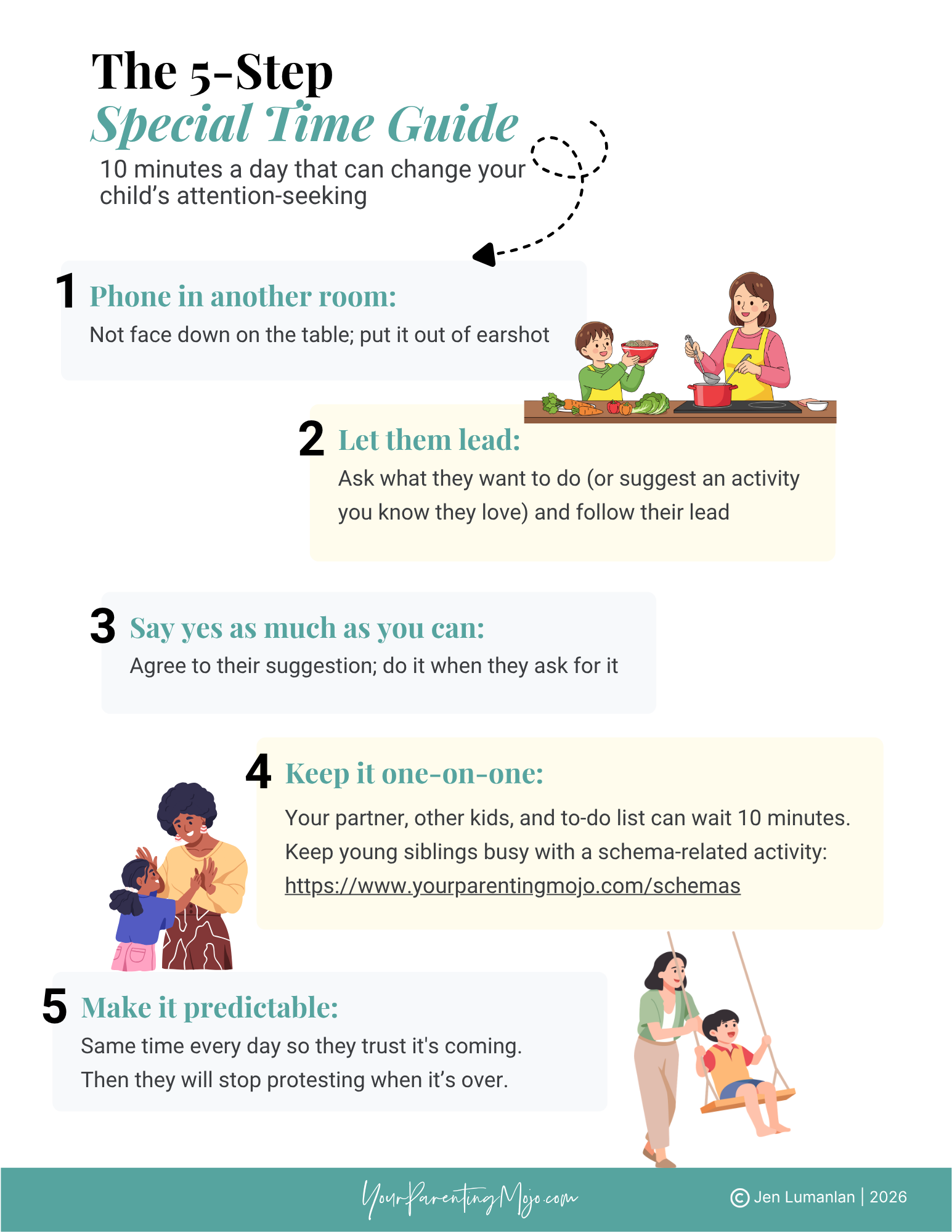
Click here to download the 5-Step Special Time Guide
How to do Special Time #1: Put your phone in another room
Put your phone in another room – not face down on the table, but actually out of earshot. Even a quick glance at a notification pulls you out of the present moment, and your child notices. This is their time.
Why do it? The whole point of Special Time is that your child gets to experience you being fully there – and a phone on the table, even a silent one, tells them they’re competing for your attention.
How to do Special Time #2: Let them lead
Try asking what they want to do. If they don’t know, suggest an activity they often ask for, or one they always say ‘yes’ to when you suggest it. Adults control most of children’s behavior. Special Time also meets a child’s need for autonomy.
Why do it? Autonomy is a core need for most kids age 2+. When your child gets to decide things that are important to them, they’re much less likely to spend the rest of the day trying to wrestle control back from you.
How to do Special Time #3: Say yes as much as you can
If they want a pillow fight and you’re exhausted, you don’t have to spend the full 10 minutes doing a pillow fight. But two minutes of pillow fight is still two minutes, and then you could do a dance party. The goal is to make yes your default if it’s safe to do so. If you can’t stand the activity, remember: it’s only 10 minutes. Try making it your mindfulness practice.
Why do it? A child who hears yes during Special Time learns that their needs and preferences are important to you – and that makes them more willing to accept a no when it really counts.
How to do Special Time #4: Keep other people out of it
Special Time is one-on-one – just you and the child whose turn it is. Your partner, your to-do list, and yes, your other kids, can all wait 10 minutes. If you have multiple children, each one gets their own Special Time separately. This isn’t a group activity. Keep young siblings busy by setting up an activity aligned with their schema.
Why do it? When your child knows that this time is theirs alone – not shared with a sibling or interrupted by a phone call – it sends a clear signal that they are important to you.
How to do Special Time #5: Make it predictable
Your child will protest the end of their first Special Time session. There may be a meltdown. By day 3, the meltdowns will likely be over. They will come to trust that Special Time will happen every day, so they don’t have to protest to make sure they can wring every moment of connection out of you.
Why do it? If your child never knows whether it’s going to happen or whether it will get cut short, they’ll keep finding other ways to make sure their need for connection gets met. Weeks later, when you’re frustrated with your child’s behavior, you will likely then realize you’ve forgotten about Special Time – then you can bring it back.
What If You Struggle To Connect With Your Child?
Not every parent finds Special Time easy. Aija came to one of our Beyond the Behavior coaching calls with exactly this problem. Her son was four and a half, and no matter how much time she spent with him, it never seemed like enough. She’d play and play, and still he’d be asking for more. She started feeling tense right after she woke up, dreading the moment she would step out of the bedroom and he’d say “Let’s play.”
When we dug into it, we quickly uncovered lessons Aija had learned learned growing up – that productivity was valuable and play was a waste of time. She remembered her dad playing with her when she was little, and how much she loved that. But as she got older she was told to focus on getting good grades and learning the skills to be a good mom.
Those messages were still playing in the background when she tried to be present with her son. Every time she sat down to play with him, her brain was telling her she should be doing something more productive.
If any part of that is familiar to you, these shifts helped Aija – and many other parents – to enjoy Special Time:
1. Offer activities you enjoy first. Aija liked building Legos and painting. Her son did too. When you offer the activities you enjoy as the first option, you’re more likely to land on an activity you both like.
2. Use Special Time as a mindfulness practice. When your mind wanders to the chores and the thought that you’re wasting time – instead of fighting the thought, acknowledge it: “I’m thinking I should be doing laundry right now.” Then come back to what’s in front of you.
When she was five, my daughter wanted to sort gravel by color every day for Special Time. Can you think of a more pointless activity? But when I reminded myself that the real point of the activity was to connect with her, and that the actual experience of it was not terrible, I could be present and enjoy it with her. It is only ten minutes!
3. Start with just two minutes. If 10 minutes feels overwhelming, start with two minutes. Sit on the floor with them. Follow their lead for two minutes and see what happens. (It’s like the idea of doing the first 10 minutes of your workout and giving yourself permission to quit after that – usually you finish the workout.) Many parents find that once they’re actually in it, the resistance they felt beforehand was harder than the thing itself.
4. Let go of the outcome. Special Time doesn’t have to seem meaningful to be meaningful. Your child doesn’t need you to be enthusiastic – they need you to be present. Showing up consistently, even when you’re not fully into it, still meets their need for connection.
5. No high-stakes activities. This is not the time for a Pinterest-perfect activity that takes longer to set up and clean up than your child plays with it. Simple is great.
6. Try to avoid screen time if you can. But if you have a child you’re struggling to connect with, and they are really into a screen activity, start by having them tell and/or teach you about it. That creates an opening to branch out into a non-screen activity in a few days/weeks.
7. Notice your child’s behavior on Special Time days. If you’re struggling to motivate yourself to do it, track your child’s behavior for a few days before starting Special Time, then for a week after. Yes, there will be meltdowns as it ends for the first day or two. But many parents see dramatic shifts in their child’s behavior the very same day Special Time begins.
A Starting Place
If Special Time helps but you’re still hitting moments where connection isn’t enough and you’re not sure what to do next, the Setting Loving (& Effective!) Limits workshop walks you through a complete framework for how to handle any behavior from your child.
There are really only five ways to respond to behavior: one of them works ~90% of the time, and builds your relationship with your child. The other four fill in the gap and create some degree of disconnection. Chances are you’re defaulting to one of those four, which is why you’re having a hard time.
Flip that ratio, and your child will want to collaborate with you!
Click the banner to learn more.

Final Thoughts
When your child’s need for connection is met consistently, attention-seeking and other difficult behavior tends to fade on its own.
A predictable ten minutes a day, with your child choosing the activity. You may well be shocked at how much this alone shifts your relationship with your child.
Frequently Asked Questions About Special Time
1. Is one-on-one time good for kids?
Yes! Children have a deep need for connection with their parents. When that need is met consistently, they’re less likely to act out to get your attention. Regular one-on-one time also strengthens your relationship over time, making it easier to work through conflicts when they do come up.
2. How much one-on-one time does a child need?
Start with 10 minutes per child per day. It sounds small, but consistency is what makes it work. A predictable 10 minutes every day does more for your relationship than an occasional longer stretch that happens whenever you can get to it.
3. How do I emotionally connect with my child?
The most direct way is through Special Time – a daily block where you give your child your full attention and let them lead. No phone, no multitasking. Just you, focused on whatever they want to do. Over time, that kind of consistent presence builds a strong emotional connection.
4. How do I build a better relationship with my child?
Start by meeting their need for connection before it turns into a behavior problem. Special Time – 10 minutes a day, child-led, distraction-free – is one of the most effective ways to shift the dynamic between you and your child and build a relationship where limits are easier to set and easier to accept.
5. Why do I struggle to connect with my child?
Many parents grew up with messages that productivity is valuable and play is a waste of time. Those messages don’t disappear when you become a parent – they show up as guilt or restlessness when you play with them. Offering Special Time activities you actually enjoy and using the time as a mindfulness practice can help.
6. How do you deal with a child that craves attention?
When your child is constantly doing things that they know irritate you, they are probably looking for connection.Rather than setting more limits, try giving them a predictable daily block of one-on-one time where they’re fully in charge. When that need is met consistently, the attention-seeking behavior tends to decrease on its own.
7. What is the root cause of attention-seeking behavior?
Most attention-seeking behavior in children comes from a need for connection with their parent. Children would prefer that you aren’t yelling at them but they’ll take yelling over being ignored. Addressing the underlying need directly, through consistent one-on-one time, is more effective than trying to set limits on each behavior you don’t like. If you want to know the need underneath your child’s difficult behavior, take the free Child’s Needs Quiz.
References
Duncan, L.G., Coatsworth, J.D. & Greenberg, M.T. A Model of Mindful Parenting: Implications for Parent–Child Relationships and Prevention Research. Clin Child Fam Psychol Rev 12, 255–270 (2009). https://doi.org/10.1007/s10567-009-0046-3
Fu, M. (2023). The Importance of the Parent-child Relationship to Children’s Psychological Development. Lecture Notes in Education Psychology and Public Media. 6. 286-291. 10.54254/2753-7048/6/20220334.
Landry, S. H., Smith, K. E., Swank, P. R., & Miller-Loncar, C. L. (2000). Early maternal and child influences on children’s later independent cognitive and social functioning. Child development, 71(2), 358–375. https://doi.org/10.1111/1467-8624.00150
Lumanlan, J. (2026, April 12). 262: How Limits Show Up in Your Child’s Body. Your Parenting Mojo. https://yourparentingmojo.com/captivate-podcast/preschool-morning-routine-behavior
Lumanlan, J. (2025, October 19). 257: I Don’t Enjoy Playing With My Kid: Why It Happens & What To Do. Your Parenting Mojo. https://yourparentingmojo.com/captivate-podcast/parenting-guilt-playing-with-kids
Lumanlan, J. (2020, November 20). 125: Should you worry about technoference? Your Parenting Mojo. https://yourparentingmojo.com/captivate-podcast/technoference/
Lumanlan, J. (2018, September 30). 074: Attachment: What it is, what it’s not, how to do it, and how to stop stressing about it. Your Parenting Mojo. https://yourparentingmojo.com/captivate-podcast/attachment/
Lumanlan, J. (2020, April 3). How to keep your child busy (and learning!) while you work. Your Parenting Mojo. https://yourparentingmojo.com/schemas/
Lumanlan, J. (n.d-a). Setting Loving (& Effective) Limits Workshop. Your Parenting Mojo. https://yourparentingmojo.com/settinglimits
Lumanlan, J. (n.d-d). Identifying Your Child’s Needs Quiz. Your Parenting Mojo. https://yourparentingmojo.com/childs-needs-quiz/
Milkie, M.A., Nomaguchi, K.M. & Denny, K.E. (2015), Does the Amount of Time Mothers Spend With Children or Adolescents Matter?. J. Marriage Fam, 77: 355-372. https://doi.org/10.1111/jomf.12170
Offer, S. (2014), The Costs of Thinking About Work and Family: Mental Labor, Work–Family Spillover, and Gender Inequality Among Parents in Dual-Earner Families. Sociol Forum, 29: 916-936. https://doi.org/10.1111/socf.12126
Ryan, R. M., & Deci, E. L. (2000). Self-determination theory and the facilitation of intrinsic motivation, social development, and well-being. American Psychologist, 55(1), 68–78. https://doi.org/10.1037/0003-066X.55.1.68
Spagnola, M., & Fiese, B. (2007). Family Routines and Rituals: A Context for Development in the Lives of Young Children. Infants & Young Children 20(4):p 284-299. https://doi.org/10.1097/01.IYC.0000290352.32170.5a
Serbin, L. A., & Karp, J. (2004). The intergenerational transfer of psychosocial risk: mediators of vulnerability and resilience. Annual review of psychology, 55, 333–363. https://doi.org/10.1146/annurev.psych.54.101601.145228

About the author, Jen
Jen Lumanlan (M.S., M.Ed.) hosts the Your Parenting Mojo podcast (www.YourParentingMojo.com), which examines scientific research related to child development through the lens of respectful parenting.