

Intentional Parenting Goals That Actually Work
Key Takeaways
- Most parenting resolutions don’t stick because they rely on willpower instead of addressing underlying needs. When you’re triggered, your nervous system takes over and willpower can’t stop that.
- Intentional parenting means choosing how you respond instead of reacting on autopilot. You figure out what needs drive your and your kids’ behavior, then set up your day so everyone’s needs get met.
- Realistic resolutions start with tracking what sets you off and which needs aren’t getting met – not promising you’ll yell less.
- Positive parenting strategies: identify the need before you react, solve problems together with your child, and change your environment so you’re not relying on willpower when you’re stressed.
- Goals of parenting: understand and meet multiple people’s needs. When we teach obedience, kids don’t learn how to truly collaborate.
- Repair time matters more than perfection. When you mess up, say what happened, own your part, and reconnect with your child.
- Getting support helps. You need other parents who get it, research-based guidance, and ways to understand what’s happening when things go sideways.
Most parenting resolutions fail by February.
You know the ones: “I’ll stop yelling at my kids.” “We’ll have peaceful mornings.” “I’ll be more patient.”
We set these goals with the best intentions. But by the end of January, we’re back to the same struggles – and maybe feeling even worse about ourselves because we “failed” again.
Most parenting resolutions rely on willpower. And willpower runs out fast when you’re exhausted, triggered, and your child refuses to put on shoes for the tenth time.
Instead of making resolutions based on behavior change, let’s focus on intentional parenting – understanding what needs aren’t getting met (ours AND our children’s) and building systems that support everyone, including you.
Why Your Parenting Resolutions Keep Failing
Think about the last parenting resolution you made. Maybe it was “I’ll stop yelling” or “I’ll be more patient with my kids.”
These resolutions focus on stopping a behavior without understanding what drives it. When your body is flooded with stress hormones and your child is having a meltdown in the grocery store, no amount of willpower will help you stay calm.
When we experience something that reminds us – even unconsciously – of difficult experiences from our own childhood, our bodies respond. Our heart rate increases. Our blood pressure jumps. The part of our brain responsible for speech can actually shut down.
The traumatic events we experienced in our lives show up in our bodies. And when we’re triggered, we yell, run away, leave emotionally, do anything to get them to stop the tantrum, or freeze (depending on what was the most effective strategy for us as we interacted with our caregivers when we were little).
Your upbringing shapes how you parent today. The ways your parents used power over you becomes the template for how you use power over your own children.
If you would have been punished for having a meltdown, when your kids have a meltdown you probably feel an intense tension. The part of you that wants your kids to be able to feel their feelings gets overwhelmed by the part of you that remembers being punished for feeling your feelings.
Because the punished part has been with you for much longer, in stressful moments it usually wins – and you yell.
Willpower-based resolutions ignore all of this. They assume that if you tried harder, you’d be able to make the change you want to see. But trying harder doesn’t address your underlying needs that aren’t getting met, or the triggers from your past that set you off.
That’s why these resolutions fail. But that doesn’t mean you can’t change how you interact with your kids.
What Is Intentional Parenting?
Intentional parenting means making conscious choices about how you interact with your child, based on your values.
It’s the opposite of reactive parenting – where you’re constantly putting out fires, saying “no” without thinking about why; just surviving each day.
When you parent with intention, you:
- Understand what needs drive both your behavior and your child’s behavior
- Make choices aligned with your values instead of just following what your parents did or what society says you “should” do
- Build systems that support everyone instead of relying on willpower in the moment
- See your child’s resistance as information rather than defiance
Parenting with purpose takes this a step further. It means knowing WHY you’re making the choices you make. What do you want for your children as they grow up? What qualities do you want to nurture? How do you want them to remember their childhood?
Your answers to these questions shape hundreds of small decisions you make every day.
Do you force your child to hug Grandma, or do you respect their bodily autonomy?
Do you make them finish everything on their plate, or do you trust them to know when they’re full?
Do you get frustrated when they don’t ‘listen,’ or do you find ways to meet both of your needs?
Each of these interactions teaches your child something – not just about the specific situation, but about:
- How people with power should treat people with less power.
- Whether they can trust their own judgment.
- Whether their feelings and needs matter.
Intentional parenting recognizes that children don’t just learn WHAT we teach them. They learn HOW we teach them.
If we use shame and control to get compliance, that’s what they learn to do with their own power someday – in their relationships with their own kids, and with others in their lives as well.
What Are the Goals of Parenting? A Needs-Based Perspective
Ask most parents what their goals are, and you’ll hear things like: “I want my child to be successful.” “I want them to be happy.”
And, in the short term: “I want them to listen” (by which we often mean “do what I tell them to do”).
Our parents basically had these goals too. They wanted the best for us. And they were surviving every day the best they could with the trauma they were carrying and the tools they had available to them.
Parenting with these goals created a lot of pain for us, because our parents tried to shape our behavior.
They might have rewarded us for fitting in with gender norms; for doing well in school; for ‘listening,’ and punished us when we didn’t do those things.
Or maybe they didn’t even have to reward us – because we understood it was safest if we didn’t even have needs, and took care of everyone else instead.
Many of the parents work with have spent so many decades suppressing their needs that they don’t even know how to identify them.
Needs drive all of our behavior – ours; our kids’; everyone.
When we understand and meet our own needs, we feel content; at peace.
When we understand and meet our kids’ needs, they feel content and at peace, and our relationship is strong. They know our love for them isn’t dependent on them producing certain behaviors. They’re more willing to collaborate with us to help us meet our needs as well.
This is the foundation for everything you want for your child. Your child can’t be happy if they don’t understand their own needs. They can’t be in nourishing, fulfilling relationships with others if they don’t know how to meet multiple people’s needs.
When you understand these deeper goals, suddenly those daily battles look different. Instead of asking “How do I make my child brush their teeth?”, you start asking “How do I support my child in developing healthy habits while respecting their autonomy and maintaining our connection?”.
How to Pick a Realistic Resolution: Parenting Goals Examples That Work
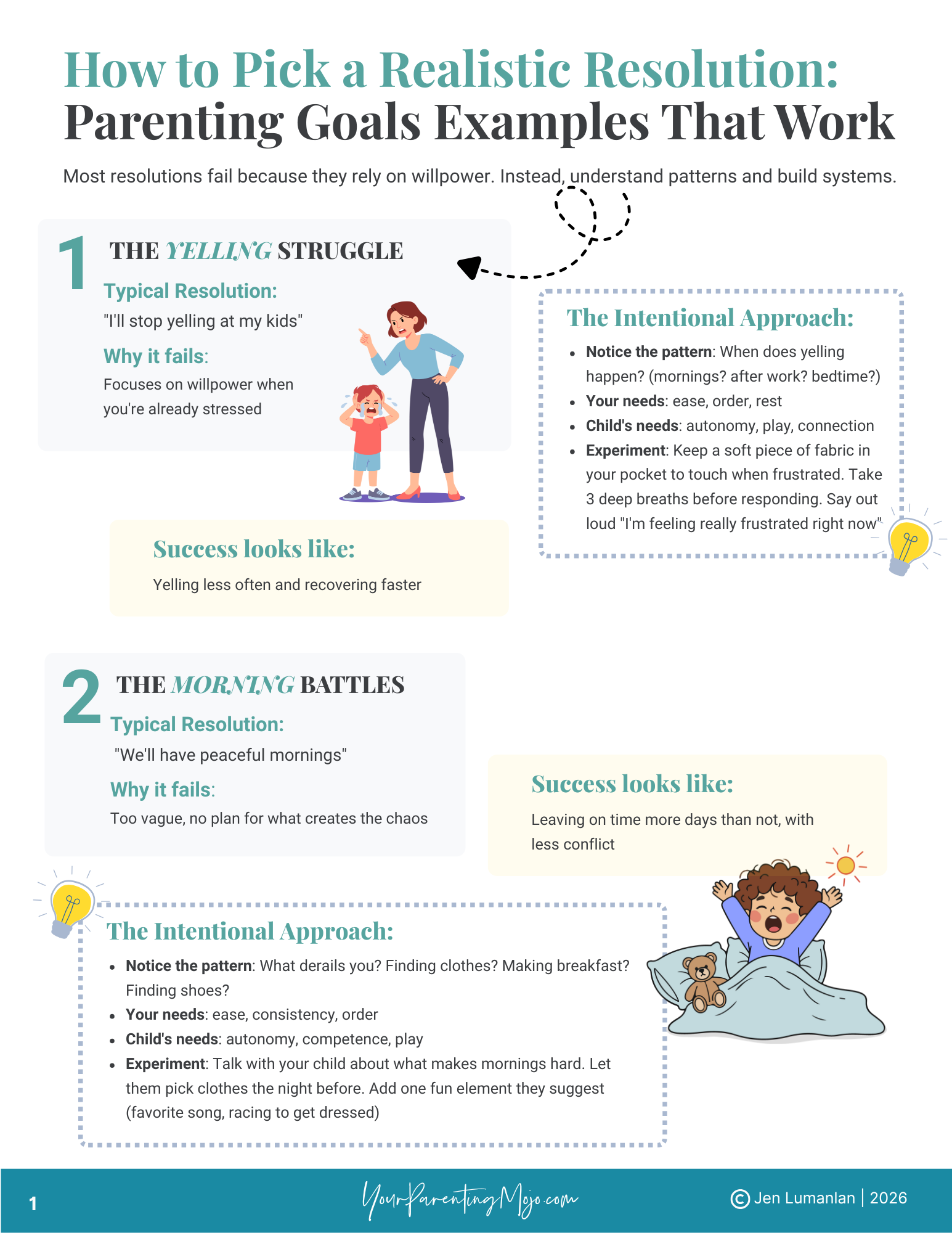
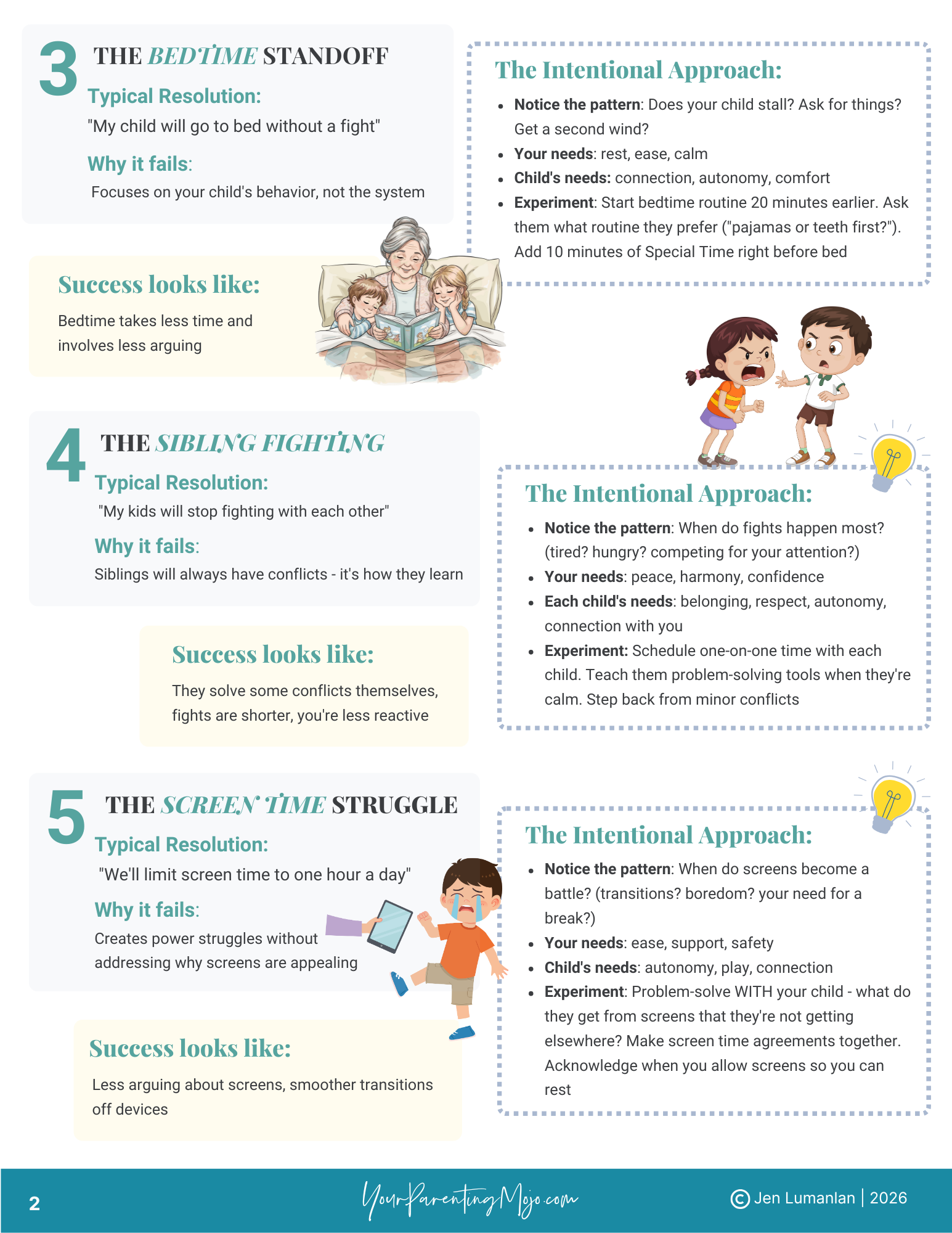
Click here to download the How to Pick Realistic Resolution: Parenting Goals Examples That Work
So if “I’ll stop yelling” doesn’t work, what does?
The key is moving from willpower to understanding patterns. Instead of resolving to be different, start by noticing when struggles happen and what needs aren’t getting met.
Here’s how this looks in practice:
Parent Goals Example 1: The Morning Battles
Typical Resolution: “We’ll have peaceful mornings”
Why it fails: Too vague, no plan for what creates the chaos
The Intentional Approach:
- Map the morning pattern: What derails you? (finding clothes, making breakfast, finding shoes)
- Your needs: perhaps ease, consistency, order
- Your child’s needs: maybe autonomy, competence, play
- Experiment: Talk with your child about what makes mornings hard for them. Maybe there are too many choices, or they feel rushed, or they’re feeling anxious about school. When you address the challenges underlying their behavior, they stop resisting.
How to know it’s working: You’re leaving on time more days than not, with less conflict
Parent Goals Example 2: The Bedtime Standoff
Typical Resolution: “My child will go to bed without a fight”
Why it fails: Focuses on your child’s behavior, not the system
The Intentional Approach:
- Notice the pattern: Does your child stall? Ask for things? Get a second wind?
- Your needs: rest, ease, calm
- Your child’s needs: connection, autonomy, comfort
- Experiment: Start bedtime routine 20 minutes earlier, ask them what routine they prefer (“pajamas or teeth first?”), add 10 minutes of Special Time right before bed
How to know it’s working: Bedtime takes less time overall and involves less arguing
Parent Goals Example 3: The Sibling Fighting
Typical Resolution: “My kids will stop fighting with each other”
Why it fails: Siblings will always have conflicts – it’s how they learn
The Intentional Approach:
- Notice when fights happen most (tired? hungry? competing for your attention?)
- Your needs: peace, harmony, competence
- Each child’s needs: belonging, respect, autonomy, connection with you
- Experiment: Schedule one-on-one time with each child, teach them problem-solving tools when they’re calm, step back from minor conflicts
How to know it’s working: They’re solving some conflicts themselves, fights are shorter, and you’re less reactive
Parent Goals Example 4: The Screen Time Struggle
Typical Resolution: “We’ll limit screen time to one hour a day”
Why it fails: Creates power struggles without addressing why screens are appealing
The Intentional Approach:
- Notice the pattern: When do screens become a battle? (transitions? boredom? your need for a break?)
- Your needs: ease, support, safety of children
- Your child’s needs: autonomy, fun, connection
- Experiment: Problem-solve WITH your child about screen time – what do they get from screens that they’re not getting elsewhere? Collaborate on screen time agreements, and acknowledge that sometimes you allow screens so you can rest
How to know it’s working: Less arguing about screens, your child transitions off devices more smoothly
Notice how each example starts with observation instead of judgment because you’re trying to understand what’s happening before experimenting with small changes.
Some experiments will work, others won’t. That’s the point. You’re building collaborative parenting skills and connection-based parenting practices that grow with your family.
Parent Goals Example 5: The Yelling Struggle
Note: This example is last in the list because you will already feel less stressed if you use the other ideas first. This one is for the times when something comes up that you didn’t anticipate, and you feel dysregulated.
Typical Resolution: “I’ll stop yelling at my kids”
Why it fails: Focuses on willpower when you’re already stressed
The Intentional Approach:
- Notice when yelling happens most (mornings? after work? bedtime?)
- Identify your unmet needs (maybe: ease, order, rest)
- Identify your child’s unmet needs (maybe: autonomy, play, connection)
- Experiment: What if you kept a soft piece of fabric in your pocket to touch when you feel yourself getting frustrated? What if you took three deep breaths before responding? What if you said out loud “I’m feeling really frustrated right now” instead of yelling?
How to know it’s working: You might still raise your voice occasionally, but you’re yelling less often and recovering faster
What Are Positive Parenting Strategies That Support Your Goals?
Once you understand your goals and the needs driving everyone’s behavior, you need strategies to bridge the gap between where you are and where you want to be.
Here are five key strategies:
Positive parenting strategies that support your goals #1: Identify needs before reacting
The next time your child does something that makes you want to yell, pause for just three seconds. Ask yourself: “What need is my child trying to meet right now?”
Maybe they’re dumping water on the floor because they need to experiment and learn. Maybe they’re hitting their sibling because they need your attention and don’t know how else to get it. Maybe they’re refusing to get dressed because they need autonomy.
Your reaction will be completely different when you see the need instead of just the behavior.
Positive parenting strategies that support your goals #2: Problem-solve WITH your child
Instead of declaring what will happen, invite your child into the conversation: “We’re having trouble getting out the door on time in the mornings. I’ve noticed you often can’t find your shoes. What ideas do you have?”
Even young children can contribute solutions. And when they help create the plan, they’re much more likely to follow it. Research shows that supporting children’s autonomy – rather than controlling them – leads to better adjustment and internalization of values.
Positive parenting strategies that support your goals #3: Create systems (not willpower)
Willpower fails, but systems succeed.
Instead of resolving to be more patient, create a system: “When I feel myself getting frustrated, I’ll touch the soft piece of fabric I keep in my pocket to bring myself back to the present moment.”
Instead of resolving to have better mornings, create a system: “We’ll lay out clothes and pack bags the night before.”
Systems remove the need for decision-making in the moment when you’re already stressed.
Positive parenting strategies that support your goals #4: Build in repair time
You will mess up. You’ll yell when you don’t want to. You’ll be harsh when you mean to be gentle. You’ll prioritize getting out the door over connection.
What matters is what you do next.
Repair doesn’t mean apologizing and moving on. It means acknowledging what happened, taking responsibility, and reconnecting: “I yelled at you this morning when you couldn’t find your shoes. That wasn’t okay. I was worried about being late, but that’s not your problem to manage. I’m sorry. Can we talk about how to make mornings easier for both of us?”
This teaches your child that relationships can survive conflict. That mistakes don’t define you. That repair is always possible.
Positive parenting strategies that support your goals #5: Get support
Parents in the Parenting Membership often talk about how much changed when they stopped trying to do this work alone.
One parent, Jenny, spent four years exhausted because she was prioritizing everyone else’s sleep above her own – her son’s sleep, her husband’s sleep because he was “the breadwinner.” When she joined the membership, she realized the best sleep solution is the one that gets YOU the most sleep. She started going to bed at 8pm with her son. She felt a bit sheepish at first, but getting decent sleep for the first time in years changed everything.
Parenting is hard. Changing patterns that have been passed down through generations is even harder. Staying calm when you’re triggered takes practice and support.
You need people who share your values. People who will remind you why this matters when you’re exhausted. People who will help you break down big overwhelming goals into steps you can actually take this week.
Getting Support for Your Intentional Parenting Goals
These strategies work better when you have support. Doing this alone is hard.
Here’s what changes when you have the right support:
You stop spending hours googling solutions at midnight and instead get clear guidance based on research and real parent experiences. You stop second-guessing every decision because you have a framework for understanding what’s happening. You stop feeling disconnected because you’re in community with parents who share your values.
The Parenting Membership gives you:
- Tools for identifying needs – so you can understand what’s really happening in difficult moments
- Coaching on your real situations – not generic advice, but specific help with your actual family
- A community of parents doing this work – who will celebrate your wins and support you through the hard parts
- Resources for specific struggles – whether it’s bedtime, sibling fights, parenting disagreements or something else entirely
Click the banner to learn more about the Parenting Membership.

Final Thoughts
Most parents don’t set out to yell at their kids or have daily battles over shoes. But without intentional planning, we fall back on the patterns we learned from our own parents – even when those patterns don’t match our values.
The New Year is a chance to try something different. Not another willpower-based resolution that will fail by February. But a shift toward understanding needs, building systems, and getting support.
Small experiments over big promises. Progress over perfection. Connection over control.
Links to products on Amazon are affiliate links, which means I receive a small commission that does not affect the price you pay.
Frequently Asked Questions About Parenting Goals & Resolutions
1. What is intentional parenting?
Intentional parenting means making conscious choices about how you interact with your child based on your values rather than just reacting in the moment. When you parent with intention, you understand what needs drive both your behavior and your child’s behavior. You make choices aligned with your values instead of following what your parents did or what society says you should do. You build systems that support everyone instead of relying on willpower when you’re already stressed.
2. What are the goals of parenting?
The goals of parenting should focus on helping children develop three key capacities: autonomy (the ability to make good decisions for themselves), connection (strong relationships where they are accepted and supported), and competence (confidence in their ability to handle challenges). When you focus only on parent-centered goals like obedience, children comply when you’re watching but don’t develop internal motivation to do the right thing when no one’s around.
3. What does parenting with purpose mean?
Parenting with purpose means knowing WHY you’re making the choices you make. What do you want for your children as they grow up? What qualities do you want to nurture? How do you want them to remember their childhood? Your answers shape hundreds of small daily decisions. Each choice teaches your child something about how people with power should treat people without power, whether their feelings matter, and whether they can trust their own judgment.
4. How to pick a realistic resolution?
Pick a realistic resolution by moving from willpower to understanding patterns. Instead of resolving to be different, start by noticing when struggles happen and what needs aren’t getting met. Map the pattern (when does the struggle happen?), identify your unmet needs and your child’s unmet needs, then experiment with small changes. You’ll know it’s working when you see progress, even if things aren’t perfect.
5. What are positive parenting strategies?
Positive parenting strategies include identifying needs before reacting (asking “What need is my child trying to meet right now?”), problem-solving with your child instead of declaring what will happen, and creating systems instead of relying on willpower. Other collaborative parenting strategies include building in repair time when you mess up and getting support from people who share your values. These approaches support respectful parenting by addressing everyone’s needs.
6. What are smart goals for parenting?
Smart parenting goals focus on understanding patterns rather than forcing behavior change. Instead of “I’ll stop yelling,” try “I’ll notice when yelling happens most and identify what needs aren’t getting met.” Instead of “peaceful mornings,” try “We’ll experiment with laying out clothes the night before and starting our routine 20 minutes earlier.” Good parenting goals examples focus on systems and understanding instead on willpower.
7. Why do parenting resolutions fail?
Parenting resolutions fail because they rely on willpower. When your body is flooded with stress hormones and your child is having a meltdown, no amount of willpower helps you stay calm. The traumatic events you experienced in your life show up in your body. When you’re triggered, you go into fight or flight mode. Willpower-based resolutions ignore this and assume you just need to try harder, without addressing underlying needs.
8. What are needs-based parenting goals examples?
For morning battles, identify your needs (ease, consistency, order) and your child’s needs (autonomy, competence, play), then problem-solve together about what makes mornings hard. For yelling struggles, notice when it happens most and experiment with keeping soft fabric in your pocket to touch when frustrated. For bedtime standoffs, add 10 minutes of connection time and let your child choose the routine order. These parenting goals examples address real needs instead of forcing compliance.
References
Conger, R. D., Belsky, J., & Capaldi, D. M. (2009). The intergenerational transmission of parenting: Closing comments for the special section. Developmental Psychology, 45(5), 1276–1283. https://doi.org/10.1037/a0016911
Duncan, L. G., Coatsworth, J. D., & Greenberg, M. T. (2009). A model of mindful parenting: implications for parent-child relationships and prevention research. Clinical child and family psychology review, 12(3), 255–270. https://doi.org/10.1007/s10567-009-0046-3
Horvath, C. A., & Lee, C. M. (2015). Parenting Responses and Parenting Goals of Mothers and Fathers of Adolescents. Marriage & Family Review, 51(4), 337–355. https://doi.org/10.1080/01494929.2014.955938
Joussemet, M., Landry, R., & Koestner, R. (2008). A self-determination theory perspective on parenting. Canadian Psychology / Psychologie canadienne, 49(3), 194–200. https://doi.org/10.1037/a0012754
Kochanska, Grazyna & Thompson, Ross. (1997). The emergence and development of conscience in toddlerhood and early childhood. Parenting and children’s internalization of values: A handbook of contemporary theory.
Lumanlan, J. (2025, October 19). I Don’t Enjoy Playing With My Kid: Why It Happens & What To Do. Your Parenting Mojo. https://yourparentingmojo.com/captivate-podcast/parenting-guilt-playing-with-kids
Lumanlan, J. (2025, May 7). How to Foster Positive Sibling Relationships. Your Parenting Mojo. https://yourparentingmojo.com/foster-positive-sibling-relationships
Lumanlan, J. (2024, April 28). How to raise a child who doesn’t experience shame. Your Parenting Mojo. https://yourparentingmojo.com/captivate-podcast/noshame/
Lumanlan, J. (2023, August 16). The connection between social challenges and power. Your Parenting Mojo. https://yourparentingmojo.com/socialchallenges/
Lumanlan, J. (2023, April 30). What I wish I’d known about parenting. Your Parenting Mojo. https://yourparentingmojo.com/captivate-podcast/whatiwishidknown/
Lumanlan, J. (2022, September 25). Healing and Helping with Mutual Aid. Your Parenting Mojo. https://yourparentingmojo.com/captivate-podcast/mutualaid/
Lumanlan, J. (2021, July 25). The Body Keeps The Score with Dr. Bessel van der Kolk. Your Parenting Mojo. https://yourparentingmojo.com/captivate-podcast/thebodykeepsthescore/
Lumanlan, J. (2021, February 7). The physical reasons you yell at your kids. Your Parenting Mojo. https://yourparentingmojo.com/captivate-podcast/yelling/
Lumanlan, J. (2018, November 26). You have parenting goals; do you know what they are?. Your Parenting Mojo. https://yourparentingmojo.com/captivate-podcast/goals/
Lumanlan, J. (2017, January 8). How do I get my child to do what I want them to do?. Your Parenting Mojo. https://yourparentingmojo.com/captivate-podcast/compliance/
Lumanlan, J. (n.d). The Anxious Generation Resources. Your Parenting Mojo. https://yourparentingmojo.com/theanxiousgeneration
Robichaud, J. M., Mageau, G. A., Kil, H., McLaughlin, C., Comeau, N., & Schumann, K. (2025). Parental apologies as a potential determinant of adolescents’ basic psychological needs satisfaction and frustration. Journal of experimental child psychology, 254, 106204. https://doi.org/10.1016/j.jecp.2025.106204

About the author, Jen
Jen Lumanlan (M.S., M.Ed.) hosts the Your Parenting Mojo podcast (www.YourParentingMojo.com), which examines scientific research related to child development through the lens of respectful parenting.