
What Childhood Defiance Is Really Telling You (And How to Respond)
Key Takeaways
- Childhood defiance is rarely about willfulness. When a child pushes back, they’re usually either trying to connect with you or telling you they’ve had too little say over their own day.
- When your child says a flat “no” instead of melting down, that’s actually progress. Simple refusals show more self-control than defiance does. A child who complies with everything is not the goal.
- If you’re not sure why you’re setting a limit, your child will sense it – and test it. Limits that stick come from values you actually believe in, not from fear of what might happen if you don’t hold them.
- Before you add another limit, look at the ratio. If your child is getting five corrections for every one warm moment, the relationship needs attention before the behavior does.
- Haim Ginott’s three-zone framework sorts behavior into what you welcome, what you tolerate temporarily, and what you never allow. Knowing which zone you’re in stops you from fighting battles that don’t need to be fought.
- Natural consequences happen on their own – the world does the teaching. Logical consequences are something you set up, and they only work when they’re directly tied to the behavior. Punishment is neither – it’s unrelated to what happened and teaches the child to react to your power rather than take on your values.
- When you know the need driving the behavior – especially the need for autonomy – you stop managing defiance and start resolving it. Most children have the same three to five needs underneath most of their hardest moments.
You ask your child not to jump on the couch. They look you right in the eye, climb up, and start jumping.
What do you do next?
You could calmly repeat yourself – and they get off the couch and immediately start emptying the kitchen cupboards.
You could tell them for the hundredth time to stop, your voice getting louder.
You could explode and then spend the next hour feeling guilty about it.
Or you could sigh and look the other way, because you already know how this ends.
None of those feel right. And if you’ve tried all of them and you’re still having the same fight every day, that’s not a you problem. It’s a signal that something different needs to happen.
Childhood defiance is one of the most exhausting things parents deal with. And the instinct is almost always to set more limits, hold them more firmly, and push harder for compliance. But the research tells a different story.
Most of the time, setting more limits makes defiance worse. What actually helps is understanding what your child’s behavior is communicating, knowing your own needs, and building the kind of relationship where limits rarely have to be set in the first place. . Let’s see how to do that – because it’s totally possible.
What Childhood Defiance Is Really Telling You
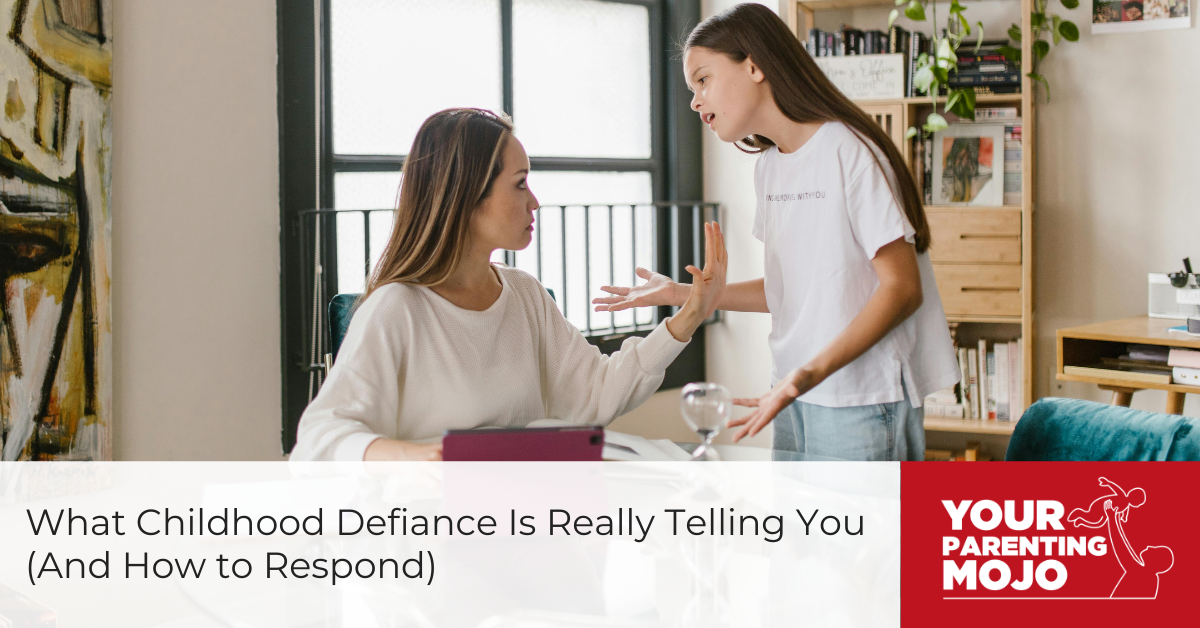
When a child ignores a request, does the opposite of what you asked, hits a sibling, or stalls at bedtime every single night, it’s easy to see that as a character problem. A willful child. A difficult child. A child who just doesn’t listen.
But behavior is communication. And what looks like defiance is usually either a bid for connection or a response to having too many limits placed on their sense of control over their own life.
Testing limits is actually a developmental milestone
When your child says a flat “no” – just a simple refusal, no drama attached – that’s actually progress.
Dr. Grazyna Kochanska’s research on how children experience parental requests found that the way children express noncompliance shifts as they grow. Young children tend toward passive noncompliance – they just don’t do the thing – or direct defiance.
Over time, those patterns shift toward simple refusals and negotiation. Simple refusals, where the child just says “no”, are viewed in the research as a developmental milestone. They show more autonomy and competence than defiance does, because the child’s goal has shifted from resisting you to asserting themselves.
So when a five-year-old looks you in the eye and says “no, I don’t want to”, they’ve actually leveled up. That’s not the same as a two-year-old screaming and throwing things. It’s a more skilled form of resistance. Which means testing limits, or at least the more sophisticated versions of it, reflects healthy development – not a problem to be eliminated.
Dr. Alan Sroufe put it plainly: “Automatic compliance is not the hallmark of a competent two-year-old.” A child who says yes to everything you ask, every time, is not a parenting success story. Research shows that highly compliant boys at age five were more likely to struggle with anxiety, sadness, and fearfulness. Complete compliance is not the goal.
Is defiance a sign of unmet needs?
Very often, yes. Consider the story of parent Peju, whose daughter was refusing to eat dinner every night and resisting going to Chinese class. Peju couldn’t figure out where all this resistance was coming from.
When we looked at the full picture of their day together, we noticed how many limits Peju was setting – and that most of them had nothing to do with her actual values.
Once Peju pulled back on those limits and let her daughter make more choices throughout the day – what to eat for breakfast, when to eat it, what to pack for lunch – the resistance dissolved. Her daughter started eating dinner and going to Chinese class without a fight.
The behavior had been communicating: you’re not the boss of me.
What does unmet need mean in this context? It means your child has something they’re trying to get – autonomy, connection, competence, safety – and the strategies they’re using to get it are ones you find difficult or exhausting. When you don’t know what your child’s needs are, their behavior looks like defiance. When you do, it starts to make sense.
The Real Reason Setting Limits Feels So Hard
Most parents don’t struggle because they haven’t found the right script or because children are stubborn. They’re struggling for one of three deeper reasons – and no script fixes any of them.
Why setting limit feels hard reason #1: You’re not sure what your values are
Values and goals are different things. A goal is the summit of the hike. Values are the decisions you make about how you want the journey to feel – whether you take photos, whether you chat or hike in silence, whether you pack trail mix or a gourmet lunch.
Goals tell us where we want to go. Values guide the decisions we make along the way.
When you don’t know what your values are, setting limits becomes guesswork. You’re setting limits based on fear (what if they become someone nobody wants to be around?) rather than on something you actually believe. And children can tell. If you set a limit you don’t believe in, your tone won’t be clear and firm – it’ll be uncertain and slightly apologetic, and your child will test it.
Our couch was about 12 years old when Carys was one and jumping on it, it seemed okay. By the time she was three and still jumping on it, it was creaking, springs were collapsing. And it was clear it was not meant to take that kind of use. So we did institute a limit of not jumping on the couch.
That limit came from a genuine value – respecting property. The limit was enforced simply because I believed in it. When you believe the limit, you don’t have to gear up for conflict. You just hold it.
Why setting limit feels hard reason #2: You’re setting limits to control behavior, not to meet a need
Think of a time when someone told you that you had no choice – that you had to do something. Maybe a parent told you what major to take in college. A boss handed you a project without asking. A partner told you what they wanted you to do and made it clear that wasn’t a discussion.
Did you want to do the thing? Even if you’d wanted it before, maybe you wanted it just a little bit less once someone took away your say.
All humans – including children who can’t yet speak – want a say over what happens to them. That’s the need for autonomy, one of the three core needs identified in self-determination theory (autonomy, competence, and relatedness). And it doesn’t kick in at adolescence or school age. It’s there in infancy. The older children get, the more strongly they feel it.
The question worth asking isn’t just “what do I want my child to do?” It’s also “what do I want their reason to be for doing it?” If the answer is fear – fear of me, fear of punishment, fear of what happens if they don’t – then we’re building something that might look like compliance but is actually a child who’s given up on advocating for themselves.
Why setting limit feels hard reason #3: You don’t know your own needs
This one is the most important – and the hardest.
Once when Carys was about six, she was jumping on the deck of a house we were staying in, and she kept jumping toward the steps down to the garden. My first instinct was to say “stop jumping like that, you’re going to hurt yourself.” But I knew what my actual need was: safety. Her safety, specifically.
So instead I said: “I’m worried you’re going to fall down the steps and hurt yourself. How can we make sure that doesn’t happen?”
She had an idea. I had an idea. Hers conflicted slightly with mine, so she came up with another one – moving pebbles to the side so she could mark her jumps without landing on them. That met both of our needs without a limit. She got play, movement, joy, and competence. I got safety.
None of that would have been possible if I hadn’t known what I actually needed. If I’d been operating on a vague sense of irritation – or if my need had actually been for quiet and I hadn’t recognized it – I would have felt resistant to her suggestions without knowing why. My window of tolerance would have narrowed, and eventually I would have snapped.
Knowing your needs doesn’t just help you set better limits. It often means you don’t need to set one at all.
Connection Before Correction
The most powerful limit-setting tool you have isn’t a consequence or a script. It’s your relationship with your child. A positive relationship between parent and child reduces the need for limits and increases the effectiveness of the ones you do set.
What the 5:1 ratio means for childhood defiance
Drs. John and Julie Gottman’s research on couples found that relationships stay healthy when there are at least five positive interactions for every negative one. When the ratio drops below that, partners start interpreting even neutral signals as hostile – and reacting accordingly.
Children work the same way (although I often think that because we’re in a position of power over them, ideally we should be aiming for a higher than 5:1 ratio because our position of power is itself a ‘negative’ position).
Many of the parents who feel stuck in a cycle of childhood defiance are running the ratio in reverse. They’re giving five corrections, limit-settings, and redirections for every one warm, connected moment.
If you have or have had a partner, think about what your relationship with them is like when you get five instructions, criticisms, and redirections for each “thanks,” “I appreciate you,” or “I love you.” We’d want relationship counseling, stat.
A child can’t ask for relationship counseling, so they become ‘defiant.’ (We might get that way too, if our partner won’t agree to counseling.)
The defiance is a signal. And setting more limits in response to that signal tends to make things worse – just like your partner giving more instructions, criticisms, and redirections would annoy you more.
What connection before correction actually looks like
A parent named Jamie had been working on her relationship with her daughter and was getting better at pausing before responding. One evening, she was walking with her daughter outside a grocery store when her daughter started heading toward a meltdown. Tired, upset, pulling in the other direction, almost tantruming.
The old move would have been to tell her daughter to watch her tone, keep walking, they needed to get the ingredient for dinner. Instead Jamie stopped. She said: “I can see you’re very tired, and you really want to go home. You must have had a really, really hard day today.”
Her daughter stopped. And said yes – she’d had a terrible day. A boy had hit her at school.
The defiance dissolved. Her daughter became talkative, happier, more cooperative. They went into the store. Things were better.
A limit would not have helped there. Correcting her daughter’s tone would not have helped. Her daughter had a need to be heard and understood. Once that need was met, she was able to cooperate with what Jamie needed too.
That’s what connection before correction looks like in practice. It isn’t always a dramatic turnaround. But it works because it addresses what’s actually happening, rather than the surface behavior.
How secure attachment reduces the need for limits
Dr. Kochanska’s research on what she called “committed compliance” – where children genuinely take on a parent’s values rather than complying out of fear or habit – found that it occurred most often when the parent and child had a mutually positive relationship. Children in those relationships didn’t need to be controlled as forcefully to cooperate. And taking on the parent’s values deepened the relationship further. Relatedness leads compliance, and compliance deepens relatedness.
Secure attachment behavior in parents – being responsive, warm, consistent – creates the conditions for children to want to take on your values. Not because you’re forcing them to. Because the relationship is one they want to maintain.
If you want this kind of connection with your child, but are still not sure how to make it work in real life – in your specific situation – the Setting Loving (& Effective!) Limits workshop was built for exactly that. Click here to join the workshop.
How to Set Limits That Actually Work
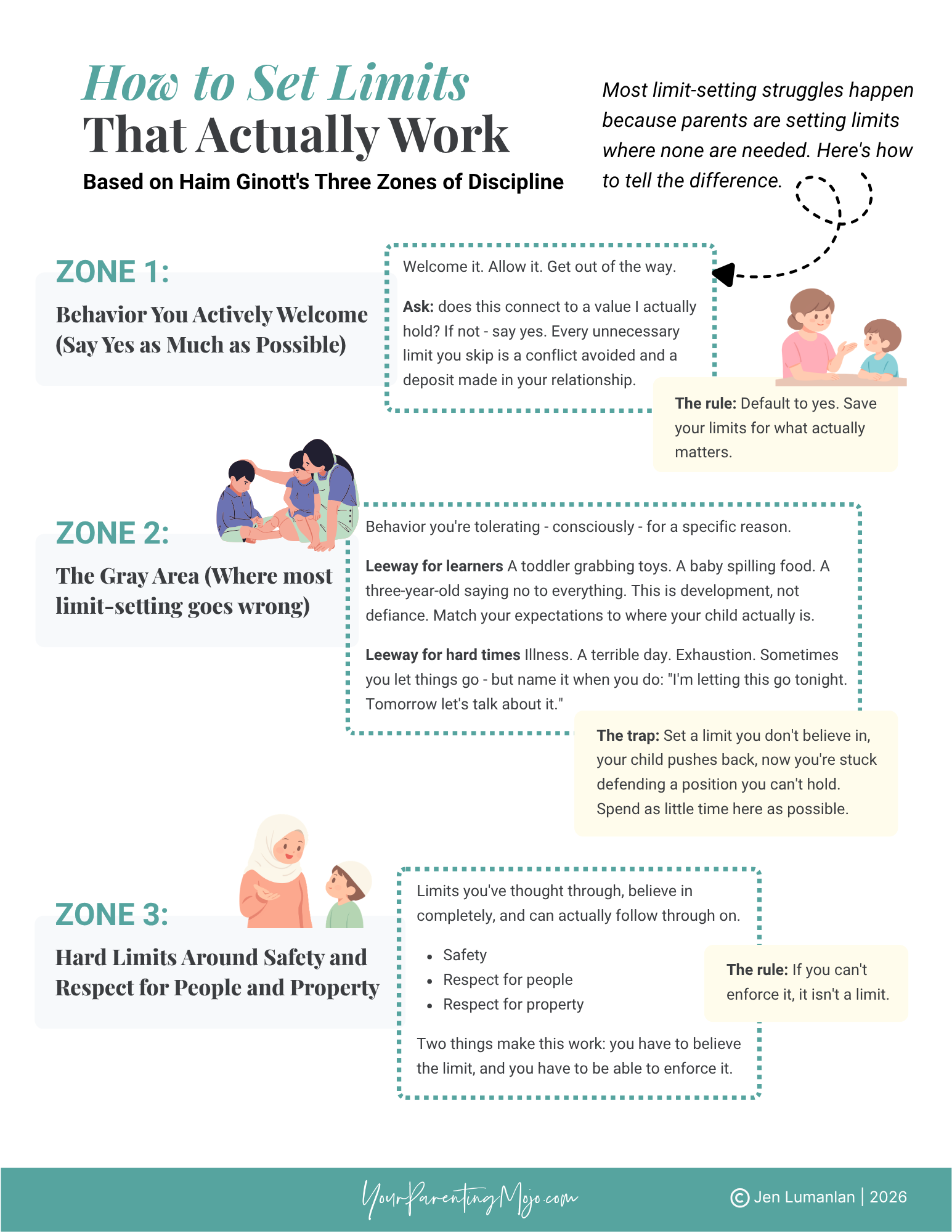
So what does effective limit-setting actually look like? Haim Ginott – an Israeli elementary school teacher who studied psychology at Columbia University and later worked with troubled children in Jacksonville, Florida – proposed a framework that still holds up decades later. It’s built around three zones of behavior, and it starts from a very different place than most parenting advice.
Click here to download the How to Set Limits That Actually Work
Zone 1: Behavior You Actively Welcome (Say Yes as Much as Possible)
The more you can default to yes, the less limit-setting you need. And your 5:1 ratio improves automatically.
When my daughter wants to go outside without shoes, instead of “you can’t go out without shoes”, I say: “Hey, you don’t have shoes on. Last time you went out without shoes you stepped on a rock and hurt your foot. Do you want to put shoes on?” She gets to decide. I don’t need to set a limit. She gets to practice deciding how much risk she’s willing to take.
If I’m not sure whether to say yes to something, I say: “I need a minute to think about it – can you tell me why you want to?” And then, if possible, I say yes. Every time I say yes, I’m making a positive deposit in the relationship account and skipping a potential conflict entirely.
Zone 2: The Gray Area (Where Most Limit-Setting Goes Wrong)
Zone 2 is the gray area: behavior that isn’t welcomed, but that you’re tolerating for specific reasons. Ginott identifies two distinct reasons for tolerance, and they call for different responses.
Leeway for Learners
Some behavior gets a pass because of where the child is developmentally. A twelve-month-old who spills food while learning to use a spoon isn’t being defiant. A toddler who grabs a toy from another child hasn’t yet developed the language to ask for it. A three-year-old who says “no” to almost everything is practicing a developmental skill, not staging a coup.
This kind of tolerance is about matching your expectations to your child’s developmental stage. Magda Gerber, the founder of RIE (Resources for Infant Educarers), put it this way: “Discipline is not a set of rigidly enforced mandates, but a process in which the child learns to become a social being.” We shouldn’t expect things from our children that are against the nature of where they are developmentally.
Leeway for Hard Times
The other reason to temporarily relax a limit is that something hard is happening – for the child, or for you. Illness, a bad day at school, a family move, a death in the family, fatigue, or any other significant stressor can temporarily shrink a child’s window of tolerance. Fatigue belongs on this list too – for parent and child both.
But the key is to be conscious about it. If you allow usually-prohibited behavior without naming it, it looks inconsistent from your child’s perspective. A better approach: “I’m going to let this go tonight because I can see you’ve had a really hard day. Tomorrow when we’re both rested, let’s talk about it.”
Zone 2 is where most parents get into trouble. You set a limit you’re not sure you believe in, your child protests, and suddenly you’re committed to holding a position you can’t fully defend – or you back down and feel like you’ve undermined your own authority. The way out is to push as many Zone 2 behaviors as possible into Zone 1 (just say yes) or Zone 3 (a clear, held limit), and to stay conscious about the times you’re choosing to tolerate something temporarily.
Zone 3: Hard Limits Around Safety and Respect for People and Property
Zone 3 is non-negotiable. These are the limits you’ve thought through, you believe in completely, and you can actually follow through on.
My Zone 3 limits are about safety and respect for people and property. Running into the street. Riding without a helmet. Sharp knives unsupervised. These are clear, calm, and non-negotiable. My daughter hears it in my tone, and the vast majority of the time she complies immediately.
One important note on Zone 3: a limit you can’t actually enforce isn’t a limit. Setting a hard limit requires being honest about whether you can actually follow through – and finding a different approach when you can’t.
Even with a clear framework for zones and limits, there will be times when a child still doesn’t cooperate. That’s when consequences come in. But not all consequences work the same way – and only one of them actually helps a child take on your values rather than just react to your power.
Natural Consequences vs. Logical Consequences – And Why Neither Is the Same as Punishment
Punishment is unrelated to what the child did. It’s tied to the parent’s mood, the child’s interests, or how severe the offense feels. Taking away a favorite toy because they drew on the wall. Canceling a birthday party because they didn’t clean their room.
The child perceives this as a withdrawal of love rather than information about a value. And when punishment induces strong emotions, research suggests the child is more likely to remember the punishment than the principle behind it.
What is a natural consequence in parenting?
My daughter steps on a rock because she went out without shoes. She gets cold because she skipped the coat. I don’t have to do anything. The world does the teaching. I bring the coat along to make sure the consequence doesn’t outlast the lesson. A natural consequence works best when it is proportionate and happens quickly – not when it’s either trivial or potentially dangerous.
What is a logical consequence?
My daughter was cutting paper snowflakes and leaving tiny scraps all over her room, which is the first thing guests see when they walk into our house. The room kept getting messier. I tried problem-solving conversations – we agreed to ten-minute tidy-ups before bed. That worked for a day, then she refused. We tried a different plan; that one didn’t happen even once. I tried tidying the room for her a few times myself, which I eventually recognized as not a reasonable long-term approach.
So I said to her: “This room is always a mess. I’d like to work with you to figure out some ideas for keeping it cleaner. I have some ideas and I’d like to hear yours.”
I offered one: take the paper out of her room, and before she gets more paper we work together to make sure her room is tidy. She said yes. And it worked. She comes to me, asks for paper, I say “of course – let’s go tidy up first”, and we spend a few minutes tidying together before she gets more paper.
That’s a logical consequence. It’s tied directly to the issue. The control I’m exerting is minimal. And I’m clear that once she demonstrates she can manage the paper differently, I’ll shift the control back to her.
Consequence vs. Punishment
The difference between consequence and punishment is in the connection. A consequence is directly tied to the behavior. A punishment is not. If my daughter leaves her bike in the driveway and I take away her tablet, that’s a punishment – there’s no logical connection between the two things. If I put her bike in the garage for two days so she has to come ask for it and we can talk about where bikes go, that’s a consequence.
What is the main difference between punishment and discipline? Discipline in this framework is about helping them take on your values so they eventually regulate themselves. Punishment keeps the focus on power. Discipline – the kind Ginott and Gerber both described – keeps the focus on relationship and internalization.
What Is RIE Parenting and What Does It Say About Limits?
Gerber’s work goes beyond the zones framework we discussed above. RIE – Resources for Infant Educarers – is a full philosophy of caregiving built on the idea that children are whole, capable people from birth. Respectful caregiving in this framework means treating them as such: offering real choices, explaining what you’re doing and why, and trusting children to develop at their own pace.
On limits specifically, Gerber was clear that structure and control are not the same thing. She said, “Knowing when to give children freedom and when to introduce limits is the backbone of the RIE approach.” Limits in the RIE parenting method are about providing the information and structure children need to understand expectations.
One place where the research and common RIE advice part ways slightly: practitioners often advise saying “make sure to keep the pen on the paper” rather than “don’t draw on the table,” on the theory that children only hear the action and miss the “don’t”. But Dr. Kochanska’s research found that “don’t” can be effective when the parent-child relationship is strong.
I use a hybrid – “do” when something would be nice but isn’t crucial, and “don’t” for more serious rule violations, usually followed by a couple of “you can do X instead” options. It’s worth experimenting to see what works best for your child.
If Gerber’s approach resonates, Your Self-Confident Baby unpacks how to apply it from the very beginning of a child’s life – including the thinking behind why structure and freedom aren’t opposites.
How Haim Ginott’s Ideas Were Proven Right by Research
Ginott’s two-part equation – accept emotions, be firm with behavior – was untested when he first proposed it. His clinical work was compelling, but there was no quantifiable evidence behind it.
Dr. Gottman provided that evidence, describing in the foreword of his book Raising an Emotionally Intelligent Child being able to prove Ginott’s ideas were “essentially correct”. Those ideas became the twin foundations of emotion coaching (accept and name the feeling) and effective limit-setting (be clear and firm about the behavior).
Using Feelings and Needs to Set Fewer (and Better) Limits
Everything I’ve described above comes down to one practice: knowing your feelings and needs and your child’s feelings and needs, and using that knowledge to find solutions that work for both of you.
When you meet the need, the resistance disappears
A parent named Cori came to the Setting Loving (& Effective) Limits workshop in a place that many parents know too well. She was holding her nearly-two-year-old son down to brush his teeth every day. He hated it. She hated doing it to him. She’d tried asking when he’d be ready – he said “never”. She let him brush his own teeth, her teeth, his toys’ teeth. Without fail, she said, “he acts as if I’m torturing him when I go to brush his teeth”.
She suspected he had a need for autonomy. But she didn’t quite know how to address it. So she set toothbrushing aside and focused on giving him more autonomy throughout the rest of their day: letting him choose whether they ate breakfast inside or outside, letting him have a snack he asked for, talking about toothbrushing without forcing it.
She’d also been struggling with him dumping open containers of liquid. Instead of trying to stop it, she came ready one day with a plan: she told him he could dump the water in the bathtub or outside.
Here’s what she wrote: “He was thrilled. His eyes lit up. We went outside and he poured his tiny cup of water several times intensely and excitedly. How was this so easy? I had spent so much time and energy trying to prevent or manage this behavior. Later in the evening, he got a hold of my cup with a little water in it. I saw him start to pour and as my arm reached out instinctively, he stopped himself and asked me, ‘Outside?'”
Two days later, when Cori was working through the workshop, her son let her brush his teeth. She’d kept offering him real choices throughout the process. She wasn’t sure he understood all of it – but she was pretty sure he could sense that she was willing to try to meet him somewhere new, and that she would make accommodations that took him into account. They ended up brushing in the kitchen sink. He opened his mouth and let her brush for the first time in probably a year. She brushed about 80% of his teeth with no struggle.
She concluded with this: “I have the sense that in the future, I will get back all the extra time I’m investing in this process now along with a much deeper relationship between us based on trust and not force.”
Cori didn’t find a better script for getting teeth brushed. She found her son’s need for autonomy and started meeting it throughout their whole day together. The toothbrushing resolved because the underlying need was finally being addressed.
How to find your child’s biggest need
Most children are trying to meet the same three to five needs all day long. In my book Parenting Beyond Power, I describe these as a child’s “cherry needs” – the needs at the very top of their cupcake. Understanding them means you don’t have to go through the whole feelings and needs list in the middle of a meltdown. You go to the cherry needs first. If it isn’t that, you check the next layer. If it isn’t that, you go to the full list.
Finding out what your child’s cherry needs are takes about three minutes using this free quiz. Once you know, a lot of the “random” defiance and resistance starts to look like a very consistent pattern – and that pattern becomes much easier to respond to.
Your free feelings and needs lists
Print them. Put them on the fridge. Pull them out when things get hard.
Even just the act of pulling out the list in a calm moment – before things get hard – shifts the way you see your child’s behavior. Instead of asking “how do I get them to stop?” you start asking “what are they trying to get?” And when you’ve done that work ahead of time, you’re much better placed to recognize what’s happening in the moment – and respond to it.
There are free feelings lists and needs lists with word lists for adults and picture lists for children, so even kids who aren’t reading yet can point to what they’re experiencing.
Final Thoughts
When children learn that their resistance will always be seen as their problem, that their needs don’t change what happens, that compliance is what keeps the peace – we teach them something about themselves. We teach them that what they want and need doesn’t matter much.
The child who stops fighting you is not always the success story. Sometimes they’ve just given up.
Everything in this post points toward the same thing. Know your feelings and needs. Know your child’s. Say yes as much as you can. Hold the limits you actually believe in, calmly and clearly. Build the relationship so your child wants to cooperate – because the relationship between you is one worth maintaining.
The defiance was never the problem. It was a signal. And once you know how to read it, it stops being something to overcome and starts being something useful – a window into what your child needs, and a chance to build something better than compliance.
Still Stuck in the Same Patterns?
If you want the tools to make this work in your house – not just the research behind it – the Self-Guided Setting Limits is now open for enrollment all year round. Click the banner to learn more and sign up.
Frequently Asked Questions About Childhood Defiance
1. What is childhood defiance?
Childhood defiance is when a child ignores your requests, does the opposite of what you asked, or pushes back repeatedly against limits. But it’s rarely about willfulness. Most of the time it’s communication – either a bid for connection or a sign that your child’s need for autonomy is chronically unmet. Understanding what’s driving the behavior is more useful than finding better ways to stop it.
2. What does it mean to test limits?
Testing limits is when a child repeatedly pushes against a rule or request. I know that can feel exhausting and personal – but research by Dr. Grazyna Kochanska shows it’s actually a developmental milestone. Simple refusals show more autonomy and competence than defiance does. Complete compliance – a child who says yes to everything – is associated with anxiety and fearfulness by age five. When your child negotiates instead of melts down, that’s progress, not regression.
3. What does unmet need mean in parenting?
An unmet need means your child is trying to get something – autonomy, connection, competence, safety – and their current strategies for getting it are ones you find difficult or exhausting.
If you need help in identifying your child’s biggest need, take this free quiz to find out. You’ll also receive practical strategies on how to meet it.
4. What is connection before correction?
Connection before correction means pausing to understand what’s driving your child’s behavior before responding to it. Think about what it’s like to receive five instructions, criticisms, and redirections for every warm moment with a partner. You’d want relationship counseling. A child can’t ask for that – so they become defiant instead. Rebuilding the ratio of positive to negative interactions often resolves the behavior without any consequence being needed at all.
5. What is the difference between boundaries and limits?
In everyday use, these words are often interchangeable. In the research-based parenting framework I use, limits refer to the constraints we set around a child’s behavior, while boundaries more often describe what a parent is willing to do in a relationship. In practice, the more useful question isn’t which word to use – it’s whether the limit you’re about to set reflects a genuine value, and whether there’s a way to meet everyone’s needs without setting one at all.
6. What is an example of a logical consequence in parenting?
A logical consequence is directly tied to the behavior and applied as minimally as possible. If a child keeps leaving art supplies all over a shared space, one logical consequence is that the supplies are stored out of reach temporarily – and before getting more, you tidy the space together. It addresses the actual issue, requires minimal control, and gets removed once it’s no longer needed. That’s what separates it from punishment, which is unrelated to the behavior and focuses on making the child pay rather than on the value behind the limit.
7. What is the main difference between punishment and discipline?
Punishment is unrelated to what the child did. It’s tied to the parent’s mood, the child’s interests, or how severe the offense feels – and it communicates withdrawal of love rather than information about a value. Discipline, in the framework built on Haim Ginott and RIE parenting, is about helping children take on your values so they eventually regulate themselves.
8. What is connection before consequence?
Connection before consequence means addressing your child’s emotional state before applying any consequence for their behavior. Relationships stay healthy when there are at least five positive interactions for every negative one – what the Gottmans call the 5:1 ratio. When a child is living in an environment weighted toward correction and limit-setting, their behavior reflects that. Rebuilding the ratio through connection first often resolves the behavior without any consequence being needed at all.
Some links to books are affiliate links, which means I receive a small commission that does not affect the price you pay.
References:
Deater-Deckard, K. (2000). Parenting and child behavioral adjustment in early childhood: A quantitative genetic approach to studying family processes. Child Development, 71(2), 468–484. https://doi.org/10.1111/1467-8624.00158
Gershoff, E. T. (2002). Corporal punishment by parents and associated child behaviors and experiences: A meta-analytic and theoretical review. Psychological Bulletin, 128(4), 539–579. https://doi.org/10.1037/0033-2909.128.4.539
Ginott, H. (1965). Between Parent and Child. New York, NY: Macmillan.
Gottman, J. M., & Levenson, R. W. (1992). Marital processes predictive of later dissolution: behavior, physiology, and health. Journal of personality and social psychology, 63(2), 221–233. https://doi.org/10.1037//0022-3514.63.2.221
Joussemet, M., Landry, R., & Koestner, R. (2008). A self-determination theory perspective on parenting. Canadian Psychology / Psychologie canadienne, 49(3), 194–200. https://doi.org/10.1037/a0012754
Kochanska, G., & Aksan, N. (1995). Mother-child mutually positive affect, the quality of child compliance to requests and prohibitions, and maternal control as correlates of early internalization. Child Development, 66(1), 236–254. https://doi.org/10.2307/1131203
Kochanska, G., Barry, R. A., Stellern, S. A., & O’Bleness, J. J. (2009). Early attachment organization moderates the parent-child mutually coercive pathway to children’s antisocial conduct. Child development, 80(4), 1288–1300. https://doi.org/10.1111/j.1467-8624.2009.01332.x
Kuczynski, L., & Kochanska, G. (1990). Development of children’s noncompliance strategies from toddlerhood to age 5. Developmental Psychology, 26(3), 398–408. https://doi.org/10.1037/0012-1649.26.3.398
Lumanlan, J. (2026, January 4). Intentional Parenting Goals That Actually Work. Your Parenting Mojo. https://yourparentingmojo.com/intentional-parenting-goals/
Lumanlan, J. (2024, April 7). 208: Three reasons why setting limits is hard (and what to do about each of them). Your Parenting Mojo. https://yourparentingmojo.com/captivate-podcast/threereasonssettinglimits/
Lumanlan, J. (2023, April 23). 182: How to get frustrating behavior to stop. Your Parenting Mojo. https://yourparentingmojo.com/captivate-podcast/frustratingbehavior/
Lumanlan, J. (202, September 7). 119: Aligning Your Parenting With Your Values. Your Parenting Mojo. https://yourparentingmojo.com/captivate-podcast/upbringing/
Lumanlan, J. (2019, April 14). 088: Setting loving – and effective! – limits. Your Parenting Mojo. https://yourparentingmojo.com/captivate-podcast/limits/
Lumanlan, J. (2018, December 9). 079: What is RIE?. Your Parenting Mojo. https://yourparentingmojo.com/captivate-podcast/whatisrie/
Lumanlan, J. (n.d-a). Feelings list. Your Parenting Mojo. https://yourparentingmojo.com/feelings/
Lumanlan, J. (n.d-b). Needs list. Your Parenting Mojo. https://yourparentingmojo.com/needs/
Lumanlan, J. (n.d-c). Setting Loving (& Effective) Limits Workshop. Your Parenting Mojo. https://yourparentingmojo.com/settinglimits
Matas, L., Arend, R. A., & Sroufe, L. A. (1978). Continuity of adaptation in the second year: The relationship between quality of attachment and later competence. Child Development, 49(3), 547–556. https://doi.org/10.2307/1128221
Ryan, R. M., & Deci, E. L. (2000). Self-determination theory and the facilitation of intrinsic motivation, social development, and well-being. American Psychologist, 55(1), 68–78. https://doi.org/10.1037/0003-066X.55.1.68
Sirois, M. S., Bernier, A., Gagné, C. M., & Mageau, G. A. (2022). Early maternal autonomy support as a predictor of child internalizing and externalizing behavior trajectories across early childhood. Social Development, 31, 883–899. https://doi.org/10.1111/sode.12575

About the author, Jen
Jen Lumanlan (M.S., M.Ed.) hosts the Your Parenting Mojo podcast (www.YourParentingMojo.com), which examines scientific research related to child development through the lens of respectful parenting.