
12 Books That Shaped How I Parent
Key Takeaways
- All parenting book authors promote a vision for society – some prioritize teaching kids to obey authority, while respectful parenting approaches emphasize collaboration (though they often still position the parent’s goals as the ‘right’ ones).
- The top parenting books I recommend don’t focus on getting compliance. Instead, they help you understand your child’s needs and build relationships where everyone matters.
- Great parenting books show how to move beyond rewards and punishments using positive discipline and nonviolent communication strategies.
- Respectful approaches to parenting start in infancy (asking babies permission during diaper changes) and continue through teen years (collaborative problem-solving instead of punishment).
- Reading respectful parenting books gives you knowledge, but real change happens when you practice these ideas with coaching support and community.
Most parenting books don’t tell you about the world they’re trying to create.
But every single one of them has a vision for what society should look like. And that vision shows up in the strategies they teach you to use with your kids.
When an author gives you methods to get immediate compliance with your demands, they’re really talking about power. They’re saying that people should comply with the demands of those who have more power. That your child’s job is to do what you tell them to do, when you tell them to do it.
If our vision for an ideal world is where people who have power manipulate everyone else, then our values are aligned with our actions when we use tools from these books.
But if we hope to create a world where people work together to meet everyone’s needs, then these obedience-based books won’t get us where we want to go. We can’t raise a child using compliance-based tools and expect them not to use power over others when they leave our homes.
If we want to raise children – and adults who can understand their own feelings and needs, and also care about other people’s feelings and needs, we have to model how to do that. If we want them to work on dismantling racial and gender power structures, we have to dismantle our power structures at home. If we want them to come to us when they’re teens even when they’re in really dire situations (rather than hiding their mistakes from us) we have to show them when they’re little that we will hear their perspective and try to meet both of our needs. In my opinion, the best parenting books help us to put these ideas into practice.
Too often, parenting book authors don’t make these ideas clear. They simply present ‘parenting tools,’ and because parenting is already hard, it’s assumed by authors and parents alike that anything that gets kids to do what parents say – to ‘listen’ – is a Good Thing.
If we don’t take the extra step of figuring out what the author’s ideas are about how the world should work, and what we want our relationship with our child to be like as they get older, we might end up using tools that aren’t aligned with our values.
For example, I recently worked with a parent who was struggling to get their toddler to stay in bed in the evenings – bedtime routine that used to take 20 minutes now took two hours of screaming and exasperation. Another parent had recommended a Time Out each time the child left their room. The parent said: “That doesn’t feel right to me.” They wanted to have a great relationship with their kid as she got older. Using Time Outs says: “I don’t care why you’re coming out of your room; all that matters is that you stay in your room – because I say so.”
Instead, we worked to understand why the toddler was coming out of her room – she had recently weaned, and was missing that connection with Mom. She also wasn’t tired, and was afraid she was missing out. The parent started:
- A daily Special Time practice (10 minutes of predictable daily play time focused on the child’s interests);
- Beginning bedtime routine later, when the child seemed tired, instead of early and before the child was tired;
- Turning off all the lights in the house when the child went to bed (and turning them back on again 20 minutes later once she was soundly asleep).
Within a week, bedtime routine was manageable again – no Time Outs or power-over moves required.
So if you pick up a parenting book, I’d encourage you to try to understand: what kinds of tools is this author recommending? What do those tools say about what they believe about our relationship with kids, and what the world should be like? And are those ideas aligned with what kind of relationship I want to have with my kids, and what I believe the world should be like?
This list of top parenting books helped me learn how to parent in a way that creates that world. These books are in the approximate order in which I encountered them. Not all of them are about parenting, but each of them taught me something that I see as important to my parenting today.
These aren’t your typical parenting book recommendations. You won’t find books here that focus on getting kids to behave or comply. Instead, these books focus on understanding children’s needs and building relationships where everyone matters.
Before we dive in, I want to mention that there while there are many great parenting books available, there are some I specifically don’t recommend. The “Your X-Year-Old Child” series is one example. These books treat children’s behavior as fixed by their age, rather than as responses to their environment and attempts to meet their needs. If you’ve been relying on those books, this podcast episode explains why I suggest putting them aside.
Now, here are the books that have shaped my approach to parenting:
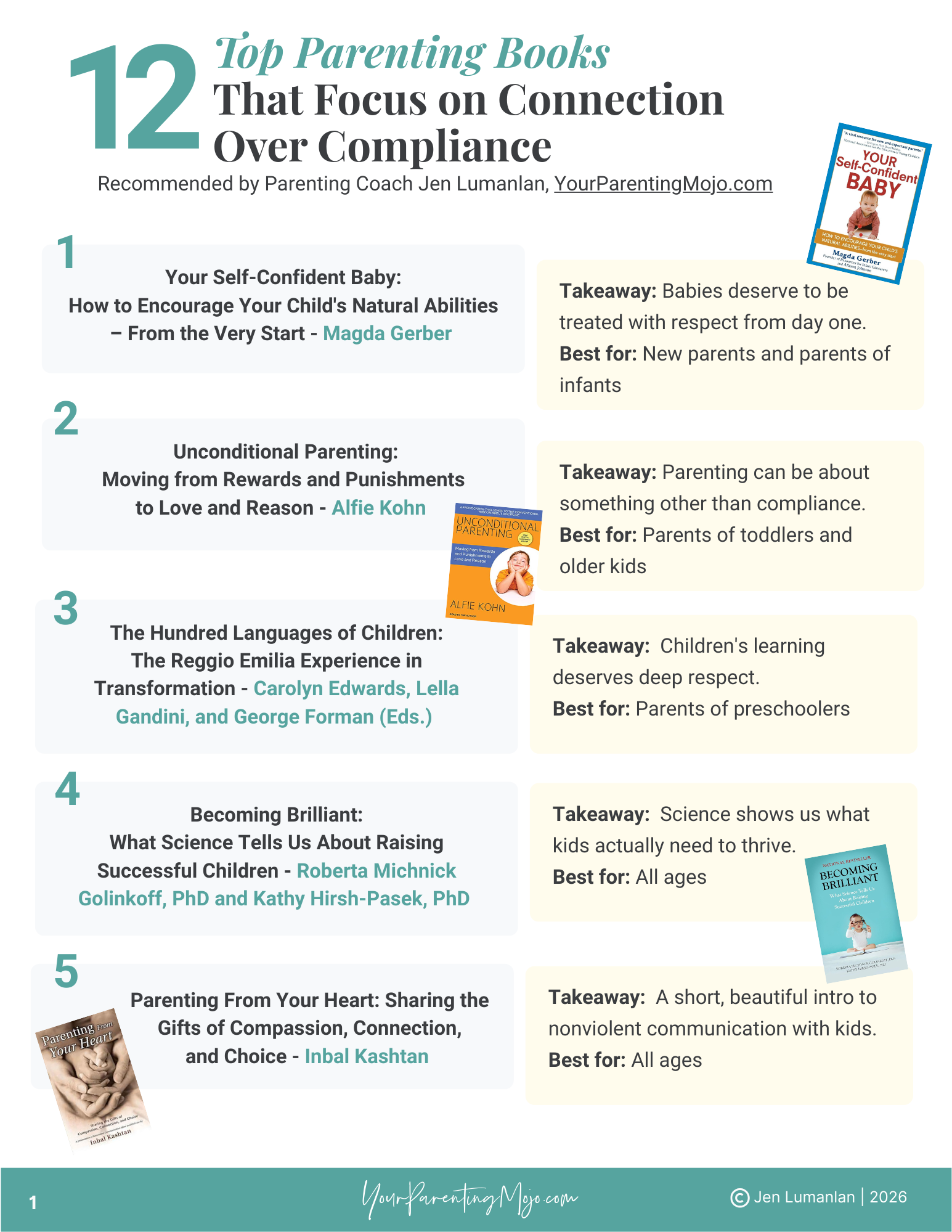
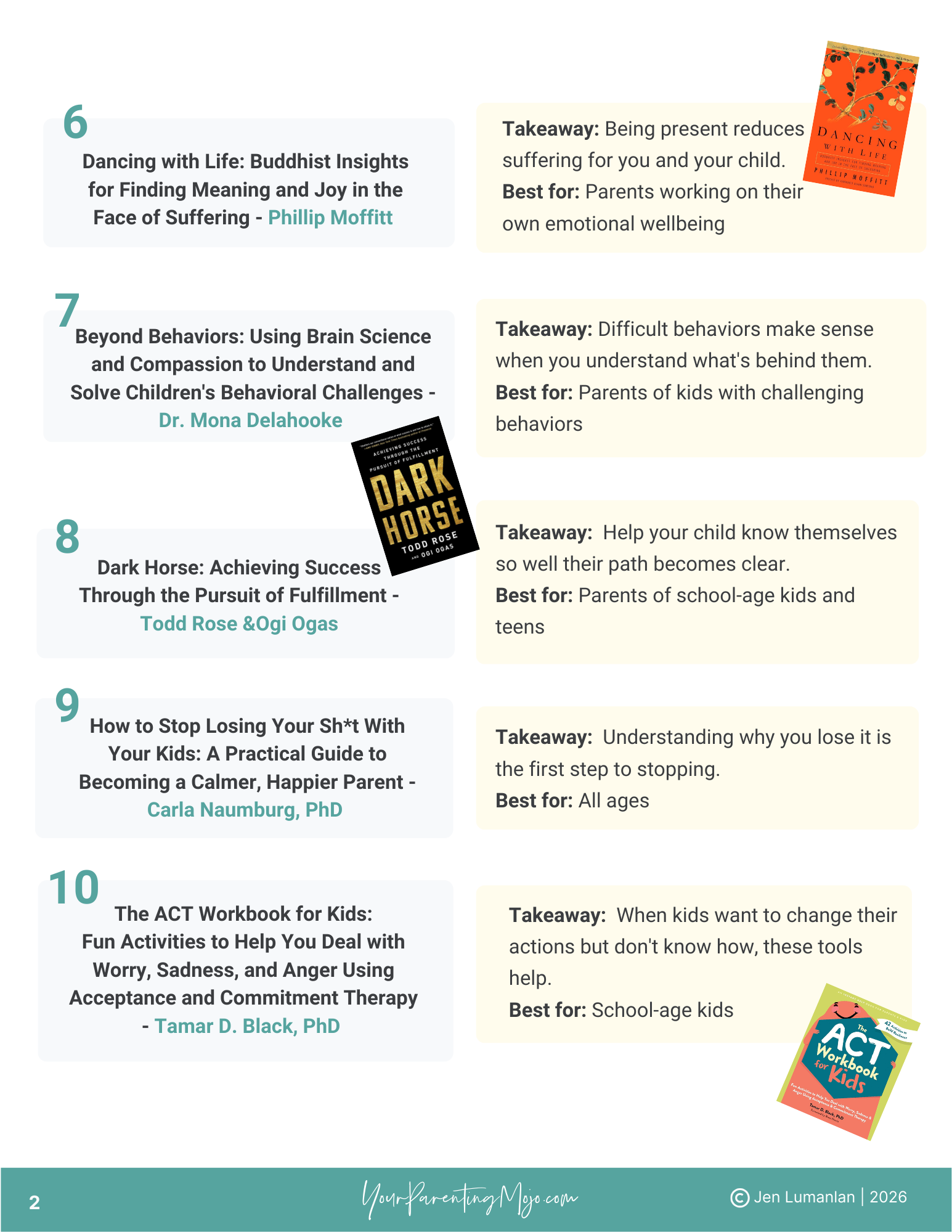
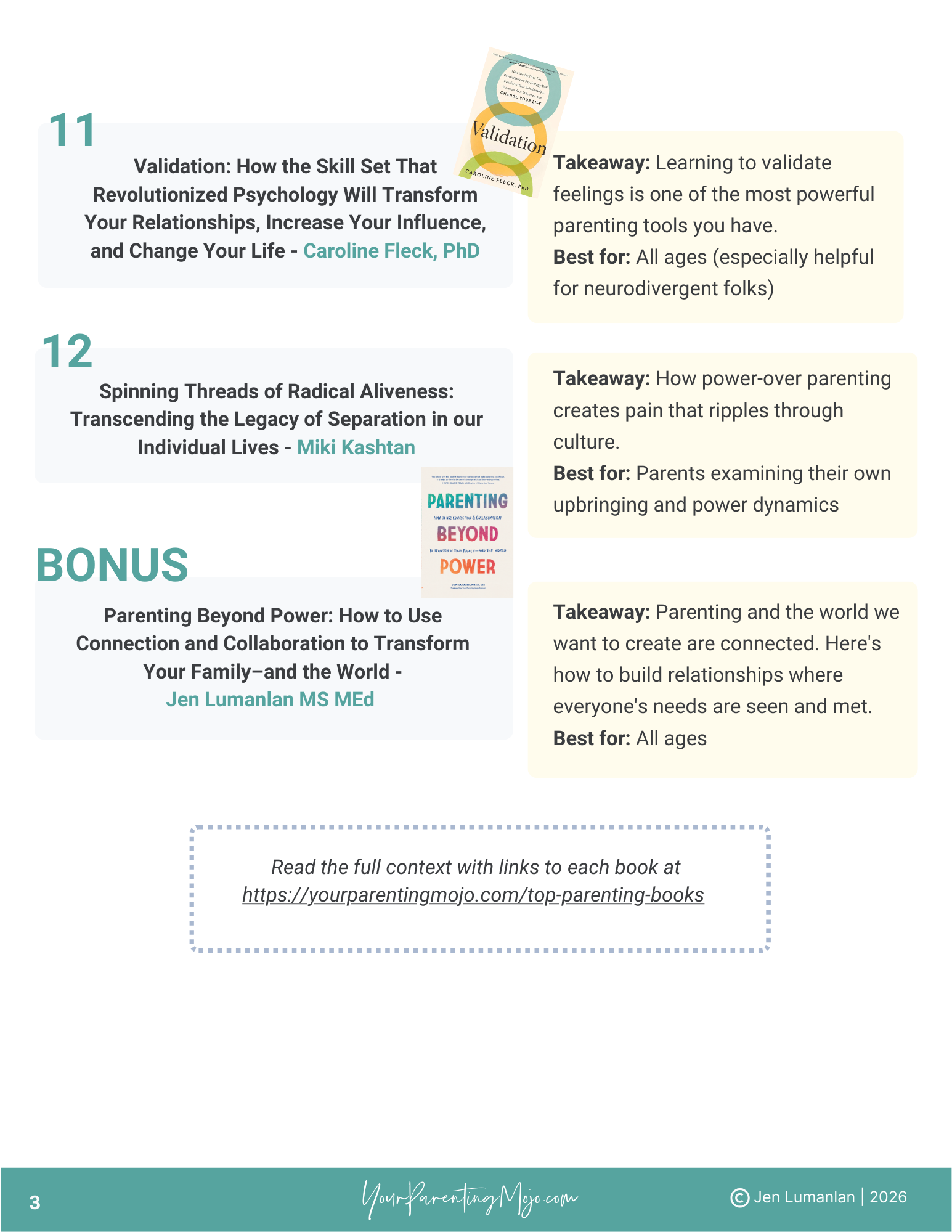
Click here to download the 12 Top Parenting Books That Focus on Connection Over Compliance
Parenting Book Recommendation #1: Your Self-Confident Baby: How to Encourage Your Child’s Natural Abilities – From the Very Start – Magda Gerber.
A friend told me about this book when my daughter Carys was about three months old. I was standing in the shower one day, thinking: “How am I going to discipline her, and also not be the disliked parent?” (That I was thinking about discipline at three months old tells you something about the parenting I grew up with.)
The friend came over to visit us with their toddler, Jack. Their child ran down our hallway toward our bedroom, and the parent said: “Jack, please don’t go in the bedroom – it’s private. You can go in the baby’s room or come back here to the living room.” Jack stood on the threshold of our bedroom, peeked in, and then ran back to the living room.
My jaw hit the floor, and I said: “How did you DO that??!”
This was the book the parent recommended. Before reading it, I couldn’t have imagined that it was even possible to treat an infant respectfully (or disrespectfully!). I started slowing down my diaper changes, talking through what I was going to do (even today, Carys will say to the cats at the animal shelter where we volunteer: “I’m going to pick you up now”!), and asking permission to do things to her body as soon as she was old enough to express a preference.
I later produced two related podcast episodes: one introducing Gerber’s Resources for Infant Educarers (RIE), and the other looking at whether RIE is backed up by academic research (as it wasn’t developed using research as a foundation).
It’s said that kids ‘age out’ of RIE at age two – likely because they become more able to express their ideas about what they think should happen. And then other tools become more useful…
Parenting Book Recommendation #2: Unconditional Parenting: Moving from Rewards and Punishments to Love and Reason – Alfie Kohn.
This book changed my world, and helped me to see how parenting a child aged 2+ could be about something other than compliance. Many of Kohn’s ideas – and his use of academic research to underpin his ideas – are still with me today:
- Punishments and rewards are really tightly related (it’s not that one is ‘bad’ and the other is ‘good’; if punishments don’t fit with our values then rewards don’t either)
- Kids (and all people) hide things from those who judge them;
- How we were parented shows up in our reactions to our kids’ behavior today
- When kids aren’t complying with our requests, one path forward is to reconsider whether the request is reasonable (and I’ve subsequently added: and consider whether there are other ways to meet our needs)
- “Attribute to children [I add: and all people!] the best possible motive consistent with the facts.” E.g. if your child is having a meltdown, it’s more likely that they’re feeling overwhelmed than that they’re trying to manipulate you.
- Children can and should be treated with the same degree of respect with which we want to be treated
- Children can and should be allowed to make real choices about things that affect their bodies and lives
- Trying to see things from our child’s perspective almost always generates useful new information
Parenting Book Recommendation #3: The Hundred Languages of Children: The Reggio Emilia Experience in Transformation – Carolyn Edwards, Lella Gandini, and George Forman (Eds.)
I visited Reggio Emilia, Italy, when Carys was about 18 months old (and I carried her along Cinque Terra at a rate of one village per day afterward – most people hike the whole trail in a day!).
I was the only parent among a sea of visiting preschool teachers, learning how to treat young children’s learning with the utmost respect. We saw how to scaffold that learning sensitively so the child ‘owned’ as much of the process as possible, and how to let their ideas guide the learning instead of explicitly trying to ‘teach’ them.
This book, comprised of a series of essays by different authors, gathers the major principles of the Reggio-based approach to working with children.
Parenting Book Recommendation #4: Becoming Brilliant: What Science Tells Us About Raising Successful Children – Roberta Michnick Golinkoff, PhD and Kathy Hirsh-Pasek, PhD.
Dr. Golinkoff was a very early guest on the podcast way back in episode 10, just after this book was released. It introduces the ‘6 Cs’ of children’s learning:
- Collaboration
- Communication
- Content
- Critical Thinking
- Creative Innovation
- Confidence
Schools focus largely on Content, so if we want our children to develop the other skills then that’s most likely to happen at home. The book shows how this does happen at home, through simple activities like doing laundry together. This gave me a lot of confidence to know that I could support Carys’ learning at home.
Even a decade and the arrival of AI later, I still find the ideas in the book to be compelling and relevant.
Parenting Book Recommendation #5: Parenting From Your Heart: Sharing the Gifts of Compassion, Connection, and Choice – Inbal Kashtan.
This book gives a grounding in using principles of NonViolent Communication (which I think should be re-branded, because many people – myself included – have such a knee-jerk reaction to being told we communicate violently!) with kids. Unconditional Parenting gives the theory of what our relationship with our kids would be like; NVC helps us to actually know what to do in difficult situations.
I know a parent who carries copies of this book to give away, because it’s so incredibly short and accessible. Readers who actually want to implement the ideas may find it short on detail, but it’s a beautiful exploration of the application of NVC to relationships with children.
Parenting Book Recommendation #6: Dancing with Life: Buddhist Insights for Finding Meaning and Joy in the Face of Suffering – Phillip Moffitt.
My first thorough introduction to Buddhist principles, that helped me through a tough patch in my own life and also helps me support Carys with her struggles today.
When we see that only a small part of your suffering comes from the original pain, and most of your suffering comes from our reliving of that pain, we find that being in the present is a powerful path to experiencing less pain.
Parenting Book Recommendation #7: Beyond Behaviors: Using Brain Science and Compassion to Understand and Solve Children’s Behavioral Challenges – Dr. Mona Delahooke.
Although this is based in Polyvagal Theory, the evidence for which is highly contested, I find Dr. Delahooke’s explanations for difficult behaviors to be compelling and useful.
Her overall approach is that behavior is like an iceberg: we see the parts on top (that annoy us), but it’s much harder to see the overwhelm, anxiety, and disconnection that can create that behavior.
When we only focus on changing the behavior, the child might learn to mask what’s underneath it so things seem better in the short term. But the underlying causes don’t go away, and can pop out in other circumstances…or much further down the road in our relationship, when they realize we’ve been trying to control them – and they aren’t willing to let that happen anymore.
Listener Jamie and I interviewed Dr. Delahooke about the book here.
Dr. Delahooke’s iceberg metaphor shows that the behavior we see on top is driven by needs underneath. Wondering what need is driving your child’s most challenging behavior? Take the Child’s Needs Quiz to find out and get specific strategies that you can use today.
Parenting Book Recommendation #8: Dark Horse: Achieving Success Through the Pursuit of Fulfillment – Todd Rose and Ogi Ogas.
This book describes how we can use our unique talents to create work we love to do.
Most of the people profiled in the book – including Todd Rose himself – struggled through school before launching their own self-guided quest for fulfillment. What if we could work with kids to support them in learning themselves so well that the next step in their future path(s) is obvious, and not one they have to find by themselves after doing a lot of unlearning lessons from school?
We don’t have to know every step in our life’s journey. These days, we expect to pivot along the way – probably multiple times.
But I think that if we shift the way we support kids from: “Get into a good college, graduate, and the rest will sort itself out,” to: “Learn what lights you up, find ways to do that, and then learn what else lights you up,” I think that both individuals and the world will be much better off.
Parenting Book Recommendation #9: How to Stop Losing Your Sh*t With Your Kids: A Practical Guide to Becoming a Calmer, Happier Parent – Carla Naumburg, PhD.
This book is short, approachable, and very good at translating academic concepts into readable scenarios.
It gives a thorough grounding in why you lose your shit with your kids – and how to work on doing it less.
There are some people who can read a book and immediately implement the changes they want to make – if you’re like this, I highly recommend this book.
For those who need more support to make the changes real in your life, my Taming Your Triggers workshop is here for you.
Parenting Book Recommendation #10: The ACT Workbook for Kids: Fun Activities to Help You Deal with Worry, Sadness, and Anger Using Acceptance and Commitment Therapy – Tamar D. Black, PhD.
I never want to use tools that try to change kids’ behavior first. I always want to begin by trying to understand: what need is the child trying to meet through their behavior? And are there ways we can help you meet that need, that also meet my needs?
But there are times when the child recognizes that their actions aren’t helping them to meet their needs, and that they want to choose a different action but don’t yet know how. Acceptance and Commitment Therapy-based tools can help them do that. There’s an introduction to ACT here.
Parenting Book Recommendation #11: Validation: How the Skill Set That Revolutionized Psychology Will Transform Your Relationships, Increase Your Influence, and Change Your Life – Caroline Fleck, PhD.
You’ll hear in my interview with Dr. Fleck that I think the first half of the book, which teaches you how to validate other people’s feelings, is outstanding. I had no idea that validation and empathy were skills that could be learned, and that it’s possible to see which tools will be most helpful in which circumstances. Neurodivergent folks who do well with specific instructions (and who might have been told they ‘lack empathy’) will find it especially helpful.
I hate mutilating books but in this case I suggest ripping out the second half of the book, in which Dr. Fleck shows you how to use your new-found validation skills to manipulate other people into doing what you want them to do.
Parenting Book Recommendation #12: Spinning Threads of Radical Aliveness: Transcending the Legacy of Separation in our Individual Lives – Miki Kashtan
Part memoir, part manifesto, this book brilliantly connects Miki’s experiences growing up with broader societal observations about power. She describes her father’s explicit project to break her spirit, her mother making feeble attempts to intervene at times but ultimately Father always got his way. Sometimes he used overt methods (locking her out of the house at age six until she apologized for misbehavior) and sometimes covert (allowing her to make the choice about going to live on a kibbutz, and refusing to speak to her for as long as that was her choice).
Even when our own punishment methods are less extreme, we often hold the power in our relationship with our kids. That’s why we train children to ask: “Can I…?” to obtain approval. Immediately after reading that, and knowing that I didn’t want to be in a power-over relationship with my daughter Carys, I encouraged her to say instead: “I’d like to…/I’m going to…” rather than “Can I…?”. If I have concerns, we discuss them. Otherwise, she goes ahead.
Through Miki’s own experiences we see how the coercive methods our parents used with us (and their parents used with them) have created pain in us – which has rippled out into our culture. It gives some starting points to work on addressing this, which I aimed to continue when I wrote Parenting Beyond Power.
Bonus: Parenting Beyond Power: How to Use Connection and Collaboration to Transform Your Family–and the World
Because I wanted to draw attention to this idea of the connection between parenting and what we want the world to be like, I wrote a book that does this explicitly. It also gives practical strategies grounded in real parents’ experience to help you be in a relationship with your kids where everyone’s needs are seen and met. It ties together all the ideas in the books I’ve mentioned here, and parents who have consumed a lot of parenting books have told me they consider it among the best they’ve read.
Final Thoughts
These are the top parenting books I’ve found for parents who want to move beyond traditional discipline methods. From Magda Gerber’s respectful approach to infants to Alfie Kohn’s groundbreaking work on unconditional parenting, each of these books offers evidence-based strategies for understanding and connecting with your child.
Not all of them are specifically about parenting. Some are about Buddhist ideas, how kids learn, or therapy tools. But each one changed how I think about being in relationship with children.
If you’re looking for great parenting books that focus on meeting everyone’s needs rather than gaining compliance, this list is a good place to start.
Links to books are affiliate links, which means I receive a small commission that does not affect the price you pay.
From Reading to Real Life
These top parenting books teach you the theory. But theory doesn’t help when your child won’t put their shoes on and you’re already late.
That’s when you need to understand: What need is my child trying to meet right now?
Instead of fighting about shoes, you’re solving the actual problem. Instead of losing your temper, you’re responding in ways that work for both of you.
Take my free Identifying Your Child’s Needs Quiz to discover what need your child is trying to meet in your most challenging situation. You’ll receive specific strategies to help you respond in ways that work for both of you.
Click the banner to take the quiz.
Frequently Asked Questions About Best Parenting Books
1. What makes a respectful parenting book different from traditional parenting books?
Respectful parenting books focus on understanding your child’s feelings and needs and meeting their needs AND your needs, rather than on just getting compliance. Traditional books often teach methods to make kids obey quickly, which reinforces the idea that people with more power should be obeyed. The best parenting books help you build relationships where everyone’s needs matter. They teach collaboration instead of control, and help children learn to care about other people’s feelings while understanding their own.
2. What is the best parenting book for beginners?
Unconditional Parenting by Alfie Kohn is excellent for parents starting to explore respectful approaches because it lays the theoretical groundwork for making a change. My own book, Parenting Beyond Power, offers a practical guide to living the values Kohn lays out in Unconditional Parenting, in the moments when your kid is refusing to do what you ask.
If you have an infant, start with Your Self-Confident Baby by Magda Gerber to learn respectful parenting from the very beginning.
3. Are there evidence-based parenting books that don’t use behaviorism?
Yes. Beyond Behaviors by Dr. Mona Delahooke uses Polyvagal Theory, which attempts to explain what’s happening in kids’ brains when their behavior is difficult. She offers: “When we see a behavior that is problematic or confusing, the first question we should ask isn’t “How do we get rid of it?” but rather “What is this telling us about the child?”
The book helps us to understand that children’s difficult behavior (especially at school) can indicate that they don’t feel safe. When we change their environment to help them meet their need for safety, they’re much more able to learn than if we try to simply shape their behavior using rewards or consequences.
4. What parenting books help with managing triggers and staying calm?
How to Stop Losing Your Sh*t With Your Kids by Carla Naumburg gives practical strategies for understanding why you get triggered and how to respond differently to your kids. It’s a great resource for people who can read a book and implement the ideas in it.
Dancing with Life by Phillip Moffitt offers Buddhist principles. These helped me to see that worrying about things that have happened or that might happen doesn’t really help – and just adds to my suffering. When instead we focus simply on what is here in this moment, we find we can cope with it more easily.
For deeper help with your triggered feelings and personalized support, the Taming Your Triggers workshop builds on these concepts with coaching and community.
5. Should I read parenting books if my child is neurodivergent?
Many books on this list work well for neurodivergent children because they focus on understanding needs rather than controlling behavior. Validation by Caroline Fleck offers specific instructions that neurodivergent parents often find especially helpful in their relationships with both co-parents and children.
Beyond Behaviors addresses how to understand challenging behaviors through a compassionate lens. However, focus on the first half of Validation – the second half teaches manipulation tactics that conflict with respectful parenting.
6. What’s the connection between parenting books and creating a better world?
Every parenting book teaches a vision of what society should look like, even when it’s not explicit. Books that teach compliance prepare children to obey authority without question. Books focused on collaboration and meeting everyone’s needs prepare children to build a world where relationships matter more than obedience. Parenting Beyond Power makes this connection explicit, showing how the way we parent shapes the kind of world our children will create.
7. Can parenting books actually change how I parent day-to-day?
Reading gives you the foundation, but real change happens when you practice these ideas in tough moments. Some parents can read a book and make changes on their own. Others benefit from support through coaching, practice opportunities, and community with parents working on similar challenges. The Parenting Membership offers modules, monthly coaching, and community support.
8. What parenting books focus on nonviolent communication with kids?
Parenting From Your Heart by Inbal Kashtan applies Nonviolent Communication principles to relationships with children. It’s short and accessible, though some readers want more detailed implementation guidance.
Parenting Beyond Power also incorporates needs-based approaches with practical strategies from real parents’ experiences. Both books help you understand your child’s feelings and needs while finding ways to meet everyone’s needs through collaboration.

About the author, Jen
Jen Lumanlan (M.S., M.Ed.) hosts the Your Parenting Mojo podcast (www.YourParentingMojo.com), which examines scientific research related to child development through the lens of respectful parenting.