
Setting Family Boundaries During the Holidays

Key Takeaways
- Family holiday stress signals unmet needs – yours (e.g. rest, autonomy) bumping against theirs (e.g.. connection, belonging, competence in their role as a parent/grandparent). Both sets of needs are valid.
- We all feel best when our needs are met. Starting by looking for strategies that meet both of your needs always helps.
- Where you can’t find strategies that meet both of your needs, boundaries can help to protect your needs.
- Healthy family holiday boundaries are clear statements about what works for you across time, location, gifts, food, and parenting while staying connected to people you care about.
- You have to (really) believe you’re worthy of your needs being met.
- Setting boundaries without guilt: Get clear on your needs, consider their needs too, be specific, offer alternatives when possible, and start conversations early.
- When family pushes back on boundaries, acknowledge them but don’t give in. Repeat boundaries calmly, follow through with consequences, stay consistent.
- Guilt when setting boundaries means you’re changing a pattern, not doing something wrong. You can care about their feelings without being responsible for fixing them.
- During gatherings, check in with yourself regularly, and have an exit plan to help you stay calm and grounded.
- Boundaries get easier with practice for everyone. Consistency helps people take you seriously and relationships often adjust after the initial reaction period.
The songs, the sparkly lights, families coming together – everything says the holidays should be the most wonderful time of the year.
But if you’re dreading this period, you’re not the only one wondering “is it normal to dread the holidays?”
You’re rushing from one gathering to the next while trying to spend quality time with family. One minute everyone’s getting along fine, and the next your preschooler refuses to thank Grandma for a gift and there are hurt feelings on both sides. Then your child declines vegetables at dinner and the “When I was a child…” lecture begins.
Maybe you’re struggling with family holiday stress because Uncle Rob makes comments you don’t want your kids hearing. Or Grandma ignores your requests about gift experiences, not things, and goes overboard anyway. Or your partner expects you to say yes to everything while you’re barely holding it together.
You love these people, but the thought of another holiday gathering feels exhausting before it even starts.
The holidays get hard when we haven’t learned how to establish boundaries with family. Most of us grew up learning that “family comes first” – which meant: “sacrifice your own needs so other people can be happy.”
In this post, you’ll learn why setting family boundaries feels so difficult, what healthy boundaries actually look like, and how to set boundaries with family – especially your parents – without feeling guilty. You’ll also get practical strategies for how to deal with family conflict at holidays and reduce the family holiday stress that’s making you want to skip the whole season.
Why Setting Family Boundaries Feels So Hard During the Holidays
When you think about setting boundaries with your mom, or telling your in-laws you won’t be there for the holidays this year, what happens in your body?
Maybe your throat tightens. Maybe your stomach clenches. Maybe you start thinking of all the reasons you should just go along with what they want.
That reaction didn’t come out of nowhere. It came from years of learning that keeping the peace was more important than speaking your truth.
The cultural messages we absorbed run deep:
- “Family comes first” (but they never explained what that costs you)
- “It’s just one day” (except it’s never just one day – it’s the lead-up, the event, and the recovery)
- “Don’t be selfish” (even though taking care of yourself isn’t actually selfish)
- “They mean well” (even though good intentions don’t erase the impact)
- “Don’t rock the boat” (because you pointing out a problem is inconvenient to them)
- “It’s the holidays!” (so normal boundaries don’t apply)
What’s really happening here is that your needs are bumping up against other people’s needs. Your needs for rest, comfort, autonomy, and to understand and be understood. Their needs for connection, belonging, and appreciation.
Both sets of needs are valid.
And here’s where guilt shows up.
Guilt appears when you’re breaking an old pattern. When you’re doing something different than what’s expected.
Guilt shows up when someone else might be disappointed.
But guilt doesn’t mean you’re doing something wrong. It means you’re changing how things have always been done, and change feels uncomfortable – for you and for them.
Family holiday stress signals that something isn’t working well for you – your needs aren’t being met. Ideally, we want to be in a situation where both people’s needs are met in a relationship. If you’re able to talk with your family about what’s not working well for you, and you’re willing to hear what they’d like to shift as well, this will be the most fulfilling path forward.
But where that isn’t possible, boundaries are our next best tool.
What Are Healthy Family Boundaries
When we can’t find a way to meet both people’s needs, we’re essentially saying: “Until we can find a way to work together on this, I’m choosing to prioritize my needs in this relationship.”
Boundaries matter because they let you protect what’s important to you while staying connected to the people you care about.
Here are family boundaries examples across different areas:
Time boundaries:
- Visiting for two hours instead of staying all day
- Leaving at a set time even if others want you to stay longer
- Choosing which holiday events you attend based on your/your kids’ capacity, not what others want you to do
Location boundaries:
- Staying in a hotel instead of at your parents’ house
- Hosting at your home so you have control over the environment
- Meeting at a neutral location like a restaurant
Gift boundaries:
- Agreeing on a spending limit
- Requesting specific types of gifts (or no gifts at all)
- Talking with grandparents about the number of presents to give your kids (Nedra Glover Tawwab suggests dropping off any extras on their back porch!)
Food boundaries:
- Serving meals that work for your family
- Not forcing kids to eat certain foods to please relatives
- Bringing your own food if needed
Parenting boundaries:
- How relatives talk to your kids (like commenting on their looks, or whether they’re acting like a “proper” boy or girl)
- Who enforces rules with your children
- Comments about your parenting choices
These boundaries aren’t punishment.
You are not rejecting your parents if you set them.
You are not being ‘mean’ or ‘selfish.’
Boundaries protect your capacity to actually enjoy time together. When you take care of your own needs, you can be your real self – perhaps in a way you weren’t able to when you were younger and didn’t set boundaries.
6 Steps on How to Set Boundaries with Family
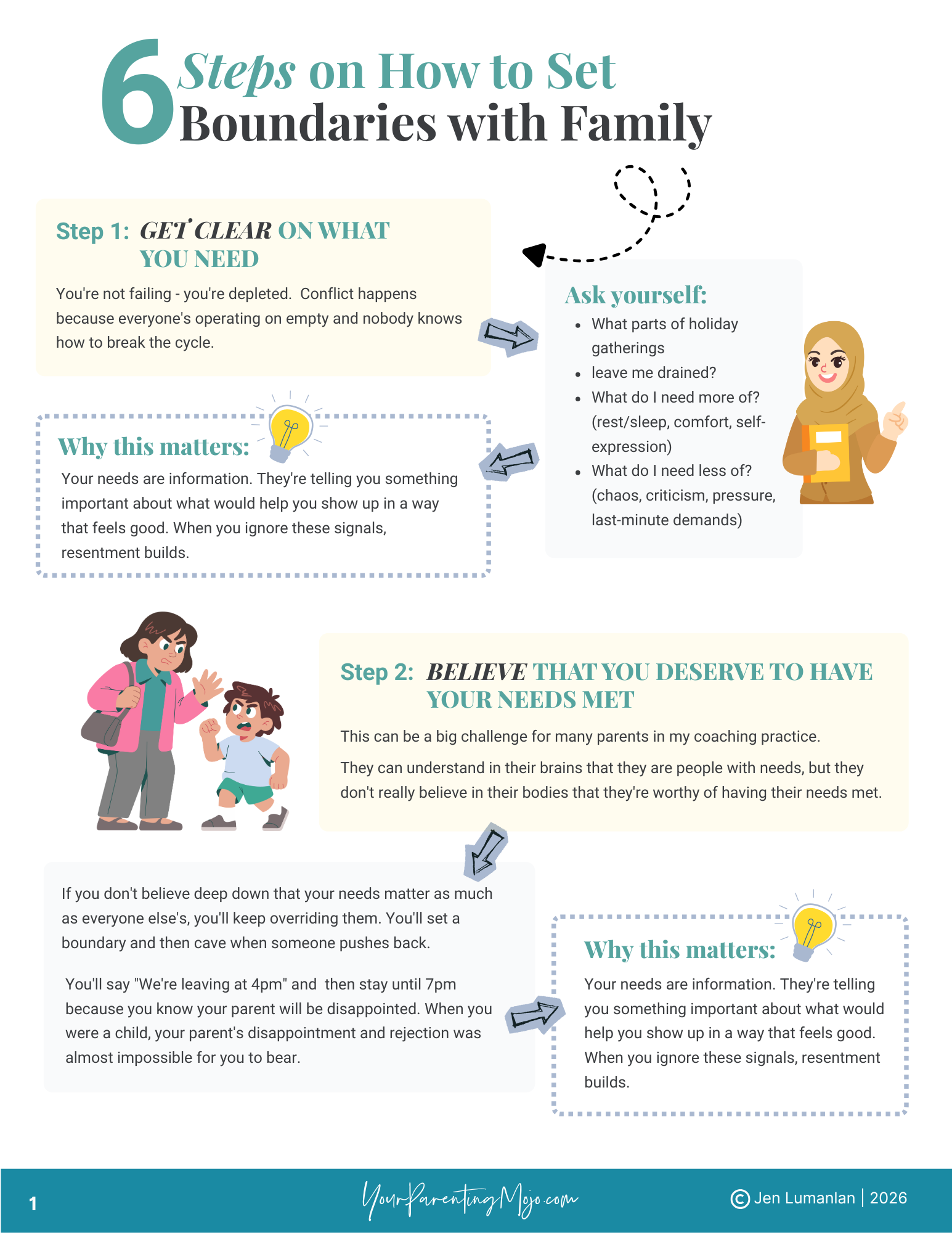
Setting healthy boundaries with family starts with getting clear on what you actually need.
Click here to download the 6 Steps on How to Set Boundaries with Family
How to set boundaries with family Step 1: Get clear on what you need
Before you can set a boundary, it’s important to know what’s working and what’s not, and notice these with some self-compassion.
Ask yourself:
- What parts of holiday gatherings do I enjoy? (e.g. seeing family in small groups; cooking with others; continuing traditions with my kids)
- What parts of holiday gatherings leave me drained? (e.g. meals with more than 10 people; my Mom telling my kid what to eat and getting offended when they don’t; my Dad telling me that he would spank a kid for talking to him the way my kid talks to me)
- What do I need more of? (e.g. rest/sleep, comfort, mental space)
- What do I need less of? (e.g. loud places, criticism, pressure)
Your needs are information. They’re telling you something important about what would help you show up in a way that feels good to you.
How to set boundaries with family Step 2: Believe that you deserve to have your needs met
This can be a big challenge for many parents in my coaching practice.
They can understand in their brains that they are people with needs, but they don’t really believe in their bodies that they’re worthy of having their needs met.
That’s one reason why they can slide into permissive parenting with their kids, and why it just seems easier to throw their hands up and do whatever their own parent wants.
If you don’t believe deep down that your needs matter as much as everyone else’s, you’ll keep overriding them. You’ll set a boundary and then cave when someone pushes back.
You’ll say “We’re leaving at 4pm” and then stay until 7pm because you know your parent will be disappointed. When you were a child, your parent’s disappointment and rejection was almost impossible for you to bear.
Now you’re older, you have other potential sources of love and belonging (partner, friends, extended family, therapist…). Your parent isn’t the only person who can meet those needs for you. And you are worthy of having your needs met.
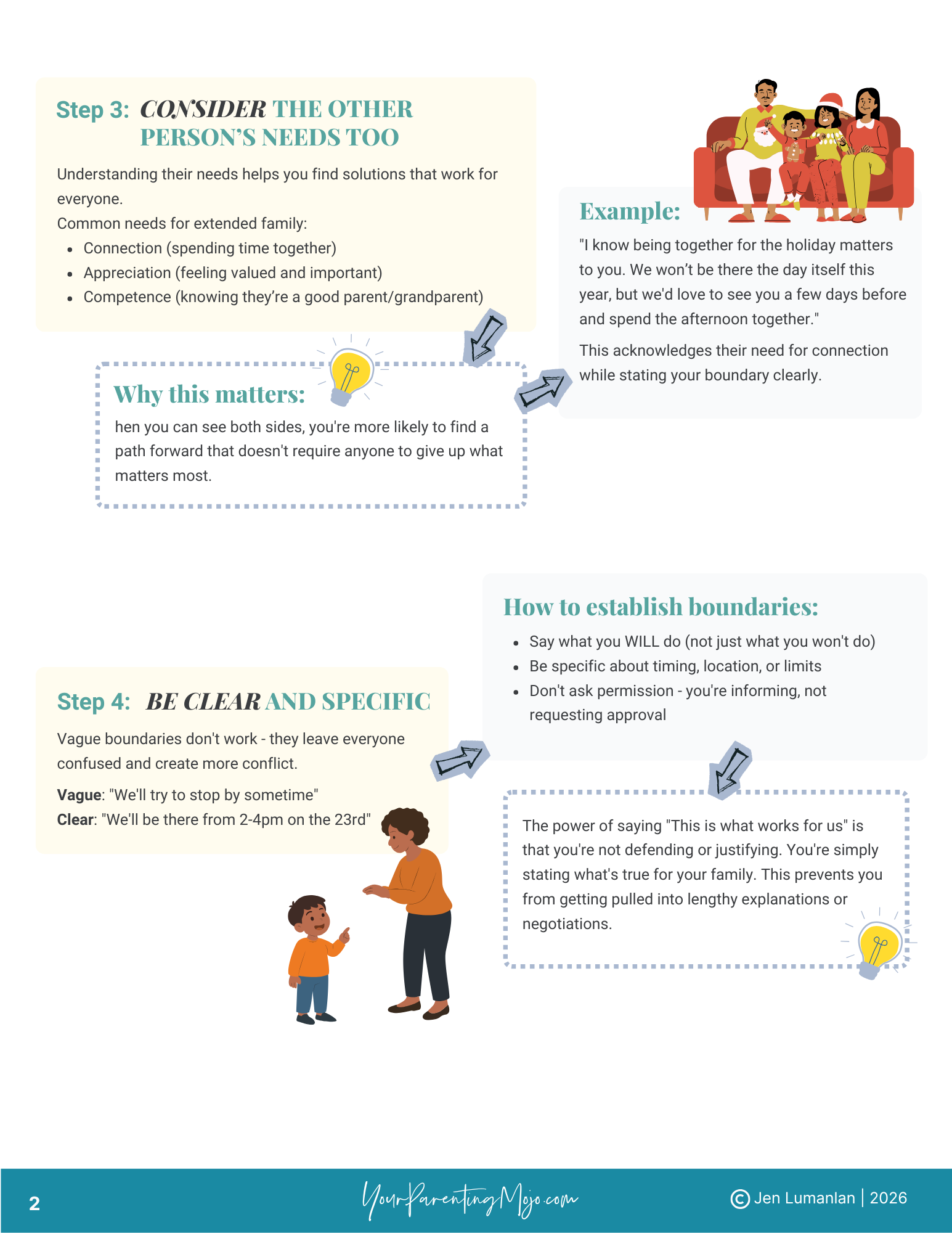
How to set boundaries with family Step 3: Consider the other person’s needs too
Understanding their needs helps you find solutions that work for everyone.
It’s common for our parents to need connection, appreciation, and competence as parents.
They want to feel connected to us and to their grandchildren, to know they’re important to us, and to be appreciated for the sacrifices they’ve made for us.
Very often, the comments we find so hurtful are related to their sense of competence – they criticize our bodies, our parenting choices, and our kids’ behavior because they care (this doesn’t make it right!).
They recognize that people with certain body shapes are more successful, and they want us to do well.
They see our parenting as validating (or criticizing) the decisions they made as parents.
They want our kids to do well, and they’re afraid that our kids will be hurt by the world.
Listening to their perspective (as long as that perspective isn’t directly hurtful to us) can really help. Validate their ideas: “Given how important education was when you immigrated to this country, it makes sense that you would be concerned that our child can’t read yet.”
You might find that once you’ve truly heard them, they’re willing to back off a bit on their pressure. Then you might find your needs for competence in parenting and integrity with your values can be met without changing anything you do. When your needs are met, there’s no reason to set a boundary.
You might even make a request, e.g.: “Would you be willing to read to [child’s name]?” I want to nurture their love of books and stories even though they aren’t reading fluently yet.”
How to set boundaries with family Step 4: Be clear and specific
Where your family member is unwilling to have a conversation about needs, or where it ends with more blame and shame, a boundary can be helpful.
Vague boundaries don’t work. “We’ll try to stop by” leaves everyone confused. “We’ll be there from 2-4pm” is clear.
How to establish boundaries with family:
- Say what you will do (not just what you won’t do)
- Be specific about timing, location, or limits
- Don’t ask permission – you’re informing, not requesting
The power of saying “This is what works for us” is that you’re not defending or justifying. You’re simply stating what’s true for your family.
Believing that you are worthy of having your needs met has to happen first. Knowing this may help you to cope with their disappointment, knowing that you aren’t setting the boundary vindictively. If you could find a way to meet both of your needs, you would. And until then, you’re going to protect your own needs for a change.
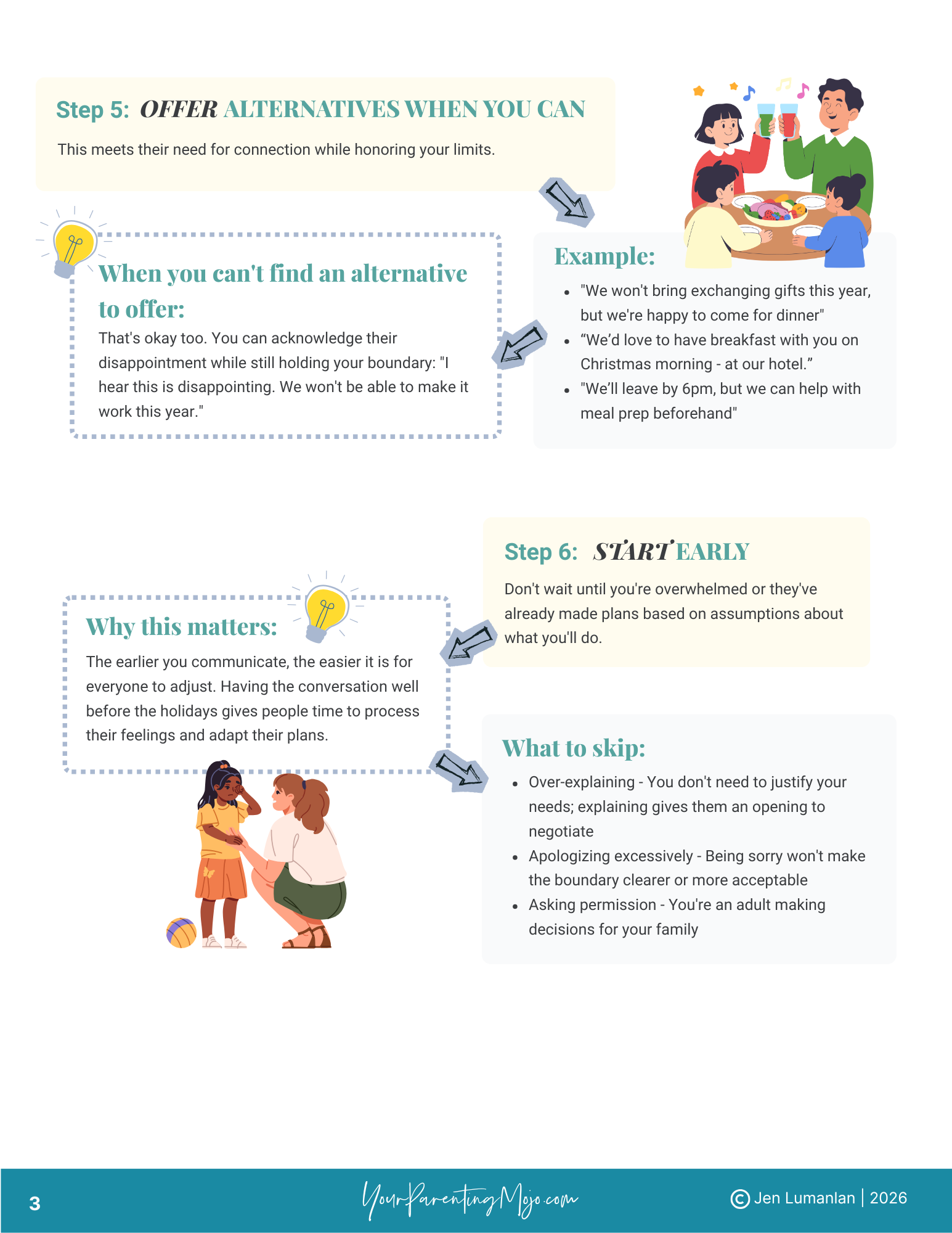
How to set boundaries with family Step 5: Offer alternatives when you can
Offering meets their need for connection while honoring your boundaries. The key to offering viable alternatives is that you have to genuinely believe the alternatives really will meet the other person’s needs. (This is why ‘giving choices’ often doesn’t work to gain kids’ compliance – because we don’t consider whether the choices will meet their needs.)
Examples:
- “We won’t be there on the day itself. We’d love to see you earlier that week” (Meets their need for connection; perhaps not for tradition/meaning-making)
- “We’re looking forward to coming for dinner. We’d prefer not to exchange gifts, so we don’t plan to bring any ourselves.” (Meets their need for tradition/meaning making; perhaps not for the way they show love)
- “We won’t stay overnight, but we’ll come for the afternoon” (Meets their need for connection)
Sometimes you might not be able to think of an alternative to offer, and that’s okay too. (If your parent suggests an alternative, consider whether it meets your needs before reflexively accepting or declining.)
You can acknowledge their disappointment while still holding your boundary.
How to set boundaries with family Step 6: Start early
Don’t wait until you’re overwhelmed or they’ve already made plans based on assumptions.
The earlier you communicate, the easier it is for everyone to adjust. Having the conversation well before the holidays gives people time to process and adapt.
What to skip:
- Over-explaining (you don’t need to justify your needs)
- Apologizing excessively (being sorry won’t make the boundary clearer)
- Asking permission (you’re an adult making decisions for your family)
How to set visiting boundaries with family during the holidays:
Think about length of visits based on your energy, your kids’ limits, and travel time. For overnight stays, ask yourself what you need – e.g. space, sleep, consistency.
When you’re facing multiple family obligations, remember: you actually can’t be everywhere, despite what guilt tells you.
Working through common scenarios helps. What happens when both sides of the family expect you on the same day? What if the “standard” visit length doesn’t work for you anymore? What if you need more space than in previous years?
Pushing yourself to comply with your parent’s requests when they don’t meet your needs will only create resentment. Instead, notice any budding frustration, anger or resentment you feel as a signal that a boundary may be helpful.
Why you’ll still experience guilt (and what to do about it):
Guilt usually means that your actions aren’t aligned with your values, and that you should change the thing you’re doing.
But where you’ve been going along with your parent’s needs for too long, you may feel guilty that you aren’t doing this anymore.
You may feel guilty that you’re prioritizing your own needs over your parent’s needs.
In this case, your feelings of guilt doesn’t mean their disappointment is your responsibility to fix.
You can acknowledge guilt without letting it make your decisions. You can notice “I’m feeling guilty right now” and still hold your boundary because you know your boundary is in service of your needs.
How to Deal with Family Conflict During Holidays
When they push back on your boundaries:
“But we always do it this way!”
What they’re really expressing is their need for consistency. You’re not responsible for maintaining every tradition, especially ones that don’t work for you anymore.
You can acknowledge their need while holding your boundary: “I hear that this tradition matters to you. We’re choosing to do it differently this year, and I hope we can find other ways to connect.”
“You’re keeping the kids from their grandparents!”
This one stings because it touches the fear that you’re somehow harming your children. But you’re not keeping anyone from anyone. You’re making choices about what works for your family.
The false choice here is that connection can only happen one specific way. You can maintain connection in different ways – video calls, shorter visits, meeting at a park instead of someone’s home.
“Just this once…”
Why “just this once” often becomes every time: because you’re teaching people that if they push hard enough, you’ll give in.
When flexibility makes sense: when circumstances genuinely change and the boundary isn’t serving you anymore.
When it undermines your boundary: when you’re caving because you’re uncomfortable with their reaction, not because your needs have shifted.
How to deal with a family who doesn’t respect boundaries:
What it looks like when boundaries aren’t respected:
- They agree but then push back again later
- They ignore what you said and make their own plans
- They try to negotiate every single time
Your options:
- Repeat the boundary (without anger or lengthy explanations)
- Follow through with consequences (if you said you’d leave at 4pm, leave at 4pm)
- Adjust your boundary if you learn something new about the situation
The difference between being flexible and having no boundaries is whether you’re making a conscious choice that serves you, or whether you’re just giving in to make someone else comfortable.
When relatives don’t invite you (because you set a boundary):
This happens sometimes, and it hurts. Their disappointment is real – and it’s still not your responsibility to fix.
You can reach out if you want connection: “I’d love to see you. Would you like to get together in January?”
Sometimes relationships need space before people can adjust to the new way you’re showing up.
Setting healthy boundaries when family members are difficult:
There’s a difference between difficult and harmful. Difficult pushes your boundaries. Harmful crosses safety lines.
When someone keeps testing your boundaries, stay consistent. Changing your boundary teaches them to keep pushing. You don’t need to explain again. Your boundary can be “We’re taking a break from visits right now.” Staying calm and consistent helps you hold your boundary without getting pulled into emotional reactions.
Dealing with family drama during the holidays without getting pulled in means remembering you don’t have to engage with every comment or conflict. “I’m staying out of this” is a complete sentence. Protecting your peace is valid.
When your partner isn’t on the same page:
This happens a lot – you want boundaries, they want to keep the peace with their family.
Get aligned before the gathering, not during it. Discuss each of your needs, and what resources you have available as a family. Maybe your partner can take the kids to their parents’ house while you take a break.
Try to avoid the Four Horsemen of the Apocalypse if you can (holidays have a way of increasing the stress level). Try to find strategies that meet both of your needs.
Staying grounded when emotions run high:
Notice when you’re getting activated – tension in your jaw, defensiveness rising, wanting to shut down.
Simple tools: Take a break. Step outside. Focus on your breath.
You can hold a boundary even when you’re uncomfortable. Their feelings are intense AND you can still take care of yourself.
Dealing with Family Holiday Stress After You’ve Set Boundaries
Before the gathering:
Review what you need and what your boundaries are. Talk through the plan with your partner or a friend. Remind yourself why this boundary matters.
Have a plan for when you’ll leave or take breaks. Knowing you have an exit strategy can help you stay calmer.
During the gathering:
Check in with yourself throughout the day. Am I okay? Do I need a break?
Hold your boundaries without announcing them repeatedly. If someone pushes back, respond briefly and move on. You don’t have to engage with every attempt to change your mind.
After the gathering:
Processing your feelings is part of the work. You might experience guilt, relief, sadness, or frustration – sometimes all at once.
Your guilt is real AND not a sign you did something wrong.
Managing other people’s disappointment gets easier when you remember: you can care about their feelings without fixing them. Their disappointment doesn’t mean you made the wrong choice. They’re capable of handling their own emotions.
When repair is needed:
If you snapped or said something harsh, you can acknowledge it. Repair doesn’t mean dropping your boundary.
“I’m sorry I raised my voice. We’re still leaving at 4pm.”
Taking care of yourself when relationships are strained:
Some relationships might be tense for a while. Give it time – people often adjust after the initial reaction.
Keep reaching out in ways that work for you. Some relationships might not survive boundaries, and that tells you something important about whether the relationship was serving you.
Remembering why you set the boundary:
When guilt or doubt creeps in, ask yourself: What was I trying to protect? How did taking care of my needs help me show up better? What did I learn about what works for my family?
Building trust over time:
Boundaries get easier with practice – for you and for them. Consistency helps people take you seriously.
As they see you’re not abandoning the relationship, they often adjust. You might surprise yourself with what becomes possible when you’re not constantly overriding your own needs.
Ready to Do This Work With Support?
Setting boundaries is powerful work – and it can bring up a lot of old patterns and wounds. If you’re realizing how deeply these patterns run and want support as you navigate them, the Parenting Membership offers the community, coaching, and tools to help you make lasting changes.
Inside, you’ll work on getting your own needs met (not just providing an ideal environment for your children), align your parenting with your values, and get support from coaches and other parents who understand what it’s like to parent differently than how you were raised.
Click the banner to learn more about the Parenting Membership.

Final Thoughts
Setting family boundaries during holidays isn’t about cutting people off or being difficult. Holiday boundaries protect your capacity for real connection.
You can love your family AND take care of your needs. In fact, when you take care of your needs, you have more to give in your relationships.
The boundary that seems hardest to set is often the one you need most.
What’s one boundary you need to set this year? Start with that one. Notice what happens in your body when you think about it. Notice what shifts when you actually set it.
You’re not just changing your holidays – you’re modeling something important for your kids about what it means to honor your own needs while staying in relationship with others.
That’s a gift that lasts far beyond this holiday season.
Frequently Asked Questions About Setting Family Boundaries During the Holidays
1. Is it normal to dread the holidays?
Many parents experience dreading the holidays when their needs for rest, comfort, and autonomy bump up against family expectations. That tight feeling in your throat or clenched stomach when thinking about family holiday gatherings comes from years of learning that keeping the peace matters more than speaking your truth. Family holiday stress signals that something needs to shift. When you take care of your own needs, you actually show up with more capacity for real connection with family during the holidays.
2. How to deal with family holiday stress?
Family holiday stress happens when your needs aren’t being met. Start by getting clear on what parts of gatherings leave you drained and what you actually need more of (like rest or comfort) or less of (like chaos or criticism). Setting healthy boundaries with family protects your capacity to enjoy time together. Before gatherings, review your boundaries and have an exit plan. During visits, check in with yourself regularly and take breaks when you notice tension building in your body.
3. How do you politely set boundaries with family?
Setting family boundaries politely means being clear and specific while acknowledging their needs too. Say what you will do, not just what you won’t. Instead of asking permission, inform them: “This is what works for us.” When possible, offer alternatives that meet their need for connection while honoring your needs, like “We won’t be there on the day itself, but we’d love to see you earlier that week.” Start conversations early so everyone has time to adjust to the new plan.
4. How to set boundaries with family without feeling guilty?
Guilt appears when you’re breaking an old pattern, but it doesn’t mean you’re doing something wrong. To establish boundaries with family, first get clear on what you need. Then consider what they need (often connection, belonging, appreciation). Be specific about timing or limits. Offer alternatives that you think might meet their needs when you can. Your guilt is real AND not a sign you made the wrong choice. You can acknowledge their disappointment while still holding your boundary because your needs are as worthy as theirs.
5. What are some family boundaries examples?
Family boundaries examples include time limits (visiting two hours instead of all day), location choices (staying at a hotel instead of their house), gift agreements (setting spending limits or requesting no gifts), food decisions (bringing your own food or not forcing kids to eat certain things), and parenting limits (how relatives talk to your kids or who enforces rules). Holiday boundaries protect what matters to you while staying connected. They’re not punishment or rejection – they help you show up with more to give.
6. How to set visiting boundaries with family during the holidays?
Think about visit length based on your energy, your kids’ limits, and travel time. Be specific: “We’ll be there from 2-4pm” works better than “We’ll try to stop by.” For overnight stays, ask yourself what you need – space, sleep, consistency – and communicate that clearly. When facing multiple family holiday gathering obligations, remember you actually can’t be everywhere. Staying in a hotel or meeting at neutral locations gives you more control over your environment and helps reduce stress.
7. How to deal with family conflict during the holidays?
When family pushes back on boundaries, stay calm and consistent. If they say “But we always do it this way,” acknowledge their need for consistency while holding yours: “I hear this tradition matters to you. We’re choosing to do it differently this year.” Don’t negotiate every time – repeat your boundary briefly without lengthy explanations. Follow through with consequences (if you said you’d leave at 4pm, leave at 4pm). You don’t have to engage with every comment. “I’m staying out of this” is a valid response.
8. Why does setting family boundaries feel so hard during the holidays?
Setting family boundaries feels difficult because of messages we absorbed: “Family comes first,” “It’s just one day,” “Don’t be selfish.” Your body might react with a tight throat or clenched stomach when thinking about how to establish boundaries with family. This reaction comes from years of learning that keeping peace matters more than your truth. But boundaries actually help relationships work better long-term. When you show up as your whole self instead of saying yes to everything, you have more capacity for real connection.
References
American Psychological Association. (2023, November 30). Even a joyous holiday season can cause stress for most Americans [Press release]. https://www.apa.org/news/press/releases/2023/11/holiday-season-stress
Brown, J., & Errington, L. (2024). Bowen family systems theory and practice: Illustration and critique revisited. Australian and New Zealand Journal of Family Therapy, 45(2), 135–155. https://doi.org/10.1002/anzf.1589
Leach, C. (2017). Understanding Shame and Guilt. 10.1007/978-3-319-60573-9_2.
Lumanlan, J. (2025, September 24). Intergenerational Trauma: How to Break & Heal the Anger Trigger Cycle. Your Parenting Mojo. https://yourparentingmojo.com/intergenerational-trauma-guide/
Lumanlan, J. (2025, May 20). What to Do When Parents Disagree on Parenting. Your Parenting Mojo. https://yourparentingmojo.com/parents-disagree-on-parenting/
Lumanlan, J. (2022, October 9). How to take care of yourself first with Liann Jensen. Your Parenting Mojo. https://yourparentingmojo.com/captivate-podcast/liann/
Lumanlan, J. (2022, February 13). How to set the boundaries you need. Your Parenting Mojo. https://yourparentingmojo.com/captivate-podcast/boundariesrevisited/
Lumanlan, J. (2021, February 21). Introduction to mindfulness and meditation with Diana Winston. Your Parenting Mojo. https://yourparentingmojo.com/captivate-podcast/mindfulness/
Lumanlan, J. (2020, November 29). How to Set Boundaries in Parenting. Your Parenting Mojo. https://yourparentingmojo.com/captivate-podcast/boundaries/
Lumanlan, J. (2020, October 18). Self-Compassion for Parents. Your Parenting Mojo. https://yourparentingmojo.com/captivate-podcast/selfcompassion/
Lumanlan, J. (2019, December 5). The ultimate holiday gift-giving guide. Your Parenting Mojo. https://yourparentingmojo.com/ultimategiftguide/
Lumanlan, J. (2019, December 5). The respectful parent’s guide to surviving the holidays. Your Parenting Mojo. https://yourparentingmojo.com/survivingholidays/
Lumanlan, J. (2018, December 2). The Your Parenting Mojo holiday survival guide! Your Parenting Mojo. https://yourparentingmojo.com/holiday/
Lumanlan, J. (2017, October 22). How to raise a girl with a healthy body image. Your Parenting Mojo. https://yourparentingmojo.com/captivate-podcast/beauty/
Lumanlan, J. (2017, March 26). Parenting beyond pink and blue. Your Parenting Mojo. https://yourparentingmojo.com/captivate-podcast/pink/
Lumanlan, J. (n-d.) Needs List. Your Parenting Mojo. https://yourparentingmojo.com/needs/

About the author, Jen
Jen Lumanlan (M.S., M.Ed.) hosts the Your Parenting Mojo podcast (www.YourParentingMojo.com), which examines scientific research related to child development through the lens of respectful parenting.